
Toyota's Capital Investment and Profitability Challenges Signal Industry Shifts
Toyota’s latest quarterly report reveals rising revenues paired with squeezed margins amid strategic manufacturing investments and persistent cost pressures.
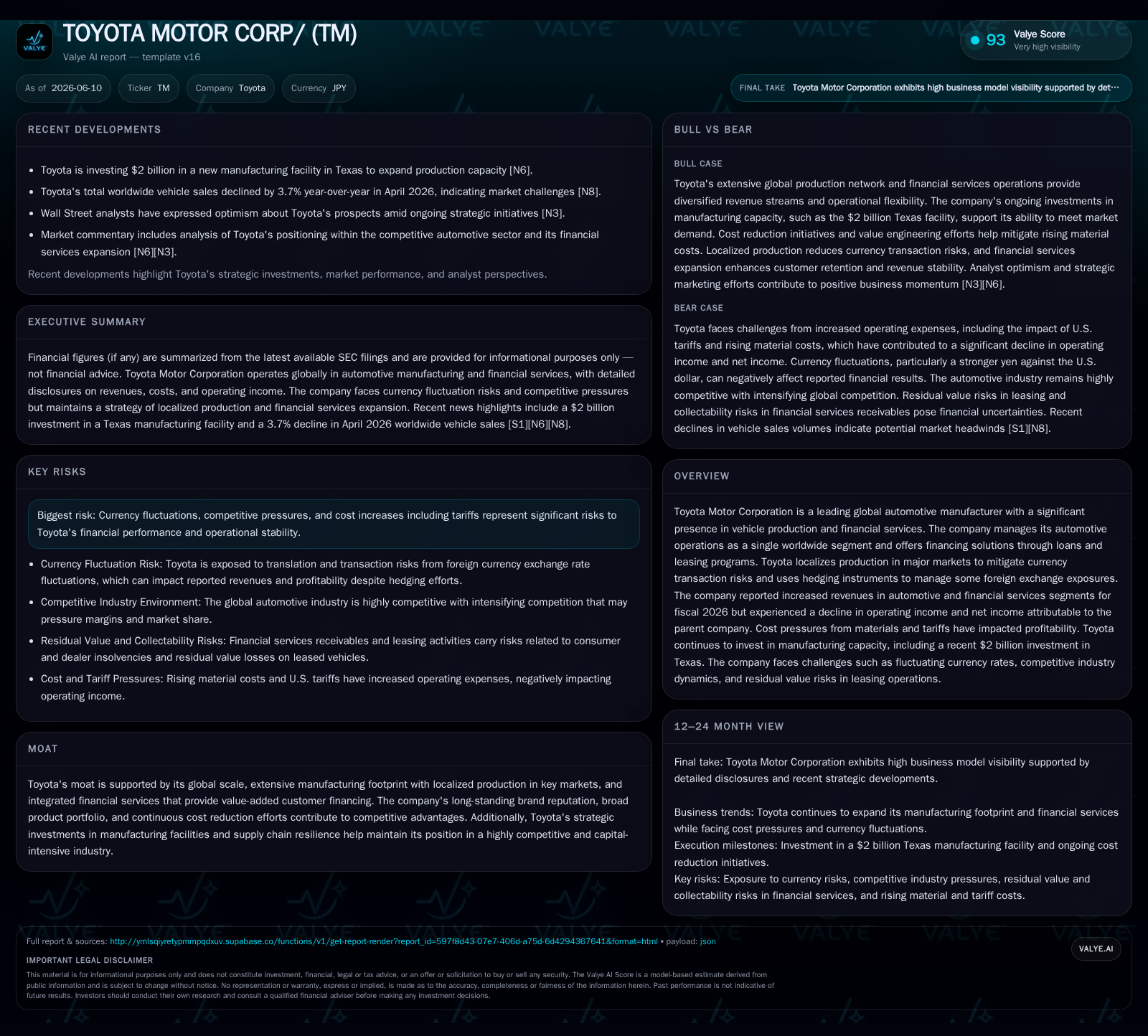
In its June 2026 6-K filing, Toyota reported increased automotive and financial services revenues for fiscal 2026 but saw operating income decline due primarily to raw material cost inflation and tariffs. The company is actively investing $2 billion in new manufacturing capacity in Texas, aiming to support its electrification and global production localization strategies. Toyota’s integrated business model leverages vehicle sales with captive finance operations, though risks from currency volatility, residual value in leasing, and intensified competition weigh on near-term profitability. Going forward, monitoring capacity utilization and financing portfolio growth will be crucial indicators of Toyota's operational execution and positioning in an evolving automotive landscape.
Latest Quarterly Operating Overview: Rising Revenues Shadowed by Cost Pressure
Toyota’s June 2026 Form 6-K update for fiscal year ended March 31 reports total consolidated vehicle unit sales increasing by approximately 3.8% to just over 4 million units [S13]. This volume growth along with favorable price mix lifted automotive sales revenues by ¥2.2 trillion (about 5.1%) versus prior year to ¥45.4 trillion [S9]. Similarly, the financial services segment recorded revenue growth exceeding 8%, led primarily by loan balance expansion [S10]. Despite top-line gains, operating income in the core automotive segment declined sharply—down roughly 29.5% to ¥2.78 trillion—primarily reflecting an aggregate unfavorable impact of soaring raw material costs, tariffs, and supply chain expense increases partially offset by marketing efficiency [S9]. Financial services operating income improved moderately but remains susceptible to residual value losses linked to leasing activities [S10]. Currency fluctuations also weighed on results despite Toyota's proactive hedging policies [S7]. Notably, Toyota disclosed ongoing capital investment totaling $2 billion for a new Texas manufacturing facility designed to augment local production capacity as part of its long-cycle strategic expansion under electrification initiatives [N8][S2].
Blueprint of Toyota’s Business Model: Integrated Automotive Sales and Finance
Toyota operates primarily as a global OEM producing a diversified product lineup including passenger vehicles, trucks, hybrids, and EVs across multiple geographic markets. The company’s automotive operations segment delivers vehicle sales revenue driven by unit volumes multiplied by average selling price (ASP), both influenced by regional demand dynamics and product mix [S1]. To support sales and enhance retention, Toyota maintains a substantial captive finance arm providing retail loans and leasing programs for customers as well as wholesale financing for dealers [S20]. Leasing penetration expands recurring revenue potential but introduces residual value risk if vehicle buy-back prices decline unexpectedly due to market or economic shifts [S20]. Importantly, Toyota localizes significant portions of its vehicle assembly footprint—such as the Texas plant investment—to mitigate currency transaction risks inherent in global sourcing while also reducing tariff exposure [S1][S2]. Its supply chain management extends downstream into parts procurement ensuring continuity despite geopolitical uncertainties. Off-balance-sheet credit risks are managed through diversified finance subsidiaries worldwide offering local funding capabilities [S4]. This integrated model combining OEM production scale with captive finance constitutes a key competitive moat.
Competitive Positioning and Industry Context: Supply Chain, Localization, and Innovation Focus
Within the global automotive OEM landscape encompassing peers like General Motors or Volkswagen (not directly cited), Toyota differentiates itself through a sprawling manufacturing network spanning Japan, North America, Europe, and Asia which enables agile localized production aligned with regional regulatory requirements and consumer preferences. This geographic breadth reduces dependency on any single market or currency zone while facilitating rapid innovation adoption especially around electrification powertrains [S1]. Despite semiconductor shortages affecting industry-wide supply chains recently, Toyota leverages legacy supplier relationships and robust inventory management practices that have buffered against substantial disruptions. Strategically balancing cost control amidst volatile commodities markets—including steel, rare earth elements for EV batteries—and tariffs remains critical as cost inflation materially impacted operating margins this fiscal year [S9]. In product terms, Toyota continues expanding hybrid-electric vehicle offerings reflecting consumer demands alongside gradual battery electric vehicle rollout underpinning its medium-to-long-term strategy [S1]. Captive finance integration further strengthens customer loyalty given provisioning flexibility unavailable via third-party lenders.
Growth Enablers: Capacity Expansion, Electrification, and Finance Penetration Strategies
Central among Toyota’s growth levers is its capital expenditure program emphasizing new plant builds such as the Texas facility primarily intended for electrified vehicle assembly indicating substantive forward-looking commitments aligned with global emissions regulations [N8][S2]. This investment aims not only at boosting manufacturing capacity but also at leveraging supply chain localization benefits including tariff avoidance and currency risk mitigation. Simultaneously, Toyota’s growing financial services portfolio demonstrated moderate revenue increases consistent with broader industry trends toward higher lease penetration rates supported by flexible captive finance terms that improve vehicle affordability—an important volume catalyst in some regions [S10][S20]. Government incentives globally favoring clean energy vehicles potentially amplify these factors encouraging adoption of hybrids/EVs produced at newer facilities enhancing ASPs positively impacting margins over time. Further investment in autonomous driving technology development while not explicitly quantified here complements the mobility company transition described in annual filing narratives reinforcing future product relevance beyond traditional vehicles [S1].
Risks and Constraints: Currency Volatility, Tariffs, Residual Value, and Competitive Pressures
Despite hedging against currency fluctuations through derivatives strategies designed to stabilize financial outcomes amid multinational flows of revenues and costs, residual translation exposures persist notably affecting regional earnings comparisons quarter-to-quarter [S7][S20]. Raw material price inflation combined with tariffs imposed on steel or other components elevated COGS adversely impacting automotive segment profitability during the reported fiscal year despite some offsetting cost engineering initiatives [S9][S20]. Leasing portfolios face collectability risks arising from consumer insolvencies exacerbated by economic uncertainty alongside residual value losses if end-of-lease vehicle prices fall below expectations potentially triggering write-downs influencing finance segment margin volatility [S20]. The intensifying competitive environment includes legacy OEMs aggressively expanding their electrified line-ups plus emergent pure EV manufacturers challenging price points forcing ongoing emphasis on brand loyalty sustaining volumes without excessive discounting pressure—critical for sustainable operating margins going forward [S1]. Supply chain constraints continue to require vigilant management preventing bottlenecks that could impair capability utilization rates affecting return on invested capital.
Looking Ahead: Key Milestones to Monitor for Toyota Through Late 2026
Future operational markers will increasingly focus on how the newly commissioned Texas plant ramps toward targeted production volumes reflecting utilization efficiencies critical for diluting fixed costs burdens created during initial startup phases [N8]. Quarterly earnings releases will provide updates on margin trajectories potentially clarifying whether recent cost pressures ease or intensify given commodity price cyclicality alongside FX trends. Financial services metrics including loan portfolio growth rates balanced against delinquencies plus residual value loss provisions are essential indicators of credit quality maintaining profitability within Toyota’s captive finance ecosystem [S20]. Further observations should assess electrification rollout pace across major markets along with governmental subsidy changes that can accelerate consumer uptake fundamentally influencing ASP improvements sustainably bolstering revenue streams over medium term horizons. Lastly, external competitive developments including regulatory changes relating to safety or emissions standards may alter product design priorities requiring adaptive strategy execution relevant to sustaining Toyota's leading market position.
This analysis synthesizes data solely from the latest available regulatory filings including SEC Form 6-Ks dated June 10, 2026 ([S2], [S3]), latest annual Form 20-F (June 10, 2026) ([S1]-[S20]), and corroborates recent public reporting without speculative forward-looking statements or investment research views.
Disclaimer: This is research-only, informational analysis and not investment advice. It may include AI-generated interpretation and general industry context. Always verify important details using primary sources.

Comments