
Core & Main Drives Growth with Expanding Branch Network and Diverse Product Mix
Core & Main’s Q1 2026 results highlight the strategic role of its dense branch footprint and broad product portfolio in stabilizing performance amid municipal spending cyclicality.
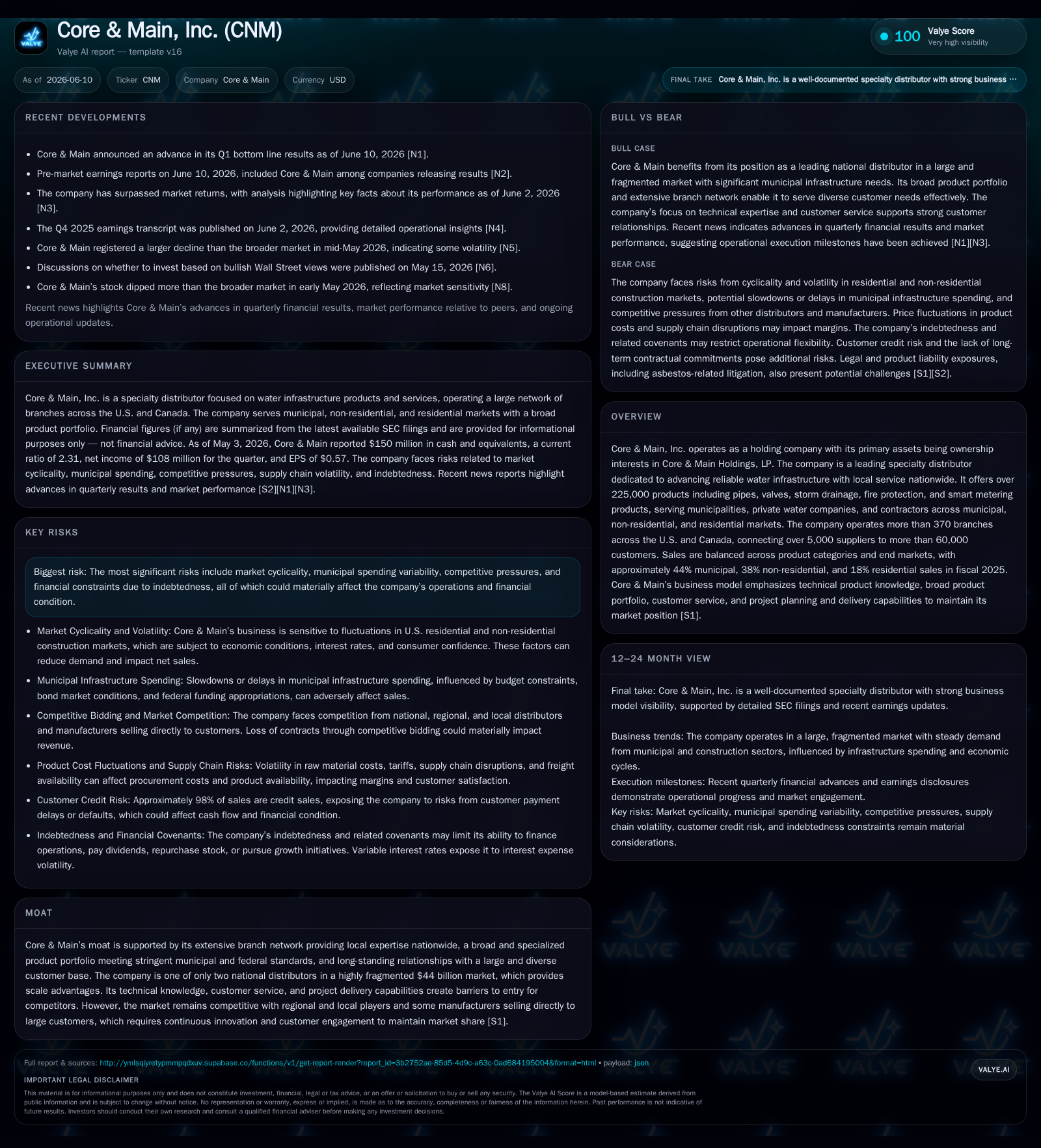
In Q1 2026, Core & Main demonstrated resilience through a stable branch network of over 370 locations servicing a diverse customer base across municipal, non-residential, and residential markets. Its balanced sales mix and extensive product offerings, including pipes, valves, storm drainage, fire protection, and smart metering products, underpin demand despite infrastructure spending fluctuations. The company’s competitive moat is driven by localized expertise and technical knowledge, offsetting pressures from regional competitors and supplier direct sales. However, elevated indebtedness near $2.16 billion remains a watchpoint amid industry cyclicality and competitive dynamics.
Latest Quarterly Operating Highlights Reflect Shifts in Market Demand
Core & Main’s Q1 fiscal 2026 results [S2] reaffirm its operational scale and market reach as foundational to navigating fluctuations in municipal infrastructure spending. The company operates approximately 370 branches throughout the U.S. and Canada [S1], connecting more than 5,000 suppliers to a diverse customer base exceeding 60,000 entities spanning municipalities, private water companies, and contractors. This dense branch network supports localized inventory management and rapid order fulfillment, critical in specialty distribution where compliance with municipal specifications and timely project delivery are paramount.
Sales distribution remains balanced across three key end markets: roughly 44% stems from municipal projects where public infrastructure funding cycles dominate demand; about 38% relates to non-residential construction activities; and approximately 18% is drawn from residential construction [S1]. This segmentation mitigates concentration risk while also exposing Core & Main to varied project timelines—new construction versus repair and replacement—each accounting for nearly half the sales base [S1]. Such balance supports revenue stability through infrastructure budget cycles and reduces exposure to single-market volatility.
Branch utilization metrics and order fulfillment rates, while not explicitly disclosed, are implied to be robust given management’s emphasis on maintaining service levels amid supply chain constraints [S1]. The company’s extensive SKU portfolio exceeding 225,000 items—including pipes and fittings, valves, storm drainage components, fire protection systems, and smart metering technology—requires sophisticated inventory turnover management and logistics coordination to meet diverse customer needs efficiently [S1]. Core & Main’s scale enables it to mitigate freight capacity tightening and supply disruptions more effectively than smaller regional distributors.
Business Model Leverages Extensive Branch Footprint and Product Breadth
Core & Main operates within the specialty distribution archetype focused exclusively on water infrastructure—a market requiring compliance with stringent municipal, state, and federal specifications [S1]. Its product portfolio spans critical categories such as waterworks materials (pipes, valves, fittings), stormwater management systems, fire protection apparatuses, and increasingly prominent smart metering solutions that support utility modernization and regulatory compliance [S1].
Revenue generation is driven by transactions with municipal utilities managing public water systems, private water companies operating under competitive pressures, and contractor firms engaged in both new construction and infrastructure maintenance [S1]. The company’s extensive branch footprint enables delivery of technical product expertise locally—a decisive differentiator given the complexity of specialized water infrastructure projects and the need for project planning and delivery support aligned with municipal engineering standards [S1]. This local presence fosters long-standing supplier-customer relationships and a high repeat customer rate despite the predominance of short-term contracts.
Beyond pure distribution, Core & Main provides value-added services including project planning assistance and compliance consulting, which are critical in navigating the complex bidding and procurement processes of municipal infrastructure projects [S1]. These services deepen customer engagement and create barriers to entry for competitors lacking similar technical capabilities.
Competitive Environment Features Scale Advantages Amid Fragmentation
The water infrastructure specialty distribution market is highly fragmented, with numerous regional and local specialist distributors competing alongside manufacturers increasingly pursuing direct sales to large utility customers [S1]. Core & Main estimates the total North American market at approximately $44 billion annually and positions itself as one of only two national specialty distributors serving this space [S1].
Scale confers significant competitive advantages, including broad geographic coverage through its branch network, enabling superior logistics efficiency, inventory availability, and rapid response times. These factors are critical in meeting stringent municipal procurement requirements and managing complex product mixes.
Competitors often compete on local expertise and pricing, but Core & Main’s combination of technical product knowledge, extensive SKU availability, and supplier relationships—over 5,000 vendors with exclusive or preferred distribution rights on many products—provides a moat against smaller entrants and manufacturer direct sales [S1]. The company’s ability to integrate emerging technologies like smart metering into its portfolio further differentiates it in a market increasingly focused on infrastructure modernization.
Growth Drivers Rooted in Infrastructure Investment and Product Innovation
Core & Main’s growth is underpinned by structural industry trends including increased federal and state funding for municipal waterworks modernization, addressing decades of underinvestment; the imperative to repair and replace aging infrastructure sustaining steady demand alongside new construction; and urbanization driving residential water system installations [S1].
The adoption of smart metering and advanced water management technologies represents a significant growth vector, as utilities seek to improve resource efficiency and regulatory compliance. Core & Main’s expanding product portfolio reflects this trend, incorporating environmental compliance-related categories and innovative solutions.
Selective branch network expansion into underserved regions aims to capture incremental market share by leveraging local expertise ahead of regional competitors [S1]. This physical growth strategy complements portfolio broadening and supports Core & Main’s mission to deliver reliable infrastructure products and services nationwide.
Risk Assessment Hinges on Cyclicality, Competition, and Leverage Considerations
Core & Main’s filings highlight several material risks inherent in water infrastructure specialty distribution [S1]:
- Cyclical volatility tied to municipal spending programs, which are subject to political appropriations timing and can unpredictably impact order volumes.
- Intensifying competition from regional distributors and manufacturers increasing direct-to-customer sales, potentially compressing margins.
- Supply chain disruptions, particularly freight capacity constraints, which could impair order fulfillment and increase costs.
- Customer credit risk concentrated among municipalities sensitive to payment delays or defaults due to budgetary pressures.
- Exposure to product liability claims, including historical asbestos-related litigation, imposing financial and reputational uncertainties.
- Significant financial leverage, with total debt approximating $2.16 billion against cash reserves near $150 million, resulting in net debt around $2.01 billion and necessitating sustained operational cash flow strength for debt servicing [F1]
These risks require disciplined liquidity management, proactive supplier and customer engagement, and operational efficiency to maintain competitive positioning.
What to Monitor Next in Market Demand and Operational Execution
Key indicators to watch include quarterly updates clarifying how federal and municipal infrastructure funding shifts translate into order pipeline changes or spending slowdowns affecting momentum. Margins will be sensitive to pricing pressures from competition and inflationary input costs.
Operationally, branch network optimization—whether through expansion into new territories or rationalization of underperforming locations—will signal strategic responses to evolving market dynamics. Monitoring order fulfillment rates amid logistical challenges will provide insight into execution capabilities critical for customer retention.
Concise Financial Profile Supports Operating Narrative
Core & Main’s latest financials underscore profitable scale with operating income around $722 million and net income near $441 million as of February 2026 [F1]. Liquidity remains solid, with a current ratio of approximately 2.31, supported by $2.56 billion in current assets against $1.10 billion in current liabilities [F1].
However, the company carries substantial leverage, with total debt near $2.16 billion and cash balances of $150 million, resulting in net debt of approximately $2.01 billion [F1]. This capital structure emphasizes the importance of operational cash flow generation and disciplined capital allocation to maintain financial flexibility amid interest rate risk and competitive pressures.
Disclaimer: This analysis is based solely on publicly available information from SEC filings dated up to June 10, 2026 ([S1],[S2],[S3]) supplemented by validated financial data ([F1]) without any proprietary insight or forecasted guidance. It does not constitute investment advice or research view.
Disclaimer: This is research-only, informational analysis and not investment advice. It may include AI-generated interpretation and general industry context. Always verify important details using primary sources.

Comments