
BriaCell Therapeutics Advances Phase 3 Trials with Robust DSMB Endorsement and Capital Infusion
Latest quarterly update highlights sustained clinical progress with six positive DSMB recommendations and a $4.7 million equity raise reinforcing financial footing.
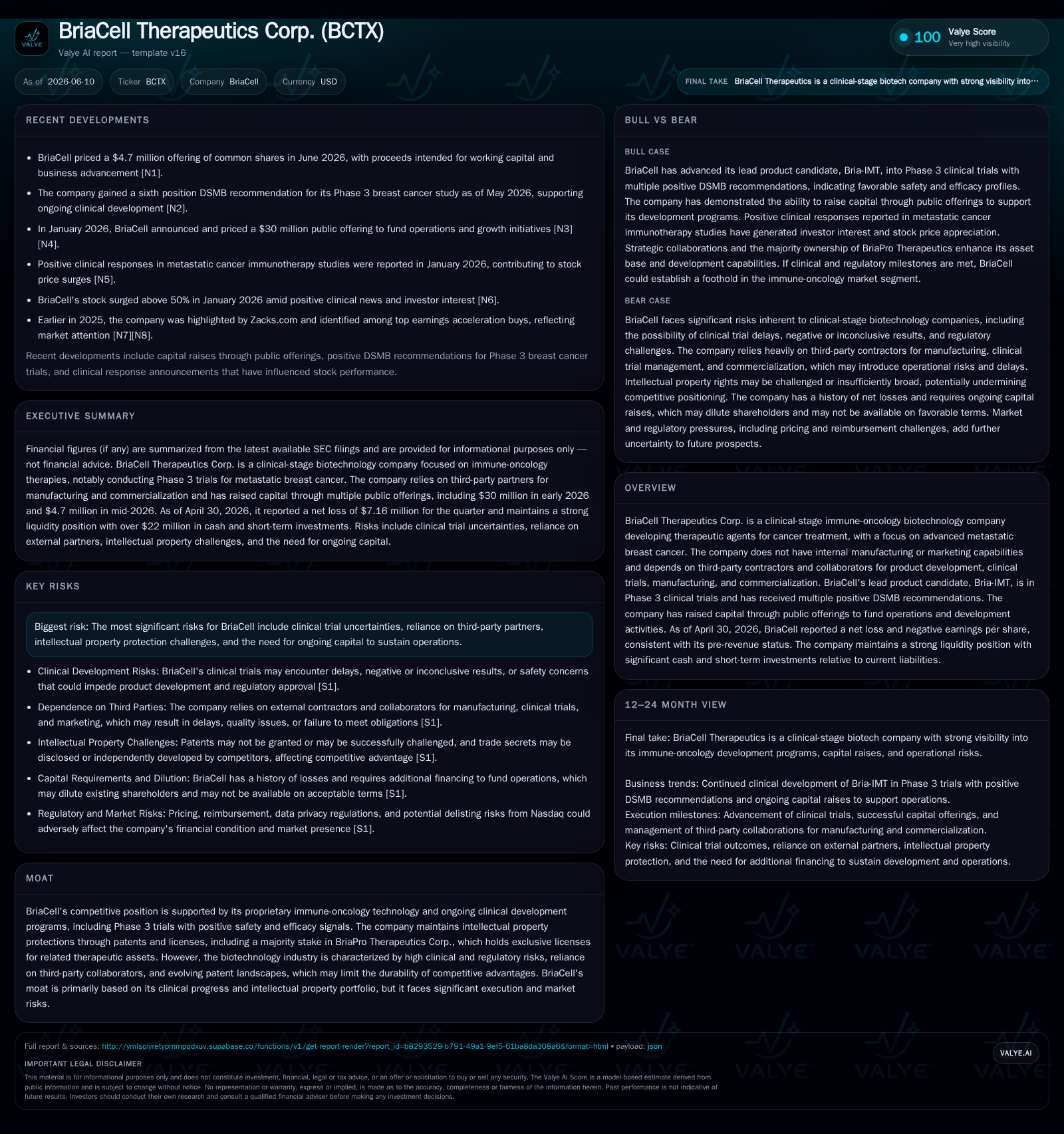
BriaCell Therapeutics continues to solidify its clinical-stage immune-oncology platform through ongoing Phase 3 trials targeting advanced metastatic breast cancer. The June 2026 10-Q reported a sixth positive data safety monitoring board (DSMB) recommendation, underscoring favorable safety and tolerability signals critical for late-stage development. Concurrently, a recent $4.7 million equity offering has strengthened the company’s liquidity, supporting continued trial execution and operational needs. BriaCell's business model remains pre-revenue and heavily reliant on third-party contractors for manufacturing and commercialization, with intellectual property leveraged via majority ownership in BriaPro Therapeutics. Key growth drivers include trial enrollment momentum, additional regulatory milestones, and capital adequacy, while risks persist in clinical uncertainty, regulatory approval, and outsourcing dependencies.
Latest Quarterly Results Confirm Clinical and Financial Foundations
BriaCell Therapeutics’ most recent Form 10-Q filed June 9, 2026, reports a sixth consecutive positive data safety monitoring board (DSMB) research view for its lead immunotherapy candidate Bria-IMT in the ongoing Phase 3 trial targeting advanced metastatic breast cancer [S2][N2]. These DSMB endorsements serve as critical clinical KPIs, reflecting consistent safety and tolerability across expanding patient cohorts, which are essential for maintaining trial integrity and regulatory confidence in late-stage immune-oncology development. Such independent safety validations help mitigate the high clinical risk typical of pivotal oncology trials and support the robustness of trial endpoints.
Complementing these clinical milestones, BriaCell completed a $4.7 million equity offering in May 2026, strengthening its liquidity position and extending its cash runway well beyond near-term obligations without immediate refinancing pressure [S3][N1]. As of April 30, 2026, the company held approximately $6.88 million in cash and equivalents against current liabilities of about $3.6 million, resulting in a strong current ratio of 7.07x [F1]. This financial cushion provides operational flexibility to sustain costly R&D activities, including multi-center trial coordination and outsourced manufacturing, while navigating complex regulatory timelines.
Business Model: Asset-Light Clinical Development Leveraging Intellectual Property
BriaCell operates a classical clinical-stage biotechnology business model focused on developing antigen-specific immune-oncology therapies, notably Bria-IMT, without internal manufacturing or commercialization capabilities [S1]. The company outsources drug production, clinical trial management, and eventual marketing to specialized third-party contract manufacturing organizations (CMOs) and contract research organizations (CROs) [S1]. This asset-light approach enables BriaCell to concentrate capital and management resources on advancing clinical development and regulatory milestones while controlling fixed overhead costs.
A strategic pillar of BriaCell’s model is its majority ownership stake in BriaPro Therapeutics Corp., which holds exclusive licenses to complementary immune-oncology assets such as Soluble CD80, potentially broadening therapeutic options and enhancing the intellectual property portfolio [S1][S3]. This relationship allows BriaCell to leverage additional proprietary technologies that may generate future licensing revenues or support co-development partnerships post-approval. However, reliance on licensing structures introduces typical biotech risks related to patent life, enforcement, and royalty dependencies.
Currently pre-revenue, BriaCell’s future monetization is expected to derive primarily from milestone payments linked to clinical and regulatory achievements, licensing fees, and eventual product sales contingent on successful commercialization. Therefore, the company’s valuation and cash flow prospects are tightly coupled to clinical trial progress, regulatory approvals, and strategic partnerships.
Competitive Dynamics: Navigating a Capital-Intensive Immune-Oncology Landscape
BriaCell competes within a crowded and capital-intensive immune-oncology sector characterized by rigorous Phase 3 trial designs and demanding regulatory scrutiny [S2]. The company’s accumulation of multiple positive DSMB safety reviews aligns with industry best practices where independent boards oversee patient safety and data integrity, akin to standards observed in trials by larger peers in the immunotherapy space
Access to capital remains a critical competitive factor, as extended cash runway during pivotal trial phases reduces dilution risk and supports uninterrupted development. BriaCell’s recent equity raise reflects successful navigation of these financing challenges, positioning it comparably to other clinical-stage biotechs that must balance capital efficiency with trial execution demands.
Outsourcing manufacturing and commercialization to third parties is a common strategy among emerging biotechs lacking internal scale, but it introduces operational risks such as supply chain disruptions and quality control challenges, which BriaCell must actively manage [S1][S29].
Growth Drivers: Enrollment Momentum, Capital Adequacy, and Licensing Optionality
Key growth drivers for BriaCell include accelerating patient enrollment rates in its Phase 3 trial, which are critical to achieving statistically powered efficacy analyses and meeting regulatory endpoints [N2][S2]. Continued positive DSMB research views serve as interim validations that may facilitate regulatory interactions and enhance attractiveness for potential licensing or partnership deals.
The recent $4.7 million equity infusion bolsters BriaCell’s financial runway, enabling sustained investment in clinical operations, including multi-center trial management and outsourced manufacturing contracts, without immediate dilution or refinancing concerns [N1][S3]
Additionally, the increased ownership stake in BriaPro Therapeutics enhances BriaCell’s control over complementary immune-oncology assets, potentially expanding its commercial and licensing opportunities beyond a single product candidate [S3][S1]. This diversification strategy mitigates risk by broadening potential revenue streams post-approval.
Key Risks: Clinical, Regulatory, and Operational Dependencies
Despite encouraging safety signals, BriaCell faces inherent risks typical of late-stage clinical development. Phase 3 trials carry substantial uncertainty, as positive early-phase results do not guarantee successful outcomes, and adverse events or efficacy shortfalls could delay or derail regulatory approval [S1][S4]
Regulatory pathways remain complex, with agencies potentially requiring additional data or imposing label restrictions that could affect market access and commercial viability [S13].
Operationally, BriaCell’s reliance on third-party contractors for manufacturing and commercialization introduces risks related to supply chain reliability, quality assurance, and timing, which are critical for launch readiness [S1][S29]
Ongoing capital needs persist due to the high burn rate associated with Phase 3 trial expansion and corporate operations [S5][S7]. While recent financing improves near-term liquidity, future funding availability on acceptable terms is uncertain and remains a key risk factor
Upcoming Catalysts: Enrollment Progress, DSMB Reports, and Partnership Developments
Near-term catalysts include monitoring patient enrollment pace, which directly impacts the trial’s statistical power and timing of primary endpoint analyses [N2][S2]. Additional DSMB updates will provide ongoing safety assessments critical for trial continuation and regulatory confidence.
Potential partnership or licensing agreements leveraging BriaPro’s intellectual property assets could provide supplementary capital and broaden development scope, representing important value inflection points [S3]
Finally, successful completion of future capital raises ahead of operational exhaustion will be essential to sustain development momentum and support commercialization readiness.
Supporting Financial Snapshot: Robust Liquidity Supports Clinical Advancement
As of April 30, 2026, BriaCell reported cash and equivalents of approximately $6.88 million against current liabilities of about $3.6 million, yielding a strong current ratio of 7.07x [F1]. This liquidity position is notable among clinical-stage biotechs at this development phase and underpins the company’s ability to fund ongoing Phase 3 operations, including outsourced manufacturing and multi-site clinical trial activities. Maintaining this financial cushion will be critical as R&D expenditures escalate with trial enrollment and data collection intensification.
Disclaimer: This report is an analytical summary based solely on publicly available SEC filings and associated news releases as listed in the sources. It does not constitute investment advice or an endorsement of any transaction related to BriaCell Therapeutics Corp. Readers should conduct independent due diligence before making any financial decisions.
Disclaimer: This is research-only, informational analysis and not investment advice. It may include AI-generated interpretation and general industry context. Always verify important details using primary sources.

Comments