
Mission Produce Confronts Pricing Pressures and Supply Challenges in Q2 2026
Q2 results reveal margin compression amid avocado market oversupply, testing Mission Produce's integrated supply model and customer reach.
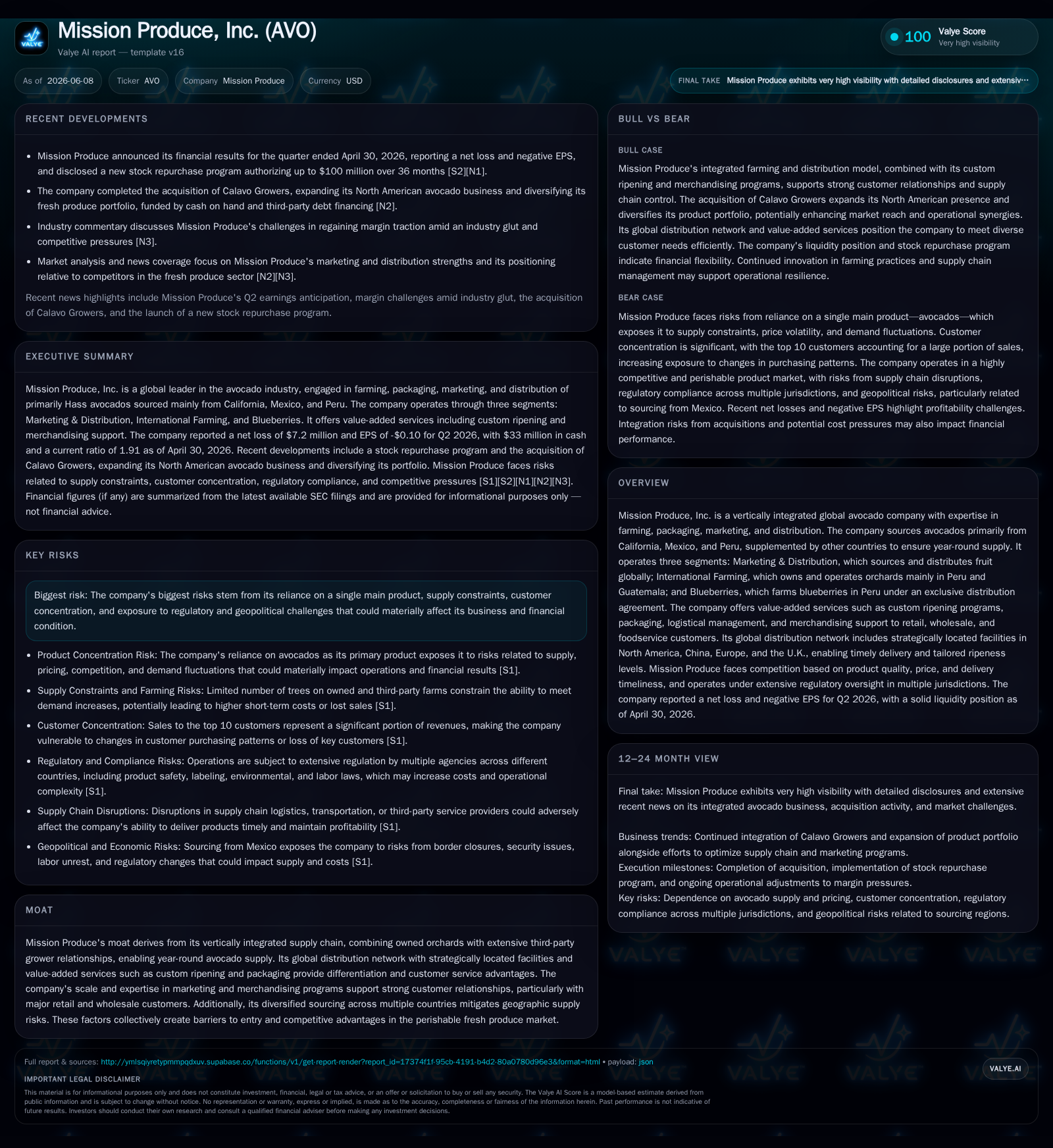
Mission Produce's latest quarterly filing for Q2 2026 highlights a challenging environment marked by intensified pricing pressures from an oversupplied global avocado market. Despite its vertically integrated business encompassing owned orchards and extensive distribution capabilities, the company faced volume softness and margin contraction. Its strategic strength lies in its diversified sourcing and ripening services, yet industry-wide glut and customer concentration risks have restrained near-term growth and profitability. Key growth hinges on managing supply-demand balance, expanding international farming efficiency, and navigating geopolitical tariffs and regulatory changes.
Recent Operating Update: Pricing Pressures Weigh on Q2 Performance
Mission Produce’s latest 10-Q filed June 8, 2026, reveals a global avocado market grappling with significant pricing pressures driven by an industry-wide oversupply. The company reported that these conditions materially compressed gross margins despite relatively stable shipment volumes for the quarter ended April 30, 2026 [S2], [N1]. The oversupply primarily stems from robust harvests in key growing regions such as Mexico and Peru, which have increased avocado availability and pressured average selling prices per carton. Management highlighted ongoing efforts to optimize marketing channels and adjust ripening schedules to better align with shifting customer demand patterns amid this challenging pricing environment.
Retail grocery partners remain cautious due to consumer price sensitivity, resulting in more selective ordering and contributing to sales variability and inventory management challenges [S21]. Additionally, evolving U.S. trade policies, including recent Supreme Court rulings on tariff legality, have introduced uncertainty regarding future import duties and supply chain costs, complicating Mission’s cost forecasting and margin management.
Business Model: Vertical Integration Fuels Supply Reliability with Value-Added Services
Mission Produce operates through three primary segments: Marketing & Distribution; International Farming; and Blueberries. The Marketing & Distribution segment functions as the commercial core, sourcing avocados from both proprietary orchards managed under International Farming and a broad network of third-party growers primarily located in California, Mexico, and Peru. This segment focuses on delivering tailored ripe fruit assortments to a diverse customer base including retail grocery chains, foodservice distributors, and produce wholesalers, leveraging custom ripening programs that synchronize fruit readiness with client merchandising cycles [S1].
The International Farming segment owns and operates orchards mainly in Peru and Guatemala, producing fruit predominantly sold internally to Marketing & Distribution. This vertical integration mitigates seasonal supply fluctuations common in perishable agriculture by enabling year-round avocado availability. The farming operations also generate packing and processing revenues, including for blueberries grown under exclusive agreements in Peru. However, farming exposes the company to climatic variability risks, such as drought or unseasonal weather, and capacity constraints that may limit rapid scale expansion without further capital investment or acquisitions.
Mission’s value proposition extends beyond fruit supply to include innovative packaging solutions designed to extend shelf life and enhance consumer appeal, alongside a global logistics network with distribution centers strategically located in North America, Europe (including the UK), China, and other key markets. This infrastructure supports flexible delivery schedules and ripening customization tailored to regional consumer preferences, differentiating Mission from competitors focused primarily on commodity-grade produce [S1].
Industry Structure and Competitive Position: Scale Meets Complexity
The global avocado industry is characterized by fragmented production regions balanced against growing consumer demand, particularly in the U.S., driven by health-conscious eating trends. Mission’s multi-origin sourcing strategy provides a competitive moat by ensuring consistent year-round supply, reducing exposure to seasonal crop shortages that affect less diversified competitors.
Customer concentration remains a notable risk factor, with the top 10 customers accounting for approximately two-thirds of revenues as of the latest filings [S10]. These customers wield significant purchasing power and base buying decisions on a combination of price, product quality, inventory management, and category strategy within increasingly competitive grocery assortments.
Among peers, Calavo Growers represents a direct competitor with a similar vertically integrated model. Mission differentiates itself through advanced ripening technologies and a broader global distribution footprint, enabling premium service offerings that contrast with more bulk commodity-focused competitors.
Growth Drivers: International Farming Expansion & Service Differentiation
Key growth initiatives focus on expanding owned orchard acreage in Peru, where favorable climate conditions allow for multiple harvest cycles annually, thereby increasing yield per acre and overall fruit volume. Investments in packing efficiency and automation aim to reduce per-unit costs and improve throughput amid inflationary pressures.
Mission is also enhancing its custom ripening programs, which provide retail partners with just-in-time fruit readiness, supporting higher margin sales beyond spot-market transactions. Geographic expansion into high-growth markets such as China leverages existing distribution centers to capture new revenue streams and diversify market exposure.
Ongoing innovation in packaging materials that prolong avocado freshness further supports premium pricing strategies by reducing perishability and shrink rates, critical KPIs in the produce sector that directly impact retailer inventory turns and markdown frequency.
Risks and Watchpoints: Supply Glut Impact & Regulatory Uncertainty
The company faces significant risks from avocado price volatility driven by cyclical supply gluts, which compress gross margins despite operational efficiencies [N1], [S8]. Regulatory complexities across multiple jurisdictions—including pesticide restrictions, labor laws, export-import tariffs, and tax regimes—add layers of compliance costs and operational uncertainty. The recent Supreme Court ruling on tariffs introduces ambiguity around future trade costs, requiring vigilant supply chain and cost management.
Operational risks from climate change-related weather events threaten crop yields and harvesting schedules, while labor shortages could disrupt packing and distribution capacity during peak seasons. High customer concentration exacerbates exposure to shifts in retailer purchasing strategies or economic downturns that could reduce order volumes.
What To Watch Next: Merger Progress & Margin Stabilization Efforts
Attention remains on Mission’s integration with Calavo Growers following the January 2026 merger agreement, which promises scale synergies but carries execution risks related to systems integration and cultural alignment [S9], [S26]. Subsequent quarterly earnings will be critical to assess whether Mission can regain pricing power and margin stability as global supply normalizes.
Key upcoming milestones include the ramp-up of new orchard plantings in Peru, adoption rates of enhanced ripening technologies by retail partners, resolution of tariff-related cost uncertainties, and progress in diversifying the customer base to reduce concentration risk.
Financial Profile: Solid Liquidity Amid Moderate Leverage Supports Strategy Execution
As of April 30, 2026, Mission held approximately $33 million in cash and equivalents against total debt of about $120 million, resulting in net debt near $87 million and a current ratio of 1.91, indicating a healthy liquidity position to support ongoing operations and capital expenditures [F1]
This financial flexibility underpins planned investments in farm expansion and technology upgrades, although management will need to monitor leverage ratios closely, especially in light of margin pressures and the pending merger integration.
This analysis synthesizes publicly available regulatory filings alongside recent market developments to provide a detailed view of Mission Produce’s operational and financial status as of mid-2026 without projecting investment opinions or future performance guarantees.
Disclaimer: This is research-only, informational analysis and not investment advice. It may include AI-generated interpretation and general industry context. Always verify important details using primary sources.

Comments