
Cycurion Extends Strategic Reach with AI-Powered Security Platform but Faces Liquidity Challenges
The cybersecurity firm leverages proprietary AI SaaS offerings to deepen government and commercial contracts while managing a tight cash runway and recent debt restructuring.
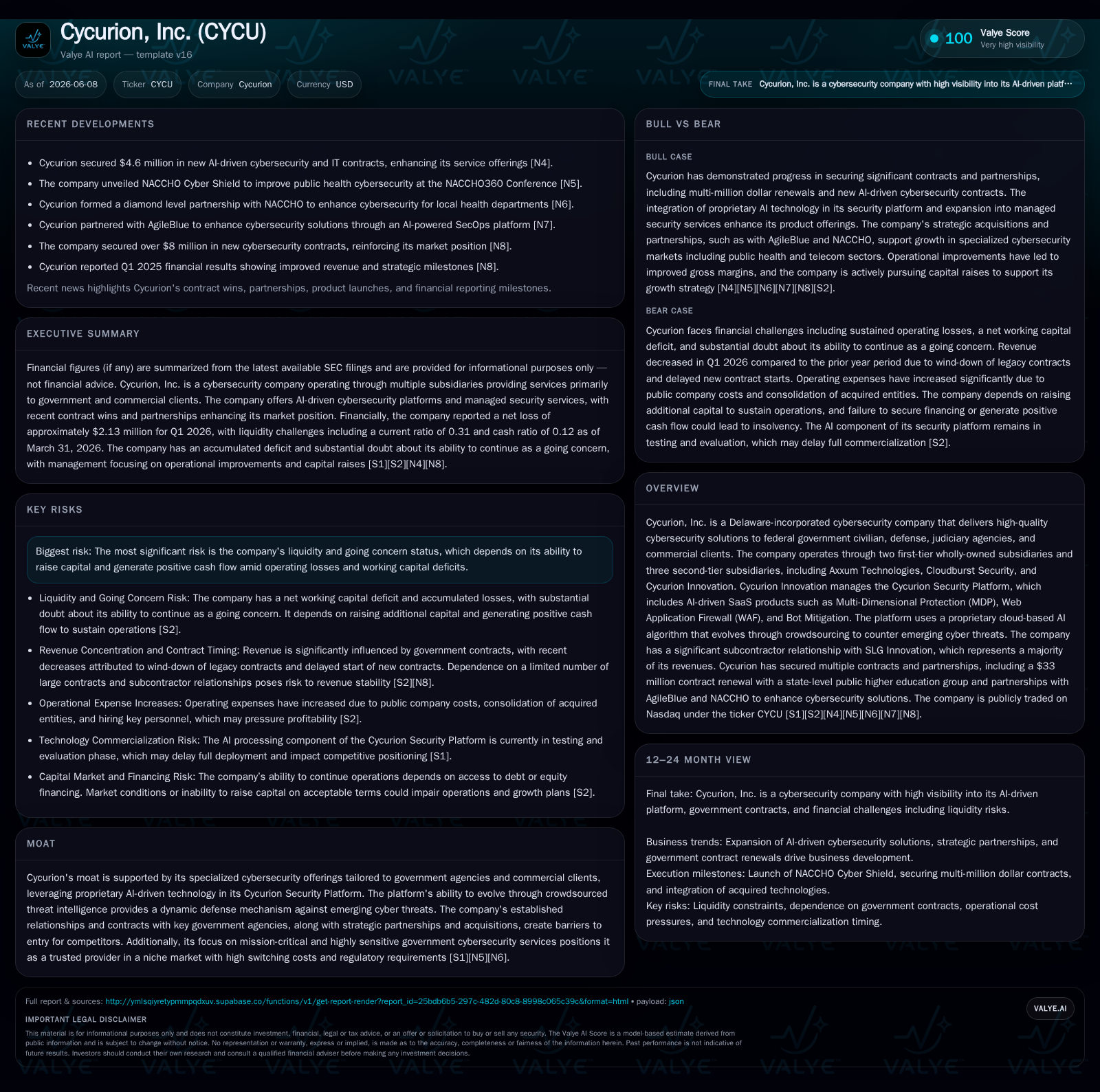
In its latest quarterly filing ending March 31, 2026, Cycurion reported a sequential revenue decline driven by legacy contract wind-downs and delayed new contract ramp-up but achieved an improved gross margin through cost controls. The company remains focused on expanding its AI-enabled Cycurion Security Platform to government agencies and commercial clients. However, liquidity constraints persist amid ongoing operating losses and a working capital deficit, prompting a recent convertible debt restructuring to manage leverage. Growth hinges on converting these technology investments into sustainable operating cash flow and closing higher-margin contracts.
Latest Operational Update Highlights
In its most recent quarterly disclosure dated May 14, 2026 [S2], Cycurion, Inc. reported revenue of approximately $3.27 million for Q1 2026, marking a 15.5% decline compared to $3.87 million for the same period in 2025 [S7]. Management attributed this drop primarily to the planned wind-down of lower-margin legacy contracts as it repositioned toward higher-margin replacements. This transition was compounded by delays in the start dates of new federal, state, and local government contracts [S7]. Notably, gross margin improved from 17.5% to 21.1%, reflecting deliberate cost-saving measures focused on portfolio optimization and operational efficiency [S7].
Selling, general and administrative (SG&A) expenses rose sharply quarter-over-quarter due significantly to the incremental costs associated with being publicly traded—such as compliance, investor relations, and audit fees—as well as the full consolidation of SLG Innovation’s SG&A after acquisition and strategic hires aimed at scaling growth initiatives [S7]. Stock compensation expense also entered the P&L at $316k for Q1 2026 versus none in the prior comparable period [S7].
Cash flow trends remain negative with operating activities consuming $2.9 million during Q1, marginally worse than prior year levels despite no business combination expenses this year [S7]. Liquidity remains critically tight: as of March-end, cash balances stood at roughly $2 million against current liabilities exceeding $17 million—resulting in a working capital deficit with a low current ratio of approximately 0.31 [F1],[S4],[S6]. This condition continues to raise substantial doubt about the company’s ability to sustain operations absent significant capital infusion or rapid revenue stabilization [S4],[S6].
Business Model Overview
Cycurion operates through multiple wholly owned subsidiaries that provide end-to-end cybersecurity solutions tailored predominantly for U.S. federal government civilian agencies, defense sectors, and judiciary branches alongside commercial clients in various industries [S2],[S1]. Its core revenue is generated from prime contracts directly with government entities as well as subcontracts mediated by strategic partners such as SLG Innovation—a critical subcontractor representing a majority of revenues [S2].
A distinguishing feature lies in the proprietary Cycurion Security Platform managed by Cycurion Innovation Inc., which offers advanced AI-driven SaaS products including Multi-Dimensional Protection (MDP), Web Application Firewall (WAF), and Bot Mitigation modules [S1]. The platform’s cloud-hosted AI employs crowdsourced threat intelligence to dynamically adapt security defenses against continuously evolving cyberattack vectors—a capability that provides Cycurion with a defensive moat difficult for competitors to replicate given regulatory scrutiny and specialized domain knowledge [S5].
Revenue mechanics rely on recurring contractual engagements delivering these SaaS services bundled with managed security services overseen by specialized Security Operations Center (SOC) teams who provide real-time threat detection, incident response, and compliance management [S5]. Contract renewals and extensions are crucial revenue drivers given high switching costs among government clients tied to regulatory mandates for vetted cybersecurity vendors, including compliance with standards akin to FedRAMP and NIST frameworks [S2],[S5].
Industry Structure and Competitive Position
Within the fragmented cybersecurity landscape serving governmental clients, Cycurion distinguishes itself through a combination of explicit government agency focus, advanced AI integration in its security platform, and ownership/control of multiple subsidiaries transmitting complementary capabilities across sensitive sub-agencies [S2]. This vertical integration fortifies barriers around compliance requirements such as FedRAMP certification equivalents and access control clearances which limit the viable competitive universe [S2].
Peers typically range from large diversified security firms with broader tech stacks but less niche specialization, to smaller boutique firms lacking scale or platform sophistication. While specific peer comparisons are not disclosed, Cycurion’s key competitive advantages are anchored by its proprietary technology stack fused with specialized federal service depth—a blend rare among mid-tier providers [S1],[S2].
However, competition pressure persists from incumbents investing heavily in R&D for AI-enhanced security analytics platforms as well as cloud-native defenders with entrenched enterprise footprints outside government that are increasingly pivoting towards public sector verticals [S1].
Growth Drivers
Despite near-term contraction due to portfolio reshuffling, structural drivers remain strong as governmental demand for cyber defense infrastructure continues accelerating amid heightened geopolitical threat landscapes [S1]. Success factors include:
- Leveraging AI platform capabilities for cross-sell into existing government contracts plus expansion into state and local jurisdictions [S2].
- Capturing fresh mandates arising from increased federal cybersecurity spending programs including ransomware mitigation efforts [S1].
- Scaling commercial client footprint leveraging evolved platform capabilities initially developed within stringent federal environments [S2].
- M&A-driven organic growth strategy evident from recent acquisitions such as Sabres assets integrated into its technology suite [S2].
- Completion of Secuvant reverse merger on June 3, 2026, adds operational breadth potentially enabling enhanced solution sets or market reach synergies [S22].
Risks and Constraints
The primary headwind for Cycurion is financial sustainability given continual operating losses ($2.56 million net loss in Q1 2026 alone) paired with ongoing negative operating cash flow exacerbated by sizeable SG&A spend required for public company overheads and growth investment [S7],[F1]. Liquidity challenges extend through working capital deficits necessitating frequent debt restructuring evidenced by June refinancing deals exchanging defaulted obligations for convertible notes and preferred shares bound by resale limitations [S12],[S18]. This creates leverage overhang risks alongside dilution considerations that could impact future equity raises needed to fund expansion before positive cash flow emerges.
Operationally, timing execution risk looms regarding transitioning away from legacy contracts without losing critical mass during ramp phases on replacement high-margin agreements. Delays or cancellations could magnify revenue volatility impacting financial viability [S7]. Moreover, competing technologies integrating next-gen AI models rapidly may challenge Cycurion’s platform relevance if innovation cadence falters compared to better-capitalized peers [S1].
What To Watch Next
Key near-term milestones include tracking:
- Successful ramp-up metrics on newly awarded federal and state contracts following prior delays announced last quarter [S7]. Client acquisition or renewal announcements would provide clearer visibility into revenue stabilization trajectory.
- Financial progress stemming from recent convertible debt restructuring via monitoring future filings for changes in leverage ratios or covenant compliance events as these materially affect runway length [S12],[S18].
- Integration success of Secuvant post-June merger completion signals potential enlarged market reach or product/service synergies [S22].
- Improvements in sales pipeline quality evidenced perhaps via disclosures around backlog or contract awards programmatically aligned with federal fiscal budgets.
- Continued gross margin expansion validated through further cost efficiency gains or enhanced mix towards SaaS subscription-like revenue streams within managed security services [S7].
Financial Profile Synopsis
As of March 31, 2026, Cycurion held approximately $2.0 million in unrestricted cash against total debt near $2.5 million resulting in net debt around $472,000; however, current liabilities stood nearly sevenfold higher than current assets at over $17 million driving a weak liquidity ratio close to 0.31 indicating apparent short-term stress [F1],[S4],[S6]. Operating cash burn remained elevated at about $2.9 million over three months despite management’s cost containment efforts compared to prior periods [S7].
Management plans hinge on securing additional capital via equity raises backed potentially by improved valuation following better operational execution; failure here heightens insolvency risks long flagged by auditors due to accumulated deficits exceeding $29 million since inception [F1],[S6]. Debt restructuring transactions completed early June aim at deleveraging defaulted instruments into convertible securities with resale restrictions intended to stabilize financing cost structures pending organic business turnaround [S12],[S18].
© 2026 Valye News analysis based on SEC filings through June 9, 2026. This report focuses on operational dynamics without investment advice or price projections.
Disclaimer: This is research-only, informational analysis and not investment advice. It may include AI-generated interpretation and general industry context. Always verify important details using primary sources.

Comments