
Lands’ End Brand Joint Venture Reshapes Capital and Licensing Strategy
Lands’ End’s Q1 2026 filing reveals a transformative joint venture with WHP Global, repositioning its brand licensing and operational structure amid a competitive apparel market.
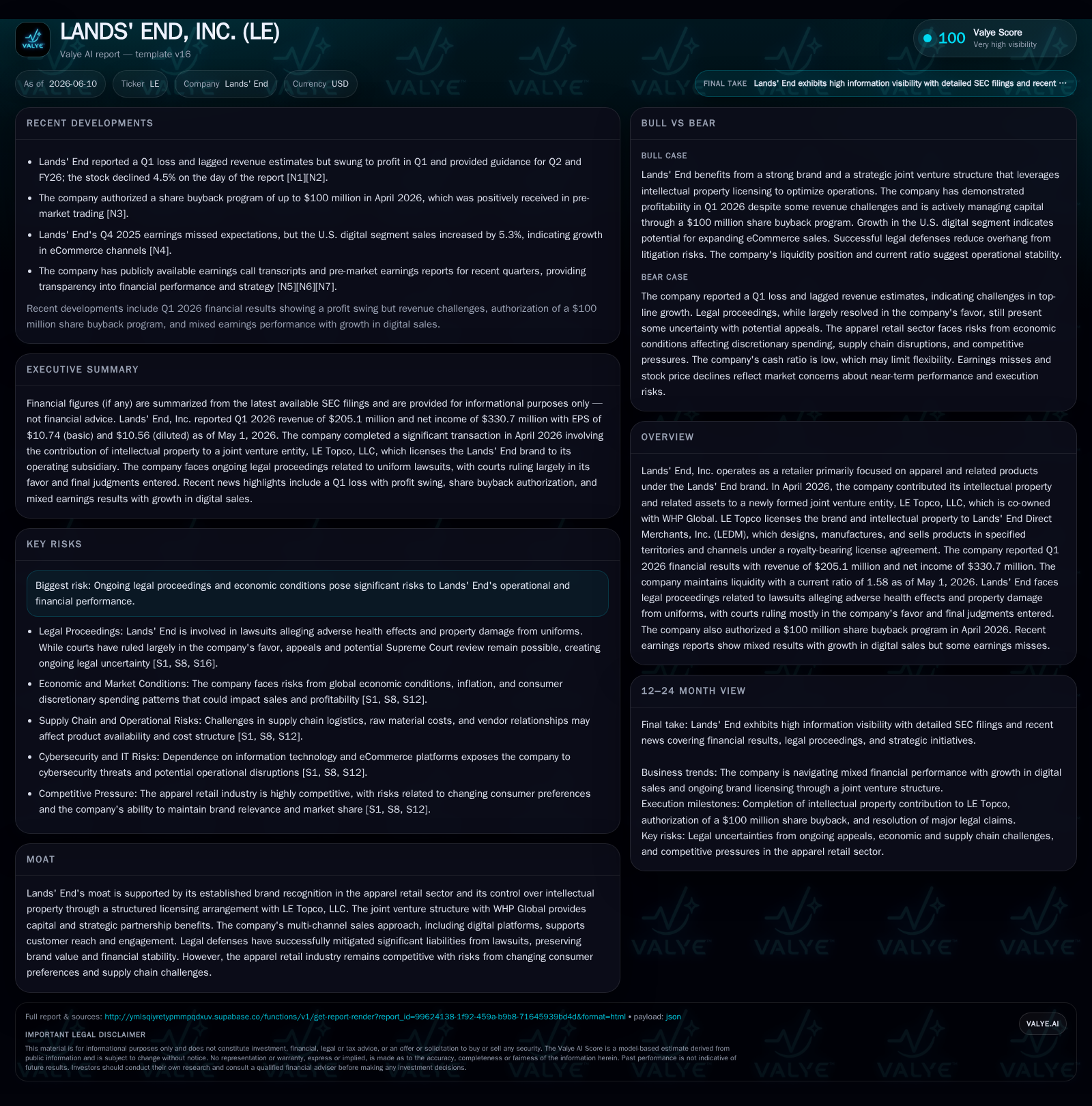
In Q1 2026, Lands’ End completed the contribution of its intellectual property to LE Topco, LLC, a joint venture with WHP Global owning 50% each. This transaction redefined its revenue model to a royalty-bearing licensing arrangement with its operating subsidiary, Lands’ End Direct Merchants, Inc. (LEDM), which continues to design and sell products across multiple channels, including direct-to-consumer e-commerce and wholesale. While Q1 revenue reached $205.1 million with a net income swing into profitability of $330.7 million primarily reflecting the JV transaction impact, operating challenges persist amid ongoing product liability lawsuits and sector competition. The company’s solid liquidity buffer supports strategic flexibility as it leverages brand licensing to optimize capital structure and pursue growth opportunities in digital retail expansion.
Q1 Operating Results Highlight Strategic Transition
Lands’ End’s first quarter of fiscal 2026 marked a pivotal moment anchored by its new corporate structure unveiled in early 2026. The company reported $205.1 million in revenue for Q1 ending May 1, 2026—a figure demonstrating operational continuity despite broader retail headwinds—and swung to a net income of $330.7 million, primarily reflecting the joint venture transaction impact [S2][N2]. This profit surge chiefly arises from the completion of its intellectual property contribution to LE Topco, LLC in April 2026 and associated equity transactions detailed in the company’s latest filings [S3]. The balance sheet displays a healthy liquidity position indicated by a current ratio of 1.58 as of May 1, 2026, supported by $392.7 million in current assets over $249.3 million in current liabilities [F1]. This liquidity underpins operational resilience as Lands’ End navigates both new structural dynamics and market uncertainties.
Innovative Brand Licensing Structure via LE Topco Joint Venture
April’s formation of LE Topco, LLC represents a deliberate strategic pivot for Lands’ End's capital and brand management framework. The company transferred all intellectual property rights associated with the Lands’ End brand into this newly created Delaware-based JV entity jointly owned on an equal basis by Lands' End (via wholly owned subsidiaries) and WHP Global [S3]. LE Topco then granted Lands’ End Direct Merchants, Inc. (LEDM), the operating unit responsible for design, manufacture, marketing, and sales under the brand, an exclusive royalty-bearing license with guaranteed minimum royalties starting at $50 million annually escalating per contract terms [S3][S27].
This arrangement effectively segmentizes brand ownership from day-to-day retail operations, enabling capital injection—$300 million from WHP for its controlling interest—while retaining operational control within LEDM. The license agreement stipulates geographic rights covering key markets including the U.S., Canada, UK, Germany, Austria, and France, and channel exclusivities allowing LEDM to manage multi-channel retailing strategically within these bounds [S3][S27]. Quarterly royalty payments linked to LEDM performance provide LE Topco owners with ongoing value capture without diluting operational agility. This model echoes licensing frameworks employed by major apparel companies such as PVH Corp., balancing capital needs with brand stewardship.
Business Model: Multi-Channel Apparel Retail with Royalty Dynamics
At its core, Lands’ End operates as a specialty apparel retailer focused on branded casual wear sold through both digital direct-to-consumer (DTC) platforms and select wholesale partners [S1]. Controlling product assortment remains a crucial lever given seasonal product cycles impacting inventory turnover and sell-through rates; failure to optimize these can lead to markdowns that erode gross margins. The introduction of LE Topco’s royalty licensing shifts part of the revenue recognition away from pure product sales toward steady royalty income streams based on licensed IP utilization by LEDM.
LEDM continues to design, source, and distribute apparel products, managing inventory levels and promotional intensity across channels. The royalty-bearing license requires LEDM to pay royalties based on net sales within specified territories and channels, providing LE Topco with predictable cash flows while LEDM retains operational control over merchandising decisions and customer engagement strategies [S3]. This structure aligns incentives to maintain brand equity and optimize inventory turnover, a key KPI in apparel retail.
Competitive Positioning in Apparel Retail Sector Context
Lands’ End leverages its longstanding brand recognition as a moat against competitive apparel retailers who grapple with fast-changing consumer preferences and discount-driven environments. Its integrated licensing structure, compared qualitatively to peers like L Brands and PVH Corp., places it uniquely between pure retailer models and pure licensing companies—a hybrid that offers capital flexibility alongside operational control.
Markdown pressures remain endemic given industry-wide inventory aging concerns; however, sustained customer loyalty helps support more stable pricing power than newer or purely mass-market brands [S1]. With digital channels accelerating industry fragmentation, maintaining inventory efficiency reflected through turnover ratios and sell-through rates remains critical for profitability. Lands’ End’s multi-channel retailing strategy balances DTC e-commerce growth with wholesale partnerships to optimize customer reach and store productivity, mitigating risks of channel conflict
Growth Drivers: E-Commerce Expansion and Licensing Synergies
Digital transformation initiatives aiming at expanding direct-to-consumer e-commerce sales represent key growth vectors for Lands’ End post-JV formation. Increasing online penetration can improve sell-through rates by matching supply and demand more efficiently while enhancing average order values through targeted marketing and loyalty programs.
The simplified royalty-paying license relationship also brings potential margin improvement opportunities; royalties typically bear less volatility than direct merchandising profits influenced by markdowns or unsold inventory [S3]. Furthermore, WHP Global’s involvement offers strategic partnership benefits—including capital access and potential cross-brand synergies—that can accelerate brand extensions or licensing opportunities internationally
Risks Including Legal Proceedings and Competitive Pressures
Ongoing litigation relating to alleged adverse health effects from uniforms manufactured by Lands' End presents continuing legal risk despite favorable court rulings thus far [S1][S29]. Although management considers these unlikely to materially impact financials long-term, reputational effects persist as watchpoints.
Additionally, apparel retail industry headwinds—such as inflationary input cost increases leading to margin compression via higher markdown frequency—continue exerting downward pressure on gross profits [S8]. Intense competitor promotional activity heightens these risks amid volatile discretionary consumer spending patterns
What Investors Should Watch Next: Milestones & Demand Signals
Stakeholders should track subsequent quarterly results closely for confirmation of sustainable revenue growth following structural changes implemented via LE Topco JV formation [S3][N2]. Royalty payments from the JV entity will serve as leading cash flow markers of IP monetization effectiveness.
Developments in pending legal cases remain material events that could affect operating expenses or require reserve adjustments. Monitoring management commentary on channel mix evolution—especially online versus offline sales proportion shifts—and any guidance changes will provide insight into operational execution capability.
Financial Profile Overview: Liquidity, Profitability, Capital Use
Financially, Lands’ End exhibits recovering profitability evidenced by positive net income in Q1 after prior losses reflecting transactional gains linked to the JV deal [S2][N2]. The current ratio standing at approximately 1.58 signals strong near-term liquidity sufficing working capital needs amidst typical apparel inventory cycles [F1]. Proceeds from WHP’s $300 million equity purchase were directed towards repaying term loans, improving leverage though total debt remains notable at an estimated $265 million based on last available data despite timing mismatch [F1]. This positions Lands’ End more robustly to invest strategically post-restructuring while managing cyclical industry risks prudently.
Disclaimer: This analysis is based solely on publicly available SEC filings dated through June 9, 2026, complemented by summarized industry context. Financial figures reference audited or reported data ([F1]) where explicitly cited. No forward-looking projections or investment advice are offered.
Disclaimer: This is research-only, informational analysis and not investment advice. It may include AI-generated interpretation and general industry context. Always verify important details using primary sources.

Comments