
ChargePoint Advances EV Charging Ecosystem Amid Intensifying Market Growth and Capital Constraints
ChargePoint's latest quarter highlights both operational momentum in expanding its EV charging platform and ongoing financial and competitive challenges shaping its near-term trajectory.
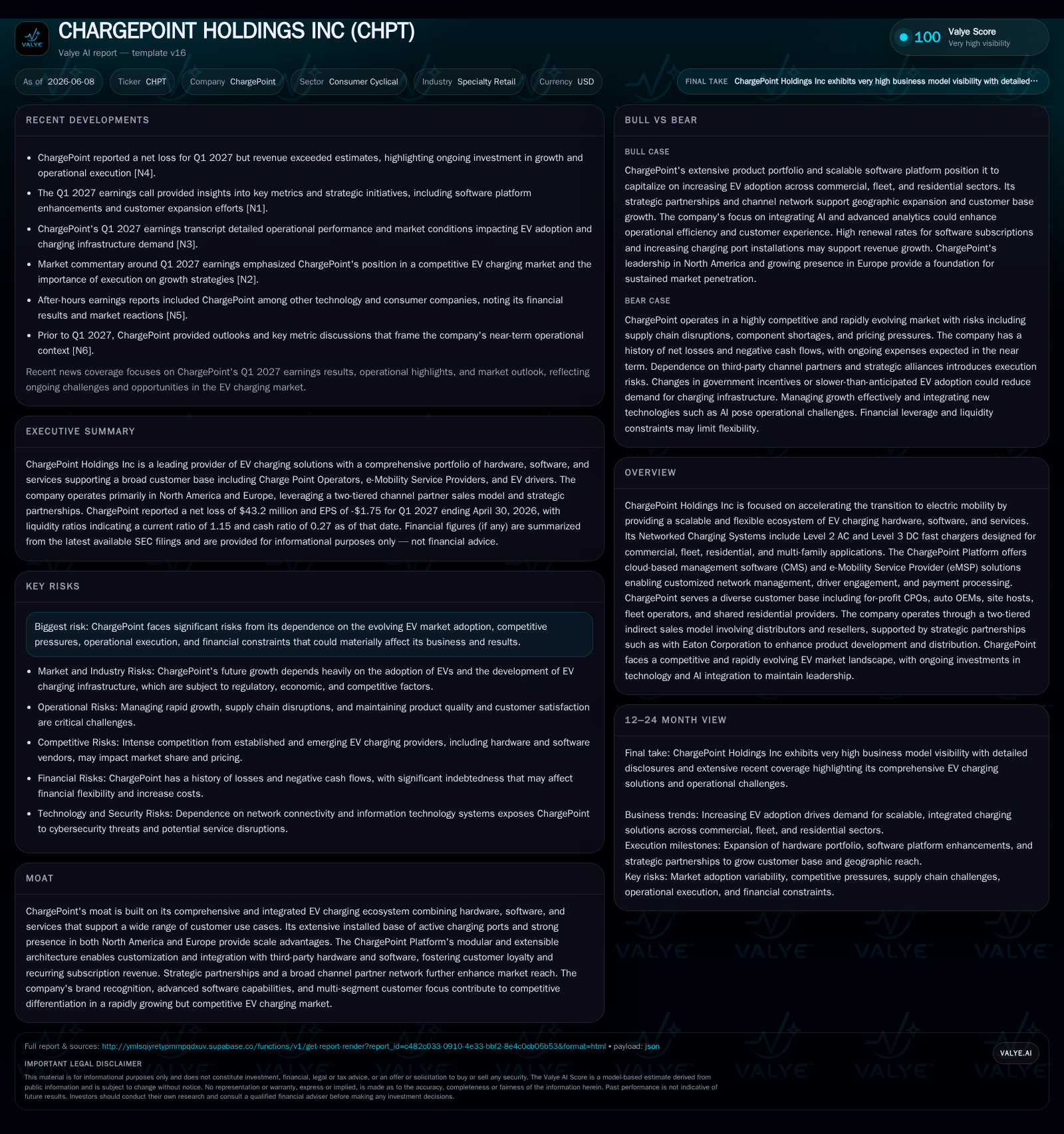
In its 2026 Q1 filing, ChargePoint reported sustained growth in its network of active EV charging ports and expanded commercial adoption, signaling structural demand amid accelerating EV market penetration in North America and Europe. The company continues leveraging a two-tier indirect sales model supported by strategic channel partnerships to broaden distribution and enhance product offerings. However, persistent operational losses, significant indebtedness with restrictive covenants, and intensifying competition underscore financial and execution risks. ChargePoint's growth hinges on scaling fleet and residential verticals while managing supply chain complexity and capital structure constraints.
Recent Operating Update: Q1 2026 Highlights
ChargePoint Holdings Inc’s latest 10-Q filing dated June 8, 2026, reveals continued expansion of its EV charging network amid intensifying market demand and operational challenges [S2]. The company reported approximately 385,000 active charging ports—defined as ports running on ChargePoint’s software platform—serving over 1.48 million unique EV drivers quarterly across North America and Europe. This metric, a key sector KPI reflecting network scale and user engagement, underscores ChargePoint’s leadership in EV infrastructure deployment [S1][S2].
Despite this growth in network density and platform adoption, ChargePoint sustained a significant operating loss of approximately $210 million through January 31, 2026, reflecting ongoing capital expenditures and R&D investments to scale fast-charging capacity and enhance software capabilities [F1][S2]. The negative operating income highlights the capital-intensive nature of expanding Level 3 DC fast charger installations, which require substantial upfront hardware costs, grid interconnection, and site development, alongside the development of cloud-based SaaS solutions that drive recurring revenue.
Strategic partnerships remain central to ChargePoint’s go-to-market approach. The alliance with Eaton Corporation, a major electrical equipment supplier, facilitates a two-tier indirect sales model leveraging distributors and value-added resellers to broaden geographic reach and accelerate customer onboarding in commercial, fleet, and residential segments [S3][S16]. This channel strategy is critical to managing supply chain complexity, which continues to pose risks due to component shortages and manufacturing lead times impacting charger production schedules [S2][S26].
Business Model: Integrated EV Charging Ecosystem
ChargePoint’s revenue streams are anchored in hardware sales of Level 2 AC chargers, suited for slower commercial and residential applications, and Level 3 DC fast chargers designed for rapid charging in commercial and fleet environments. These hardware sales are complemented by recurring SaaS subscriptions from the ChargePoint Platform, which includes the Charger Management Software (CMS) and e-Mobility Service Provider (eMSP) solutions [S1][S11]. The CMS enables charge point operators (CPOs) and site hosts to remotely monitor charger uptime, manage payments, optimize utilization rates, and perform predictive diagnostics—key operational KPIs in the sector.
Customers encompass a diverse base: commercial property owners (retail, office parks), fleet operators seeking tailored electrification solutions to improve vehicle uptime and reduce total cost of ownership, residential property managers offering shared charging amenities, automotive OEMs integrating branded charging experiences, and direct CPOs managing public networks [S11]. This multi-segment approach requires continuous innovation in hardware-software integration and service customization.
ChargePoint’s two-tier indirect sales model involves selling hardware to distributors who then supply value-added resellers, enabling localized sales and installation services critical for turnkey project execution [S11][S16]. This channel dependency introduces concentration and execution risks but also allows scalable market penetration without extensive direct salesforce expansion.
Industry Structure and Competitive Position
The EV charging infrastructure market is in a rapid growth phase, with Bloomberg New Energy Finance projecting U.S. passenger EV sales to increase from 2.4% in 2020 to 27% by 2030, and Europe’s share rising from 12.2% to 51.5% over the same period [S1]. This structural demand underpins a projected increase in regional EV infrastructure investment from $3.7 billion in 2020 to $17.8 billion by 2030, emphasizing the scale of opportunity for network operators.
ChargePoint competes with established players such as Blink Charging and Tesla’s proprietary Supercharger network, alongside emerging public-private partnerships and utility-backed consortia. Its competitive moat lies in a modular, interoperable platform architecture that supports multiple hardware types and third-party chargers, extensive roaming agreements expanding driver access beyond proprietary ports, and a SaaS-driven service layer enhancing operational efficiency and customer stickiness [S11].
Partnerships like Eaton’s enable ChargePoint to leverage established electrical distribution channels, accelerating fast charger density growth—a critical metric given the sector’s focus on reducing average charging session duration and improving charger uptime [S16]. However, pricing pressure remains intense, especially in commercial deployments where site hosts demand compelling total cost of ownership economics.
Growth Drivers
ChargePoint’s growth is propelled by accelerating fleet electrification, driven by regulatory mandates targeting fossil fuel vehicle bans and corporate sustainability commitments. Fleets, characterized by high utilization rates, require scalable, reliable fast-charging infrastructure optimized for operational efficiency, representing a high-value vertical [S1][N2]
Recurring SaaS subscriptions tied to charger utilization and network management form a growing revenue base, with features such as smart queuing and dynamic load management enhancing utilization rates—a critical KPI for monetizing infrastructure investments. Geographic expansion, particularly in Europe, leverages channel partnerships but requires navigating complex regulatory environments.
OEM collaborations integrate ChargePoint’s software and hardware into branded charging experiences, increasing switching costs and reducing churn risk [S11]. The virtualization of charging management through software platforms embeds ChargePoint deeper into customer operations, supporting long-term revenue visibility
Risks, Watchpoints, and Growth Constraints
ChargePoint faces several execution and financial risks:
- Persistent operating losses and high leverage, with net debt estimated near $204 million after cash reserves of approximately $96 million, constrain financial flexibility under restrictive covenants in its 2025 Senior Loan credit agreement. These covenants limit additional indebtedness and require minimum liquidity thresholds, potentially restricting capital allocation for R&D and infrastructure expansion [F1][S5][S8].
- Supply chain disruptions remain a significant risk due to reliance on a limited number of hardware component suppliers, affecting production schedules and cost structures [S2][S26].
- Dependence on third-party channel partners introduces concentration risk, as non-exclusive agreements allow partners to shift toward competitors, impacting sales predictability [S16].
- Regulatory changes, including the phase-out or modification of government incentives and tax credits, could dampen near-term demand despite favorable long-term trends [S17].
- Intensifying competition pressures pricing strategies, particularly in commercial and fleet segments where total cost economics are paramount.
- Execution risks include scaling installation capacity while maintaining service quality, essential for customer retention and reducing churn among enterprise clients.
What To Watch Next
Key performance indicators to monitor include quarterly growth in active charging ports, software subscription billings reflecting customer retention and platform monetization, and margin improvements driven by a higher mix of recurring services versus hardware sales. Supply chain normalization will be critical to meeting demand forecasts and improving gross margins.
The performance of strategic channel partnerships, especially the Eaton reseller network, will be a barometer for geographic expansion success. Progress in fleet-specific charging solutions will indicate traction in a high-potential vertical.
Liquidity management relative to scheduled debt service obligations will require close attention, with potential capital raises or operational cash flow improvements signaling financial health [S2][S5]
Financial Profile Snapshot
As of April 30, 2026, ChargePoint reported cash and equivalents of approximately $95.8 million against current liabilities of about $350 million, resulting in a current ratio near 1.15x, indicating tight but manageable working capital dynamics [F1]. Total debt remains near $300 million based on the latest available data, with net debt exceeding $200 million after accounting for cash reserves [F1].
The 12% fixed-rate 2025 Senior Loan includes restrictive covenants and prepayment premiums, with some interest payments converted into equity shares subject to stockholder approval, posing potential dilution risks [S5][S18]. Research and development expenditures remain elevated, consistent with prior annual levels exceeding $140 million, reflecting ongoing investment in product innovation despite capital constraints [S12][S27].
Overall, liquidity appears sufficient for near-term operations but remains vulnerable to macroeconomic and industry-specific headwinds affecting financing conditions.
This analysis synthesizes ChargePoint’s recent quarterly disclosures with broader industry context as of June 2026, emphasizing operational metrics, business model specifics, competitive positioning, and financial constraints without providing investment research views.
Disclaimer: This is research-only, informational analysis and not investment advice. It may include AI-generated interpretation and general industry context. Always verify important details using primary sources.

Comments