
Perma-Pipe International Navigates Project Variability and Margin Pressures with Strategic Credit and Operational Stability
Recent quarterly results show revenue growth driven by higher volumes offset by margin compression linked to product mix and new facility costs.
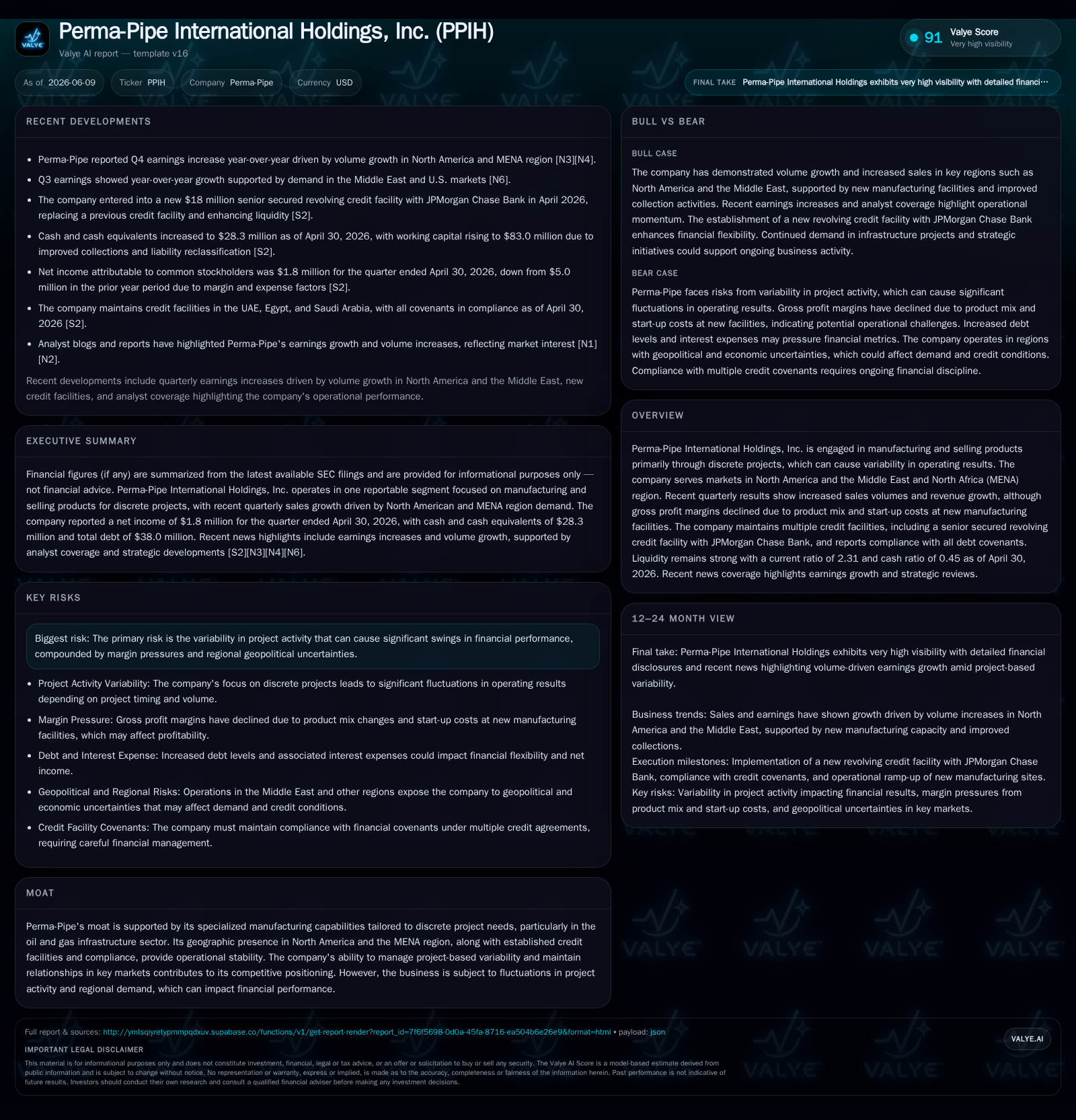
Perma-Pipe International Holdings, Inc. reported a 7.5% revenue increase in the first quarter ending April 30, 2026, reflecting improved sales volumes across its core markets. However, gross profit margins declined from 36% to 29%, primarily due to project-based product mix shifts and ramp-up costs associated with new manufacturing capacity. The business benefits from geographically diversified operations spanning North America and the MENA region, alongside stable financing arrangements including a recent refinancing of its North American revolving credit facility with JPMorgan Chase. While the project-based nature of Perma-Pipe’s revenue introduces operating volatility, ongoing backlog orders and strategic liquidity management mitigate short-term risks. Going forward, the company must carefully manage margin pressures and regional geopolitical uncertainties that could impact project activity.
Latest Operating Update Reflects Growth with Margin Headwinds
Perma-Pipe International Holdings, Inc. reported first-quarter results for the period ending April 30, 2026, with net sales increasing 7.5% year-over-year to $50.3 million, driven by higher project volumes across its core North American and MENA markets [S2][S3]. Despite revenue growth, gross profit declined by $2.1 million, compressing gross margin from 36% to 29%, primarily due to a shift in product mix toward lower-margin project types and start-up costs associated with new manufacturing capacity expansions [S2]. These margin pressures reflect the typical variability in discrete project manufacturing where contract size and complexity directly impact profitability.
General and administrative expenses rose modestly to support scaling operations, while interest expense increased in line with higher debt levels, including the recent refinancing of the North American revolving credit facility with JPMorgan Chase Bank, which extended maturity to October 2027 and is secured by substantial North American assets [S2][S4][S6]. The company maintained compliance with all debt covenants during the quarter, supported by strong cash flow generation and working capital improvements.
Business Model Anchored in Discrete Project Manufacturing
Perma-Pipe operates in a single reportable segment focused on engineering, manufacturing, and selling specialized pipeline insulation and heat-tracing systems primarily to oil and gas infrastructure clients [S1]. Revenue is generated through discrete, large-scale projects rather than recurring volume contracts, with customers paying based on negotiated contract terms that typically include progress billings tied to project milestones. This structure links cash flows closely to project execution phases and introduces operating volatility tied to project timing and size.
The company’s product portfolio ranges from standard insulation materials to complex engineered heat-tracing packages, each with distinct cost structures and margin profiles. As a result, project mix shifts can materially affect gross margins quarter-to-quarter. Start-up costs for new manufacturing facilities further depress margins temporarily until operational efficiencies are realized [S1][S2]. Key operating metrics include backlog conversion rates and contract win rates, which influence revenue visibility and margin stability.
Industry Structure and Perma-Pipe’s Competitive Positioning
Perma-Pipe competes in a niche industrial hardware segment requiring specialized engineering capabilities and geographic reach across energy-producing regions in North America and the MENA region [S1]. Its competitive advantage stems from proprietary manufacturing processes tailored to bespoke project requirements and longstanding relationships with major oil and gas operators.
The company’s subsidiaries in the Middle East operate with multiple credit lines secured by assets such as accounts receivable and inventory, with borrowing costs reflecting local market conditions—interest rates on Egyptian facilities range from 15.0% to 20.8% per annum, including government-sponsored initiatives [S2]. This geographic diversification provides access to growing upstream and midstream infrastructure projects but exposes Perma-Pipe to foreign currency risk, elevated financing costs, and geopolitical uncertainties.
Compared to peers focused on commodity-driven cyclicality, Perma-Pipe’s discrete project orientation cushions some commodity price shocks but introduces volatility linked to capital expenditure cycles and project award timing within the energy infrastructure sector.
Distinct Growth Drivers
Perma-Pipe’s growth is closely tied to global oilfield infrastructure investment trends, particularly projects requiring robust thermal insulation and heat-tracing for pipelines transporting hydrocarbons in harsh or remote environments. As of January 31, 2026, the company reported a healthy backlog of approximately $121.6 million, primarily expected to convert into revenue within the next fiscal year, providing near-term visibility into project execution schedules [S1]
Capacity expansions through new manufacturing facilities aim to address increasing order volumes and improve operational leverage, which may help alleviate margin pressure once scale efficiencies are achieved [S2]. The company’s ability to secure repeat orders from established clients supports predictable revenue streams despite the inherent variability of discrete project contracts.
Risks and Constraints
Key risks include the inherent volatility of large project awards, which can cause significant quarter-to-quarter earnings swings and impact cash flow due to working capital tied up in receivables and performance guarantees [S1]. Delays or cancellations of major projects could materially affect financial performance.
Geopolitical instability in parts of the MENA region adds uncertainty to foreign subsidiary operations and credit facility renewals, requiring ongoing lender engagement and risk management [S20]. Elevated interest rates on foreign borrowings, particularly in Egypt, increase the financial burden during slower revenue periods [S2].
Margin pressures from start-up costs related to manufacturing expansions pose near-term headwinds, while supply chain disruptions and raw material price inflation remain ongoing challenges [S1]. Management mitigates these risks through diversified sourcing, advance purchasing strategies, and customer pricing adjustments to offset cost increases
Financial Position and Credit Stability
As of April 30, 2026, Perma-Pipe held $28.3 million in cash and cash equivalents, with current assets totaling $146.4 million and current liabilities of $63.4 million, resulting in a strong current ratio of approximately 2.31 [F1][S2]. Total debt was approximately $32.6 million, with net debt reduced to around $4.3 million due to ample liquidity cushions [F1].
The company replaced its prior PNC revolving credit facility with a senior secured asset-based revolving credit facility from JPMorgan Chase Bank, featuring an $18 million commitment and maturity extended to October 2027 [S2][S4][S6][S7]. This facility is secured by substantially all North American assets and includes customary covenants such as minimum fixed charge coverage and maximum leverage ratios, which the company was in compliance with as of quarter-end
Foreign subsidiaries maintain credit lines in the UAE, Egypt, and Saudi Arabia, with borrowing costs reflecting local market conditions and secured by subsidiary assets [S2][S20]. These arrangements provide flexible project financing but require careful covenant compliance and renewal management amid regional geopolitical risks
Operating cash flow improved significantly to $6.1 million in the quarter from $0.7 million a year earlier, driven by improved collections and higher revenues, partially offset by increased capital expenditures supporting capacity growth [S4][S18][S24]
This analysis contextualizes Perma-Pipe International Holdings’ recent operating performance within its discrete project manufacturing business model serving energy infrastructure markets. While top-line growth validates sustained demand momentum, margin compression highlights the sensitivity of profitability to product mix and capacity expansion costs. The company’s credit arrangements and liquidity position reflect prudent financial management consistent with sector norms, though regional financing costs and geopolitical risks remain key considerations.
Disclaimer: This analysis is based solely on publicly available regulatory filings and news reports as cited herein and does not constitute investment advice.
Disclaimer: This is research-only, informational analysis and not investment advice. It may include AI-generated interpretation and general industry context. Always verify important details using primary sources.

Comments