
Urban Outfitters Expands Store Base and Digital Channels, Strengthening Multi-Brand Lifestyle Retail Model
Latest quarterly update highlights growth in omni-channel sales, brand portfolio expansion, and operational investments supporting Urban Outfitters' competitive position.
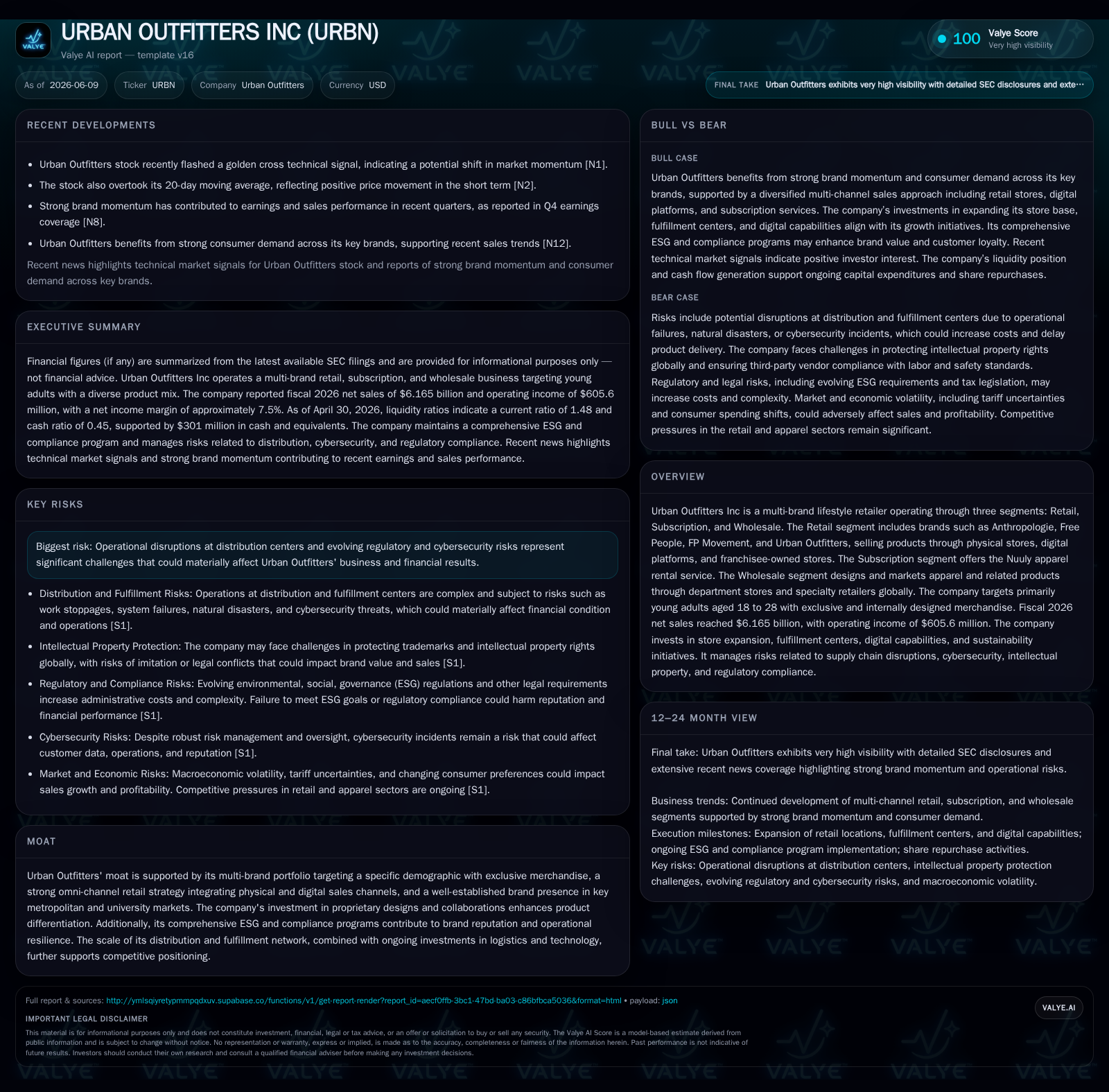
Urban Outfitters Inc reported strong operating performance for fiscal 2026, driven by a diversified multi-brand retail strategy spanning Anthropologie, Free People, FP Movement, and Urban Outfitters itself. Recent filings reveal continued expansion in retail locations and digital sales, supported by investments in fulfillment infrastructure and marketing. The company’s subscription rental service Nuuly and wholesale business complement core retail operations, targeting younger demographics with exclusive merchandise. Key risks include distribution center disruptions and regulatory challenges, though Urban Outfitters’ integrated omni-channel approach and proprietary inventory provide resilience. Capital allocation prioritizes store growth, logistics investments, and share repurchases backed by solid operating cash flow.
Recent Operating Update
Urban Outfitters Inc's latest quarterly filing dated June 9, 2026 ([S2]) highlights continued momentum in its multi-brand specialty apparel retail portfolio, with fiscal 2026 operating income rising to $605.6 million, representing a 9.8% operating margin compared to $473.8 million (8.5%) in the prior year ([S16],[F1]). This margin expansion was driven by improved gross profit rates across its Retail, Subscription, and Wholesale segments, reflecting effective merchandise pricing and inventory management.
The company operates approximately 793 company-owned retail stores globally, spanning its core brands—Urban Outfitters, Anthropologie, Free People, and FP Movement—with notable store base growth in North America and Europe ([S1]). The Retail segment’s omni-channel strategy integrates physical stores with digital platforms, including websites and mobile apps, enabling a seamless customer experience. Comparable store sales (comps) showed mid-single-digit growth in Free People and Anthropologie, offset by a slight decline at Urban Outfitters brand stores. Digital channel growth contributed positively to overall comps, supported by increased web traffic and conversion rates, although average order values moderated slightly ([S17]). Key retail KPIs monitored include customer traffic, conversion rates, average units per transaction, and average order value, reflecting responsiveness to fashion trends and marketing effectiveness.
The Subscription segment, led by the Nuuly apparel rental service, now accounts for over 9% of consolidated net sales, fueled by a 51% increase in active subscribers during the period ([S7],[S16]). Nuuly’s circular fashion model targets environmentally conscious consumers aged 18-28, generating recurring revenue through monthly rentals and purchase options, thereby enhancing customer lifetime value and diversifying revenue streams.
Wholesale operations contribute approximately 5% of net sales by distributing proprietary apparel collections through department stores and specialty retailers worldwide, extending brand reach beyond direct-to-consumer channels ([S7]).
Business Model Analysis
Urban Outfitters generates revenue primarily through direct sales to consumers via its retail stores and digital commerce platforms, including websites, mobile applications, social media, and third-party marketplaces ([S1],[S11]). The Retail segment emphasizes exclusive, internally designed apparel that appeals to trend-sensitive young adults, leveraging initial markup strategies and inventory turnover to optimize gross margins. The company’s inventory management focuses on maintaining high inventory turnover rates while minimizing markdowns, critical KPIs in specialty apparel retail to sustain profitability.
The Subscription segment’s Nuuly service introduces a hybrid business model combining rental and purchase options, providing a stable recurring revenue base and increasing customer engagement. Wholesale operations, while smaller in scale, support brand visibility and incremental sales with lower capital intensity.
Revenue generation depends on driving traffic (both in-store and online), improving conversion rates, increasing average units per transaction or order value, and efficient inventory management. Investments in marketing campaigns and technology enhancements aim to boost brand awareness and optimize the omni-channel customer journey ([S5],[S16]). Proprietary designs and curated exclusivity reduce direct price competition and increase customer loyalty.
Industry Structure & Competitive Position
The specialty apparel retail industry is characterized by rapid product turnover, trend-driven demand, and the need for agile supply chains. Urban Outfitters’ competitive advantage lies in its diversified multi-brand portfolio targeting the young adult demographic, combining lifestyle branding with fashion-forward merchandise. Its store footprint balances scale with niche brand identities, supported by an integrated omni-channel approach.
Competitors include fast-fashion and contemporary apparel retailers such as Abercrombie & Fitch, Nordstrom’s contemporary brands, and off-price operators like TJX Companies. While these peers compete on scale, price, and assortment breadth, Urban Outfitters differentiates itself through proprietary designs and curated brand experiences, creating higher switching costs for style-conscious customers. Digital penetration and elevated conversion rates on web and mobile platforms further strengthen its competitive moat by mitigating reliance on physical store traffic volatility ([N6],[S8]).
Recent investments in fulfillment infrastructure, including acquisition of a Nuuly-focused distribution center, enhance logistics capabilities critical for e-commerce scalability and customer satisfaction, reducing lead times and supporting subscription growth ([S8],[S19]).
Growth Drivers
Key growth catalysts include:
- Store Expansion: Approximately 57 new company-owned retail locations planned for fiscal 2027, alongside remodels and relocations to capture market share in urban and university markets, increasing selling square footage and enhancing brand presence ([S8],[S1]).
- Omni-Channel Enhancement: Continued investments in digital user experience and integrated marketing campaigns aim to increase traffic, conversion, and average order values across channels, aligning with shifting consumer preferences toward e-commerce and experiential retail.
- Subscription Service Scaling: Nuuly’s subscriber base growth taps into rising demand for sustainable fashion, with potential to increase its contribution beyond the current 9% of net sales, supporting recurring revenue and customer retention.
- Wholesale Channel Expansion: Strategic partnerships with department and specialty stores internationally provide incremental revenue streams with lower capital expenditure.
- Logistics and Fulfillment Capacity: Expansion and modernization of fulfillment centers reduce delivery lead times and improve operational efficiency, critical for sustaining e-commerce growth and subscription service reliability.
Risks and Growth Constraints
Operational risks primarily stem from the complexity of distribution centers reliant on automated systems, which are vulnerable to power outages, cyber threats, and system failures that could disrupt order fulfillment and increase costs ([S6],[S13]).
Intellectual property protection challenges exist internationally, where trademark enforcement may be weaker, increasing counterfeit risks that could erode brand equity. Regulatory risks include evolving environmental, social, and governance (ESG) compliance requirements and labor law enforcement impacting manufacturing costs and reputational risk ([S28],[S6]).
Macroeconomic uncertainties, such as tariff fluctuations and inflationary pressures, pose input cost challenges that could compress margins. Competitive pressures necessitate sustained marketing investments, which contributed to a slight deleverage in selling, general, and administrative expenses as a percentage of sales despite revenue growth ([S16]).
What to Watch Next
Key performance indicators to monitor include:
- Quarterly comparable omni-channel sales growth by brand and channel, with a focus on digital versus physical store mix shifts.
- Nuuly subscription metrics, including active subscriber growth and retention rates, to assess sustainability of recurring revenue.
- Contribution margins from new store openings and their ramp-up periods.
- Inventory turnover rates and markdown cadence, which directly impact gross profit sustainability.
- Progress on supply chain resilience initiatives addressing automation risks at distribution centers.
- Regulatory developments affecting import tariffs, labor compliance, and ESG standards impacting sourcing and cost structures.
Financial Profile Summary
Urban Outfitters maintains a strong liquidity position with cash and equivalents of approximately $301 million against current liabilities of about $1.04 billion as of April 30, 2026, resulting in a current ratio of approximately 1.48, indicating adequate short-term financial flexibility ([F1]). Total debt remains modest relative to cash holdings, with an implied net cash position supporting operational liquidity amid ongoing capital expenditure plans.
This analysis is based solely on published regulatory filings up to June 2026 combined with industry context; it does not constitute investment advice or market research views.
Disclaimer: This is research-only, informational analysis and not investment advice. It may include AI-generated interpretation and general industry context. Always verify important details using primary sources.

Comments