
Lakeland Industries Secures UK Fire Service Contracts and Marks Modest Profitability in Q1
Latest quarterly filings underscore Lakeland’s contract wins with UK fire services, supported by NFPA certification, driving modest profitability.
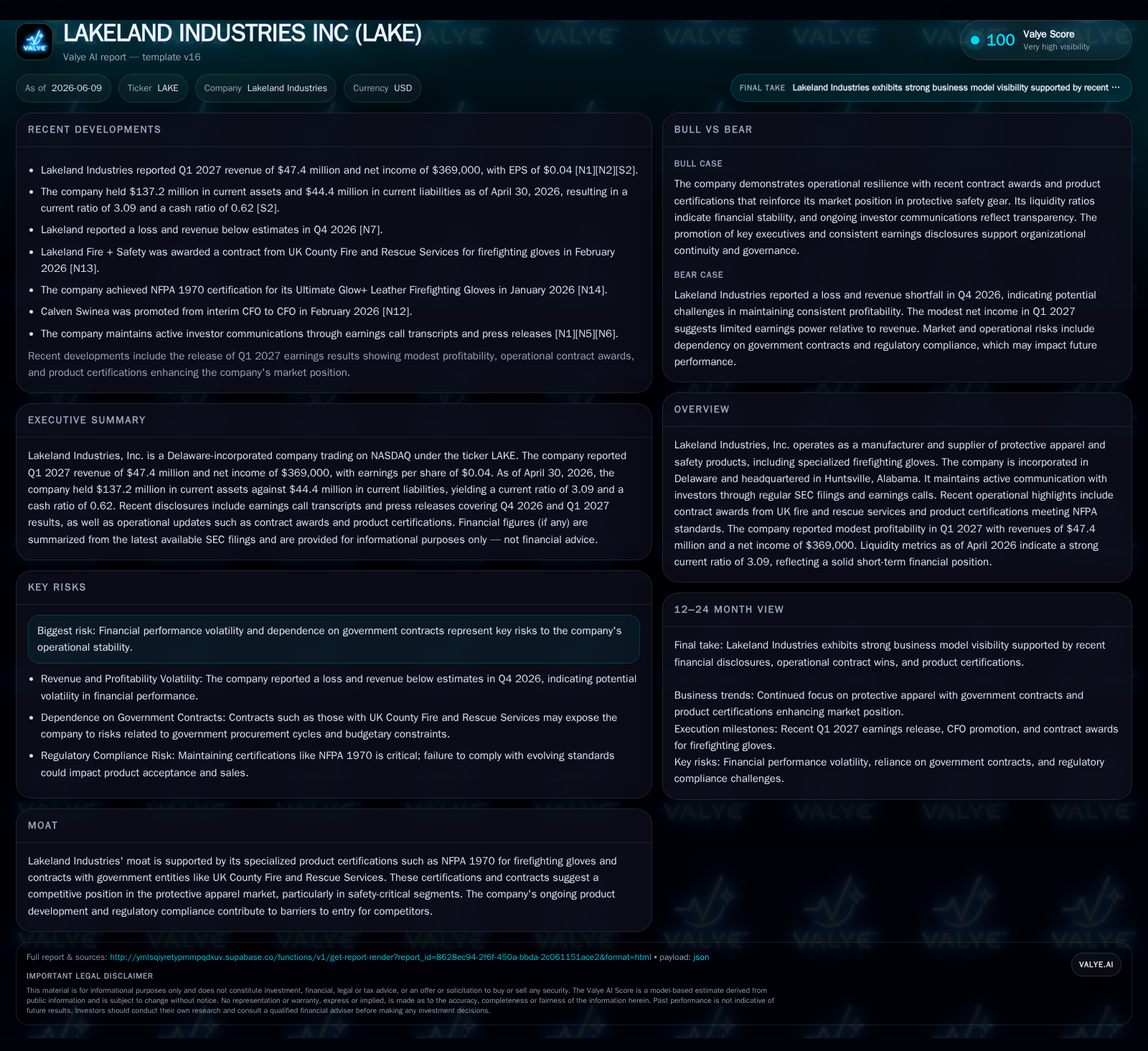
In the first quarter ending April 2026, Lakeland Industries reported revenues of $47.4 million and a net income of $369,000, reflecting modest profitability. The quarter was marked by strategic contract awards from UK County Fire and Rescue Services, underscoring the company's competitive advantage grounded in NFPA-certified firefighting gloves. Lakeland’s business model centers on supplying specialty protective apparel with a strong reliance on government contracts and adherence to safety standards, which serve as barriers to entry. Liquidity remains robust with a current ratio exceeding 3, supporting operational stability amid industry pressures.
Q1 Operational Update Highlights Contract Wins and Profitability
Lakeland Industries’ latest quarterly disclosures dated June 9, 2026, reveal revenues of $47.4 million with net income tallying $369,000 for the first quarter ended April 30, 2026 [S2][N1][N2]. This marks continued modest profitability following prior earnings volatility, reflecting incremental margin improvement in a specialized manufacturing environment. Central to this performance are newly awarded contracts from multiple UK County Fire and Rescue Services detailed in recent event filings [S3], signaling successful penetration into vital government procurement channels abroad.
These contract wins are closely tied to Lakeland’s NFPA 1970-certified firefighting gloves, a critical product segment within its specialty protective apparel portfolio. NFPA certification serves as a key competitive moat, ensuring compliance with rigorous heat resistance, durability, and ergonomic standards required by fire service agencies [S1]. This certification-driven product differentiation underpins Lakeland’s ability to secure and retain government contracts, which form the backbone of its revenue model.
Business Model Overview: Certification-Driven Government Contracting
Lakeland operates primarily as a manufacturer and supplier of specialized personal protective equipment (PPE), focusing on firefighting gloves and related apparel that meet stringent NFPA standards such as NFPA 1970. The company’s revenue generation is predominantly through government contracts, where procurement decisions are heavily influenced by compliance with these certifications [S1]. This reliance on public sector clients, including domestic and international fire rescue agencies, imparts relative revenue stability but also introduces cyclical risk linked to public budget cycles and contract renewal timelines.
The company’s sales process is characterized by competitive bidding within government procurement frameworks rather than traditional wholesale or retail channels. This necessitates continuous investment in product development to maintain certification adherence and respond to evolving regulatory requirements. Key operating metrics in this sector include contract win rates, certification renewal rates, and product lifecycle management to ensure ongoing compliance and market relevance.
Industry Setting: Regulatory Barriers and Competitive Dynamics
The protective apparel industry, particularly firefighter PPE, is defined by stringent regulatory standards that create high barriers to entry. NFPA certifications require exhaustive testing for thermal protection, chemical resistance, and ergonomic fit, which competitors such as Ansell Protective Products and 3M’s Personal Safety Division also pursue but may not specialize in to the same degree for firefighting gloves [S1].
Lakeland’s niche expertise in NFPA 1970-compliant gloves allows it to differentiate within this competitive landscape. The certification process elevates switching costs for customers due to the significant time and expense involved in qualifying alternative suppliers, thereby enhancing customer retention and contract renewal probabilities.
Growth Drivers: Geographic Expansion and Innovation Pipeline
The recent contract awards from UK fire services represent a strategic expansion into new geographic markets, leveraging Lakeland’s certification credentials to access regulated government procurement channels [S2][S3]. This geographic diversification aligns with broader industry trends emphasizing enhanced firefighter safety standards globally, which drive periodic PPE upgrades.
Lakeland’s ongoing investment in research and development aims to sustain and advance its certification portfolio, supporting a product innovation pipeline focused on improving protective performance and ergonomic design. This pipeline is critical to maintaining competitive differentiation and addressing evolving safety protocols, which are key growth levers in the specialty PPE market.
Risks and Constraints: Customer Concentration and Margin Pressures
Lakeland’s business model entails concentration risk due to its heavy dependence on government contracts, exposing it to potential budgetary constraints and policy shifts that could impact contract renewals [S1]. Additionally, the specialized manufacturing segment faces margin pressures from raw material cost volatility and competitive pricing dynamics, despite the premium commanded by certified products.
Capacity constraints could also emerge if demand accelerates without proportional investment in scalable manufacturing capabilities, potentially affecting order fulfillment timelines and customer satisfaction.
What to Watch Next: Contract Renewals and Certification Milestones
Key near-term milestones include outcomes of contract renewals with existing government clients and announcements of new procurement awards, particularly in international markets. Progress in obtaining additional NFPA certifications or updates to existing standards will be pivotal in sustaining Lakeland’s competitive positioning.
Monitoring order backlog trends, bid pipeline status, and management commentary on innovation initiatives during upcoming earnings calls will provide further insight into the company’s operational momentum and growth prospects [N1][S2]
Financial Snapshot: Liquidity and Earnings Performance
Lakeland maintains a strong liquidity profile entering mid-2026, with a current ratio of approximately 3.09 as of April 30, 2026, supported by current assets of $137.2 million against current liabilities of $44.4 million [F1]. Cash and equivalents stand near $25.2 million, effectively offsetting total debt of approximately $25.8 million, resulting in a negligible net debt position of roughly $549,000 [F1].
The modest net income of $369,000 this quarter contrasts with prior operating losses, signaling cautious financial stabilization amid ongoing margin pressures inherent in the specialty PPE manufacturing sector [S2][F1]. This financial flexibility supports continued investment in product development and contract bidding activities.
This analysis synthesizes publicly filed SEC documents alongside recent earnings commentary to provide an informed perspective on Lakeland Industries’ operational footing and industry context as of June 2026. All financial metrics are sourced strictly from verified company disclosures without extrapolation beyond disclosed figures.
This piece does not provide investment advice but aims to delineate key structural factors shaping Lakeland's market position and near-term outlook.
Disclaimer: This is research-only, informational analysis and not investment advice. It may include AI-generated interpretation and general industry context. Always verify important details using primary sources.

Comments