
Oil-Dri Corp of America Reports Record Revenues with Earnings Pressures Amid Strategic Share Repurchases
The company shows operational resilience with record revenue in Q3 2026 while facing margin headwinds and emphasizing shareholder returns.
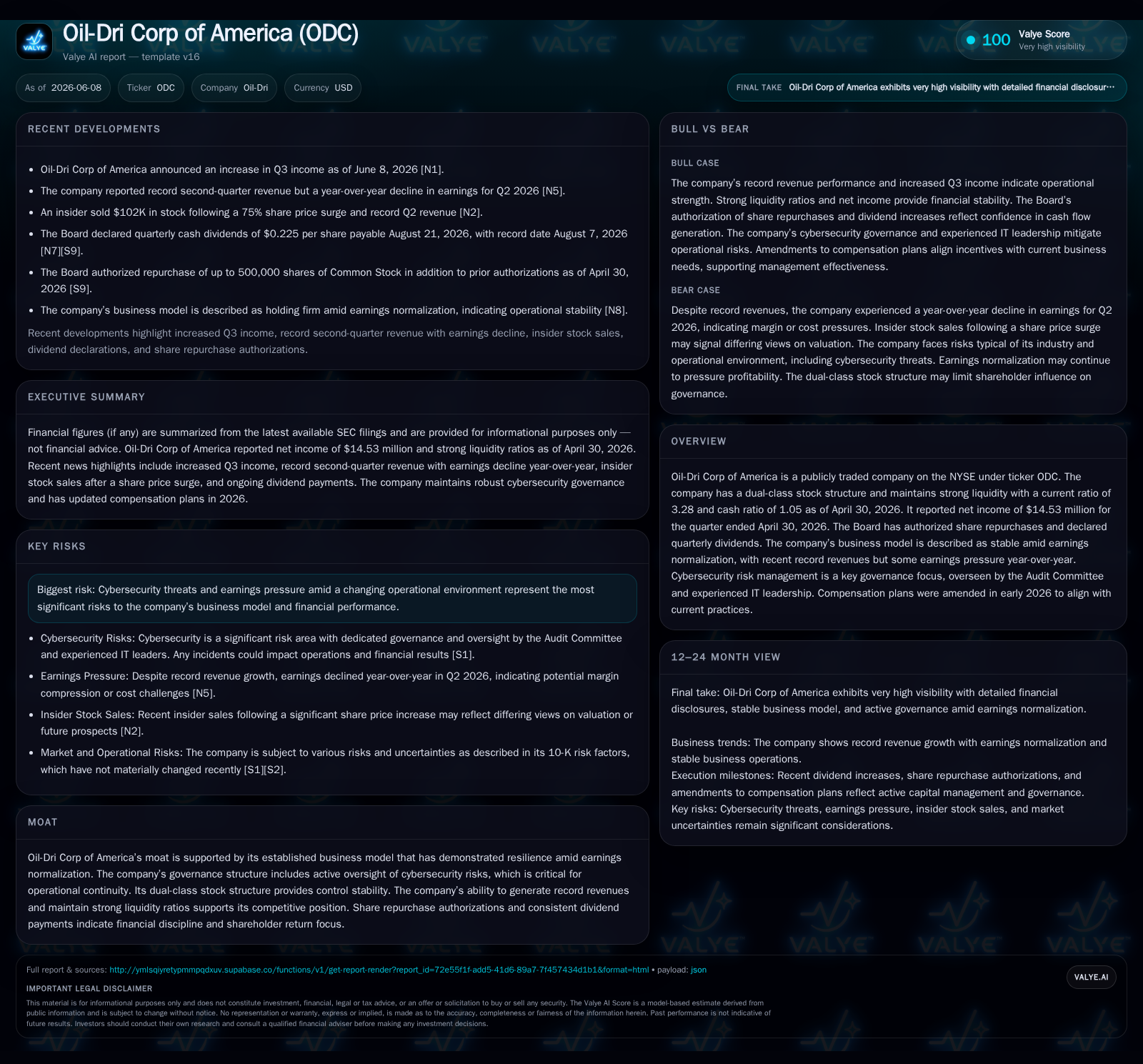
Oil-Dri Corp of America (ODC) released its Q3 2026 results showing record revenues but some earnings pressure compared to prior periods. The firm maintains strong liquidity and a conservative balance sheet, enabling fresh share repurchase authorization alongside steady dividend increases. Cybersecurity oversight remains a governance priority underpinning operational stability. ODC’s business model continues to demonstrate resilience amid evolving market conditions, supported by active management of risks and shareholder capital.
Recent Operating Update
Oil-Dri Corp of America’s latest quarterly filing (10-Q dated June 8, 2026) reports results for the third quarter ended April 30, 2026 [S2][S3]. The company achieved record revenue levels during the quarter, underscoring sustained end-market demand for its absorbents and related specialty materials. This top-line growth reflects robust volume trends across core product lines such as industrial absorbents used in oil spill remediation, filtration aids, and pet litter applications, where absorbency performance and product consistency are critical KPIs for customer satisfaction and retention.
The current ratio stood at a healthy 3.28, supported by $62.9 million in cash and equivalents against $59.9 million in current liabilities [F1]. Total debt remains minimal at approximately $1 million, effectively maintaining a net cash position of nearly $62 million [F1]. These balance-sheet metrics provide Oil-Dri with strategic flexibility to manage working capital cycles, raw material procurement, and capital allocation initiatives.
Reflective of this financial strength, on June 3, 2026, Oil-Dri’s Board authorized an additional common stock repurchase program of up to 500,000 shares beyond the roughly 380,000 shares available under prior authorizations as of April-end [S3][S6]. This move, alongside incremental quarterly dividend increases to $0.225 per common share declared, signals management’s confidence in sustainable cash flow generation and a shareholder-focused capital return strategy. The repurchase program execution will be a key operating variable to watch, as it can influence earnings per share and capital structure dynamics.
Business Model: Stable Demand Anchored in Specialty Absorbents
Oil-Dri generates revenues primarily through sales of industrial absorbents composed mainly of natural minerals such as diatomaceous earth and clay-based materials, which serve critical roles in oil spill containment, filtration processes, and pet care products [S1]. Customers, ranging from industrial operators to consumer product manufacturers, pay based on volume and product mix, with pricing influenced by raw material costs, product grade, and competitive market conditions.
The company’s operating model depends on maintaining high absorbency rates and product purity, which are essential KPIs in this sector, as these factors directly impact efficacy and regulatory compliance for end-users. Raw material sourcing is a strategic focus, given the variability in mineral quality and availability, which can affect production costs and margin profiles. Customer retention is supported by moderate switching costs and the technical performance differentiation of Oil-Dri’s proprietary formulations.
Cybersecurity governance is integrated as a critical risk management layer within Oil-Dri’s operational framework. Led by seasoned IT executives with decades of experience and overseen by the Audit Committee through quarterly reporting cycles, this governance structure mitigates potential operational disruptions or compliance risks arising from cyber threats [S23].
Industry Structure and Competitive Positioning
Operating within the specialty chemical additives and industrial absorbent sectors, Oil-Dri holds an established market position characterized by product customization capabilities and long-standing customer relationships [S1]. The company’s dual-class stock structure supports management continuity amid evolving industry dynamics.
Competition in this sector centers on cost-effective production, product differentiation through technical performance metrics such as absorbency rates and particle size distribution, and supply chain reliability. Barriers to entry include securing quality raw mineral sources and maintaining efficient distribution channels. The industry is also influenced by environmental regulations that drive demand for absorbents in spill mitigation and filtration applications, providing structural support despite commodity price cyclicality.
Growth Drivers
- Expanding application areas for industrial absorbents driven by tightening environmental standards and spill response regulations offer incremental volume growth opportunities.
- Product innovation targeting enhanced absorbency rates and improved filtration characteristics can justify premium pricing and broaden the customer base.
- Continued shareholder return programs, including dividends and share repurchases, may enhance investor confidence and support stock valuation stability.
- Operational efficiency initiatives focused on raw material sourcing optimization and cost control can improve profitability amid fluctuating input costs.
Risks and Constraints
Despite operational resilience, notable risks remain:
- Cybersecurity incidents pose potential operational disruption risks despite robust governance frameworks [S23].
- Margin pressure from raw material inflation or competitive pricing dynamics could constrain earnings growth.
- Market cyclicality or weakening end-user demand may challenge volume expansion assumptions.
- Regulatory shifts impacting raw mineral sourcing or environmental compliance could affect cost structures or product demand.
What To Watch Next
Key milestones include monitoring quarterly earnings for margin recovery or further compression trends, tracking the pace and effectiveness of share repurchase deployment under newly authorized programs, and watching for guidance updates reflecting near-term demand visibility. Additionally, management commentary on raw material cost trends relative to pricing pass-through will provide insight into the sustainability of earnings normalization. Updates on cybersecurity risk incidents or enhancements to controls will also be relevant to operational stability.
Financial Overview
As of April 30, 2026, Oil-Dri posted net income of approximately $14.53 million in the most recent quarter reported through public disclosures [S3]. The balance sheet exhibits significant liquidity strength with over $62 million in cash relative to a nominal debt load of around $1 million as of mid-2025 [F1]. These fundamentals underpin the company’s capital return strategy via dividends—which have been raised sequentially—and fresh share repurchase authorizations that add flexibility for efficient capital deployment [S6].
This financial position supports operational investments and shareholder returns without compromising balance-sheet conservatism.
Disclaimer: This is research-only, informational analysis and not investment advice. It may include AI-generated interpretation and general industry context. Always verify important details using primary sources.

Comments