
Global Crossing Airlines Expands ACMI Fleet Amid Liquidity Pressures
The May 2026 quarter reveals a growing Airbus A320 fleet fueling ACMI contract expansion while underscoring urgent liquidity constraints.
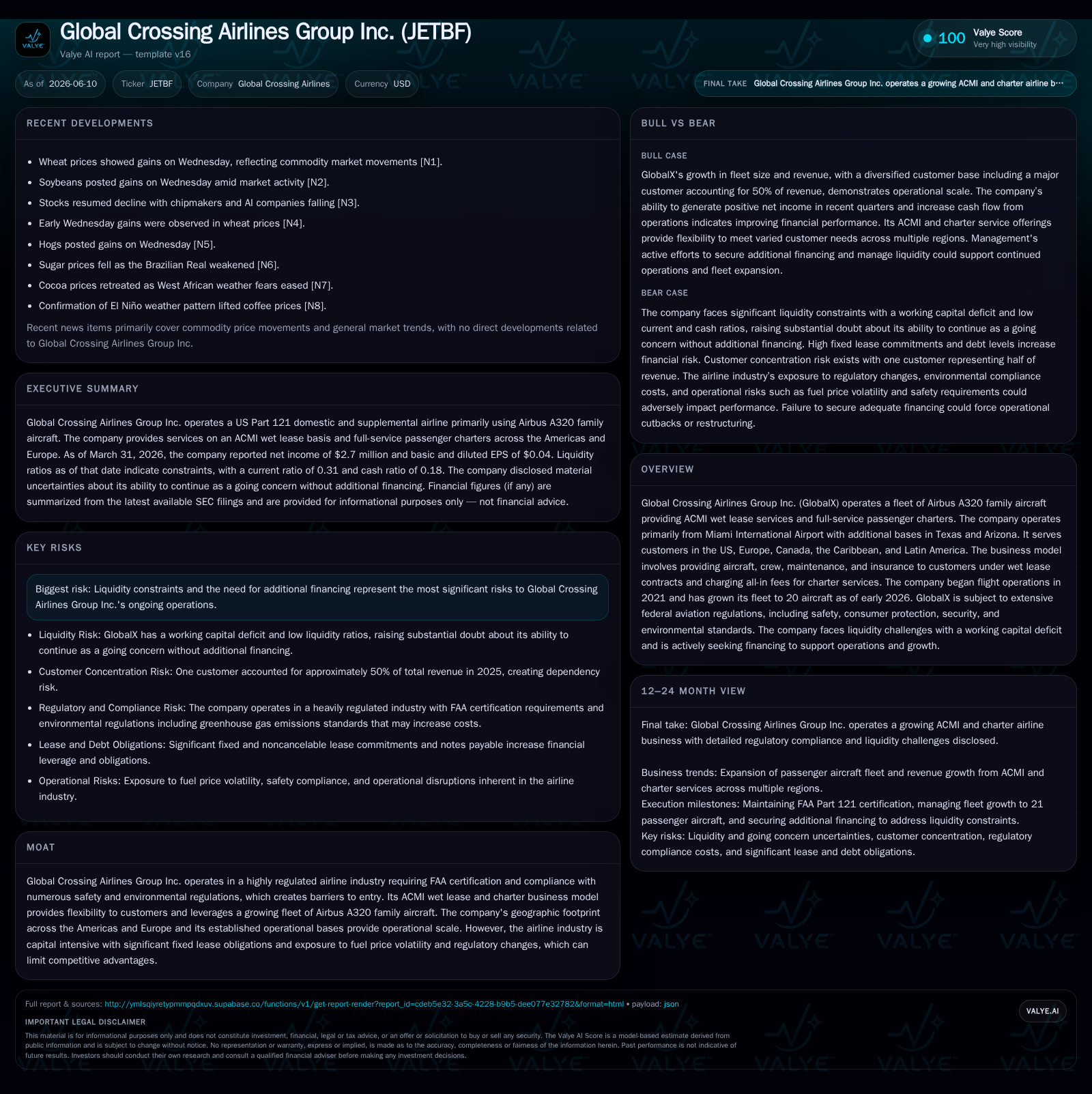
Global Crossing Airlines Group Inc. reported fleet growth to approximately twenty aircraft as of early 2026, reinforcing its ACMI wet lease and charter business model targeting diverse markets across the Americas and Europe. The latest quarterly filing highlights increased operational block hours signaling demand traction despite ongoing liquidity challenges marked by a working capital deficit and a current ratio below 0.5. The company’s capital-intensive structure within a heavily regulated airline industry poses critical execution risks, especially around refinancing and regulatory compliance. Future milestones center on securing financing and scaling fleet utilization to capitalize on expanding ACMI contracts and charter opportunities.
First Quarter Results: Fleet Expansion Meets Capital Strains
Global Crossing Airlines Group Inc.’s latest quarterly report dated May 7, 2026 [S2] details significant operational momentum alongside financial constraints that set the near-term tone for the company. The fleet has grown from sixteen passenger Airbus A320-series aircraft at year-end 2025 toward roughly twenty by early 2026. This expansion underpins an increase in block hours—the total time aircraft are in flight—demonstrating higher utilization of available flying capacity critical for revenue generation in the wet lease model. Despite this operational progress, liquidity challenges loom large: current assets stand at about $29.15 million versus current liabilities near $92.75 million as of March-end 2026, producing a current ratio of merely 0.31 [F1]. This working capital deficit of approximately $63.6 million highlights an urgent need for additional funding to continue operations without disruption.
Business Model Overview: ACMI Wet Lease Versus Charter Services
GlobalX operates a dual-stream business model combining Aircraft, Crew, Maintenance, and Insurance (ACMI) wet lease contracts with standalone full-service passenger charters [S1]. Under the ACMI agreements, GlobalX provides leased aircraft complete with crew, scheduled maintenance programs, and insurance coverage. Customers primarily pay an all-in fee excluding fuel costs and certain operational fees such as landing charges; these expenses fall to the lessee airline customer who assumes fuel price risk and flight demand variability. Alternatively, the full-service charters charge fixed all-inclusive fees where GlobalX retains responsibility for fuel and associated operating expenses. This bifurcation allows GlobalX to serve both airline partners seeking flexible outsourced capacity through wet leases and direct end-user customers wanting predictable costs via charters.
This model leverages regulatory Part 121 certification requirements enabling commercial transport within the US domestic supplemental carrier space but also demands rigorous compliance impacting cost structure. The customer choice dynamic reflects trade-offs between cost certainty in charters versus risk transfer on fuel/demand in ACMI contracts, influencing pricing flexibility and margin stability.
Industry Context and Competitive Positioning in ACMI and Charter Sectors
Situated within the capital-intensive US airline industry subject to stringent FAA Part 121 safety and environmental regulations, GlobalX contends with high barriers to entry that protect incumbents but impose heavy fixed-cost burdens including aircraft leases and maintenance reserves [S1]. Peers like Air Transport Services Group exemplify dedicated ACMI operators offering scale advantages through broader fleets serving cargo and passenger clients globally; meanwhile, Sun Country Airlines’ hybrid model mixes scheduled services with charter/ACMI contracting to diversify revenues.
Against major scheduled carriers such as JetBlue Airways, which operate larger fleets with extensive route networks optimizing fleet utilization via scheduled service yields, GlobalX’s smaller size concentrates operational risk but grants nimbleness in serving niche markets requiring flexible capacity.
Operational Performance: Flight Hours, Load Factors, and Fleet Utilization
Maintenance downtime remains a key variable controlling net available aircraft days; GlobalX reports standard provisions against unplanned servicing impacting daily utilization rates typical of Airbus A320 family operators. The young fleet profile since starting operations in 2021 aids reliability metrics but also requires ongoing investment in line maintenance mandated by regulators.
Growth Drivers: Geographic Reach and Contracted Capacity Gains
The company’s geographic footprint spans strategic bases at Miami International Airport with extended operations into Texas and Arizona serving routes across North America, Latin America, Europe, Canada, and Caribbean regions (as detailed in the May investor presentation) [S3]. This multi-continent reach facilitates diversified customer acquisition targeting airlines needing supplemental lift during peak seasons or market disruptions plus group-based charters.
Fleet expansion plans remain focused on increasing passenger aircraft count toward twenty-one by late 2026 while stabilizing cargo Airbus A321 freighter units at four planes [S1]. This growth is enabled by existing lease commitments supplemented by pending agreements underwriting new aircraft deliveries secured via deposits or binding contracts pending final documentation execution.
Moreover, ongoing airline traffic recovery globally post-pandemic supports structural demand for outsourced capacity in ACMI contracts allowing GlobalX to capture volume without bearing fuel cost risk associated with direct ticket sales.
Risks: Liquidity Challenges, Regulatory Compliance, and Fuel Price Volatility
Liquidity pressures dominate risk considerations sharply evident from financial disclosures showing a working capital deficit around $63.6 million expressed via the imbalance between current assets ($29.15 million) and liabilities ($92.75 million) as of March-end quarter close [F1]. Without successful refinancing or equity raises imminently secured per management commentary [S2], this funding gap risks curtailing growth ambitions or sustaining day-to-day expenses.
Regulatory exposure extends beyond FAA Part 121 safety certifications into evolving EPA particulate matter emission rules finalized in January 2023 plus potential future carbon offset regime obligations under CORSIA standards posing considerable cost uncertainties over horizon periods described in Form 10-K/A filing [S1]. These create variable operating cost risks difficult to hedge compared to fuel expenses traditionally passed through fully or partially under wet lease agreements.
Fuel price volatility impacts depend on contract type: ACMI customers generally absorb jet fuel costs removing direct commodity risk from GlobalX’s income stream but potentially affecting kilometers flown if demand reacts adversely; charter flights bear full price exposure pushing margin variability higher.
What To Watch Next: Financing Milestones and Demand Indicators for H2 2026
Investor focus is expected on updates regarding capital raise initiatives or restructuring efforts referenced indirectly across SEC filings with management actively evaluating equity or debt options to bridge present liquidity deficits without impairing control stakes unduly [S2],[S3],[S1].
Subsequent quarterly disclosures will likely reveal evolved block hour statistics correlating with incremental fleet integration effectiveness plus possibly new contract announcements expanding the clearinghouse of ACMI counterparties or charter clients providing better revenue visibility.
Operational execution milestones such as smooth execution of aircraft delivery schedules and controlled maintenance costs will remain key markers signaling sustainable growth capability within tight regulatory confines.
Financial Profile: Latest Balance Sheet Snapshot and Cash Flow Considerations
As of March 31, 2026 quarter close per companyfacts data [F1], cash and equivalents stood at approximately $16.9 million juxtaposed against total debt near $42.8 million producing net debt of around $25.9 million. Operating income was positive at roughly $8.9 million based on year-end figures from December 2025 [F1], indicating some operational leverage achieved through revenue gross-ups from larger block hours flown but net losses persisted reflecting scale-up phase investment costs alongside interest expense burdens.
Cash flow activities display reliance on incremental operating cash inflows partially offset by significant investing outflows related to property & equipment including aircraft leases plus principal repayments on finance leases worsening free cash flow dynamics—all symptomatic of an emerging carrier balancing growth investment with constrained capital resources.
In sum, liquidity management remains paramount as GlobalX seeks synergies between its strategic expansion stance framed by a growing Airbus A320 fleet underpinning its specialized ACMI wet lease offering amid elevated capital intensity characteristic of the highly regulated US airline sector.
Disclaimer: This is research-only, informational analysis and not investment advice. It may include AI-generated interpretation and general industry context. Always verify important details using primary sources.

Comments