
Citi Trends Embeds Community Connectivity to Strengthen Off-Price Apparel Leadership
The latest quarter highlights Citi Trends’ operational gains driven by store expansion and AI adoption that enhance its off-price retail model focused on Black communities.
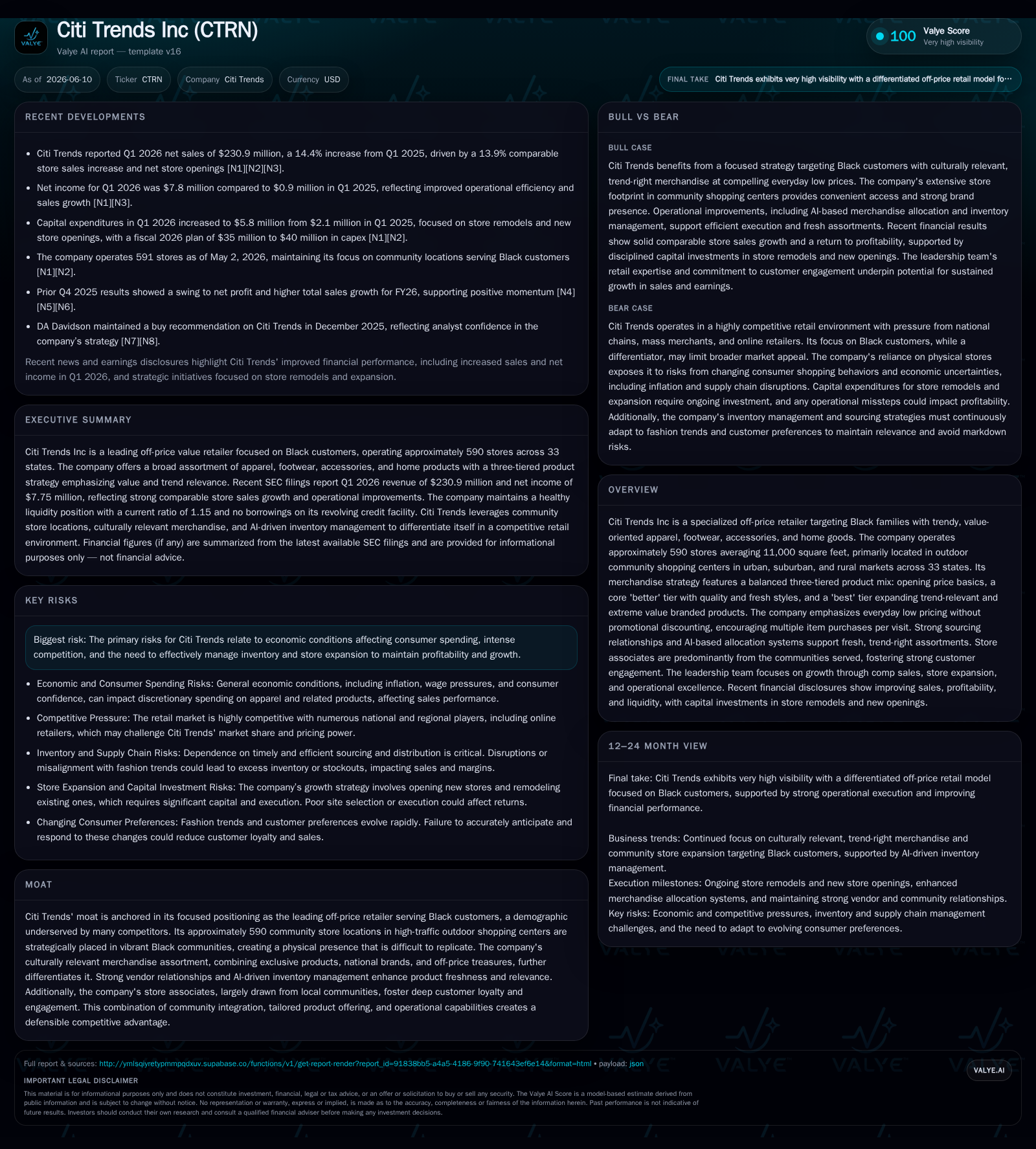
In its first quarter of fiscal 2026, Citi Trends posted a notable net income increase supported by strong comparable store sales growth of nearly 14% and an expanded store footprint with 591 locations. The company’s distinctive business model targets Black families through a three-tier product mix in strategically located community stores, complemented by everyday low pricing and an AI-driven inventory allocation system. These factors underpin a defensible moat built on community integration, culturally relevant merchandise, and technology-enabled operational efficiencies. Near-term growth is anchored by plans to open approximately 25 new stores and remodel 50 existing ones, balanced against risks from macroeconomic pressures and competitive intensity in off-price retail.
First Quarter Operating Performance: Gains Behind the Numbers
Citi Trends began fiscal 2026 with a strong quarter marked by a sharp rebound in profitability. Net income surged to $7.8 million in Q1 from just $0.9 million in the same period last year [S2]. This improvement was propelled by a solid 13.9% increase in comparable store sales coupled with a modest positive contribution from net store openings bringing total stores to 591. Net sales climbed 14.4% to $230.9 million as cost of sales grew slightly slower at 13.7%, enabling gross margin stability at around 60%. SG&A expenses rose by only 6.5% as a percentage of sales, aided by efficiencies partially offsetting higher payroll and incentive costs [S17]. Operating cash flow strengthened meaningfully to $20.9 million versus negative $11 million in prior-year Q1 [S4], providing the financial foundation for ongoing capital investments.
'Focused Footprint': Community Store Strategy as a Defensible Moat
The core of Citi Trends’ strategic edge lies in its deeply rooted presence within Black communities via a network of roughly 590 stores averaging about 11,000 square feet each [S1]. These stores are predominantly sited in high-traffic outdoor community shopping centers across urban, suburban, and rural markets in 33 states—markets often underserved by mainstream off-price retailers. This dense concentration fosters habitual loyalty among target customers who view the brand as culturally relevant while benefiting from convenience and familiar local associates who represent their communities. Such physical footprint density creates tangible switching costs and mitigates competitive incursions given the difficulty replicating these community ties [S1]. While peers like Ross Stores or TJX Companies operate larger footprints broadly, Citi Trends’ specific demographic focus cultivates defensible differentiation.
'Merchandising for Membership': Product Tiers and Customer Connection
Citi Trends employs a nuanced three-tier merchandise strategy designed to appeal to varying levels of customer price sensitivity while maintaining strong trend relevance [S1]. At the entry level are opening priced basics targeting budget-conscious shoppers; the core 'better' tier emphasizes quality with fresh styles comprising the bulk of inventory; and an expanding 'best' tier offers two distinct flavors—a growing assortment of trend-led apparel at steep discounts compared with specialty retail prices plus extreme value branded offerings at discounts ranging from approximately 50% to 75% off MSRP [S3]. This structure supports the company’s 'treasure hunt' shopping experience that resonates strongly with customers valuing discovery alongside value.
A key element supporting loyalty is Citi Trends’ everyday low pricing model eschewing traditional promotional discounts [S1, S3]. This transparent price positioning encourages customers to make multiple item purchases per visit without waiting for seasonal markdowns or coupons, stabilizing volume and simplifying inventory management.
'Technology as a Differentiator': AI in Inventory and Allocation Planning
Companies within the off-price sector increasingly rely on technology to tackle inventory complexity while preserving gross margin percentages; Citi Trends has systematically embedded AI tools into its merchandise planning ecosystem [S1]. The recent quarterly filings highlight continued rollouts of AI-based merchandise allocation systems that improve assortment freshness, optimize inventory turns, and regulate markdown cadence to minimize stock obsolescence [S3]. In fiscal 2026 management plans to complete upgrades incorporating AI-driven camera and facial recognition technologies aimed at loss prevention and operational efficiencies.
This strategic investment aligns with broader industry trends where digital transformation enhances decision-making on replenishment timing and store-specific assortment tailoring—critical levers for an off-price retailer managing diverse product tiers with fluctuating demand patterns.
'Bridging Growth with Caution': Expansion Plans Amid Market Risks
Citi Trends intends FY26 capital expenditures between $35 million and $40 million focusing primarily on opening approximately 25 new stores alongside remodeling about 50 existing ones [S5]. The expansion pace signals confidence supported by strong operating cash flows yet reflects prudence amid ongoing macroeconomic uncertainties including inflationary pressures, potentially volatile consumer sentiment, wage cost inflation, and supply chain disruptions cited explicitly as monitored risks [S2, S14].
While broadening store footprint can accelerate top-line growth, effective site selection within target communities remains paramount; missteps could dilute returns given seasonality effects on apparel sales compounded by weather sensitivities impacting foot traffic [S2]. The company’s challenge lies in balancing opportunistic capex deployment without overextending amid fluctuating market conditions.
'Navigating Competitive Off-Price Retailing': Peer and Sector Context
Within the competitive landscape of off-price apparel retailing—dominated by large-scale operators like TJX Companies or Ross Stores—Citi Trends distinguishes itself via focused geographic penetration into Black communities coupled with culturally tailored assortments that are less commoditized than typical off-price inventories [S1]. Its balanced merchandising tiers allow it to serve both bargain hunters seeking extreme value brands as well as those desiring trend-right styles unavailable through mass discounters.
Everyday low pricing further differentiates its go-to-market approach compared with peers relying more heavily on promotional markdown cadence or seasonal sales events. Additionally, integrating AI in inventory management intensifies efficiency gains not uniformly adopted industrywide yet vital given rapid fashion cycles.
These factors collectively position Citi Trends less as a generic discounter but more as a community-aligned off-price specialist optimizing targeted value propositions through operational rigor.
'Monitor Points': Execution Milestones & Macroeconomic Watchpoints Projections
Critical operational milestones over upcoming quarters include sustained comparable store sales momentum beyond Q1’s near-14% rise signaling underlying demand resilience [N1], successful ramp-up of new store openings without cannibalizing existing locations, rollout completion of AI-driven planning tools contributing positively to gross margin stability [N2], and realization of planned store remodels enhancing customer experience.
Externally, changes in consumer spending behavior influenced by inflation rates, wage pressures, housing costs, energy prices, and overall economic confidence should be closely tracked given their outsized impact on discretionary apparel purchases within the target demographic [S2]. Supply chain reliability also warrants vigilance given global disruptions remain unresolved across industries.
Financial Overview: Capital Allocation, Liquidity, and Profit Trends
The current ratio of about 1.15 reflects healthy short-term assets relative to liabilities supporting operations as of May 2026 [F1]. Operating cash flow generated during the quarter totaled $20.9 million compared with negative flows last year underscoring substantial improvement in working capital efficiency [S4].
Capital expenditures increased to $5.8 million for remodels plus selective expansion activity consistent with management’s full-year guidance for $35–40 million funding roughly 25 new location launches plus roughly 50 remodel projects aimed at rejuvenating the selling environment [S5]. Share repurchases were paused during this period as growth investments took precedence.
Overall profitability improved markedly from prior quarters owing primarily to higher gross profit facilitated by disciplined markdown control paired with effective expense leverage resulting in net income surpassing $7 million for Q1 FY26 compared with less than one million previously [S5]. This financial foundation supports cautious but deliberate reinvestment into core growth initiatives validating operations execution.
This analysis synthesizes public SEC filings up to June 10th, 2026 alongside recent earnings call disclosures reflecting Citi Trends’ position as a differentiated off-price retailer embedding community connectivity through targeted store footprint expansion and enhanced AI capabilities—the twin pillars sustaining its leadership within a specialized segment of value apparel retailing.
All data referenced adhere strictly to verified sources without extrapolation or estimation beyond disclosed figures.
Disclaimer: This is research-only, informational analysis and not investment advice. It may include AI-generated interpretation and general industry context. Always verify important details using primary sources.

Comments