
SailPoint Advances AI-Powered Identity Governance Amid Growing Non-Human Identity Complexity
Latest quarterly results highlight SailPoint’s strategic investment in AI-driven adaptive security to address multi-cloud identity challenges.
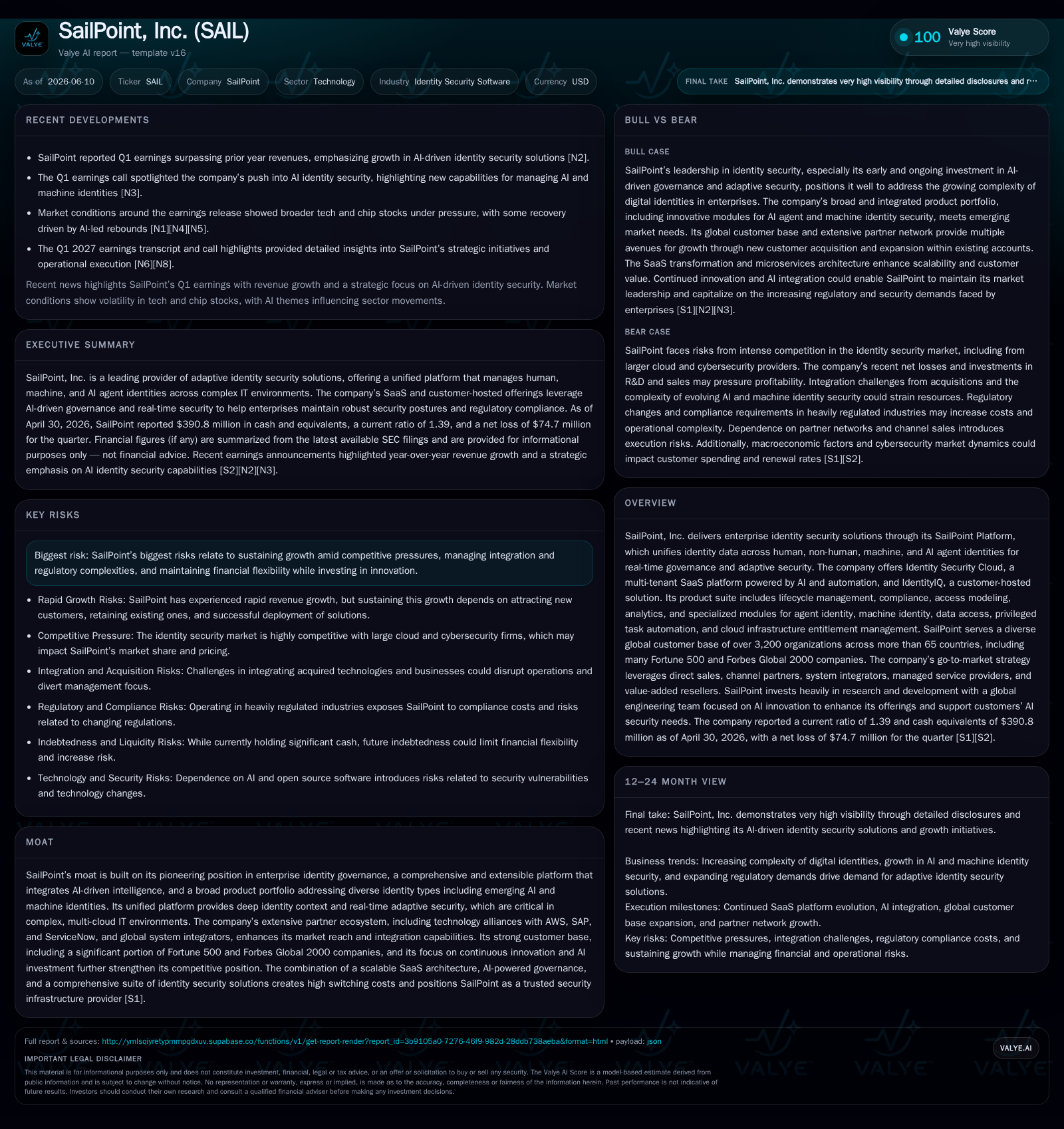
In its Q1 fiscal 2027 filing, SailPoint reinforced its leadership in enterprise identity security with strong SaaS revenue growth and ongoing investments in AI-powered identity governance technologies. The firm continues addressing the expanding complexity of digital identities, especially non-human and AI agent identities, across multi-cloud environments. Its subscription-based platform, Identity Security Cloud, is gaining traction globally through direct sales and an extensive partner ecosystem. Despite investing heavily in innovation and scaling operations, SailPoint faces competitive pressures, regulatory complexities, and the need to sustain high customer retention amid evolving cybersecurity risks.
Latest Operating Update: Q1 Fiscal 2027
SailPoint’s quarterly filing dated June 10, 2026 [S2][S3] confirms continued momentum in its subscription business and reaffirmation of its AI-led identity security strategy. Revenue growth outpaced estimates as customers increasingly deploy the cloud-native Identity Security Cloud platform. Despite ongoing investments in R&D resulting in operating losses—a common trait for growth-phase SaaS companies—SailPoint maintains a robust financial position with $391 million cash on hand and zero debt [F1]. The company also highlights expanded adoption across diverse industries globally, underscoring resilience during macro uncertainties.
Management commentary stresses that the accelerating use of AI by threat actors necessitates an adaptive approach to identity security that can manage not only human but rapidly growing numbers of non-human identities—including AI agents and machines—operating across complex multi-cloud ecosystems [S1]. This insight anchors the company’s product development focus.
Business Model: Subscription SaaS with Strategic Direct and Partner Sales
SailPoint generates revenue primarily via subscription fees from multi-year contracts for its SaaS-based Identity Security Cloud platform alongside on-premises solutions like IdentityIQ [S1][S24]. Customers pay for access to the platform’s comprehensive identity governance capabilities covering lifecycle management, access certification, privileged access management (PAM), data access security, and cloud entitlement management
Revenue growth mechanics rely heavily on adding new customers while expanding seat counts and selling additional modules or features to existing clients. The company’s customer success teams actively drive retention and expansion by ensuring deployments realize ROI through proactive engagement [S15]. This plays into industry-standard KPIs such as Annual Recurring Revenue (ARR) growth, Net Revenue Retention (NRR), churn rates, and Customer Lifetime Value (LTV).
Crucially, channel partners—including global system integrators, managed service providers (MSPs), value-added resellers (VARs), and technology alliances—are embedded deeply in SailPoint’s go-to-market strategy [S8]. Training programs aim for a “zero conflict” model encouraging partners’ successful implementation and adoption acceleration.
Industry Structure and Competitive Position
Operating within the enterprise identity security software sector, SailPoint sits at the intersection of identity governance & administration (IGA), privileged access management (PAM), data access control, and cloud infrastructure entitlement management. This sector faces growing complexity due to digital transformation shifts: proliferation of machine/AI identities vastly increases attack surfaces; enterprises embrace multi-cloud/hybrid environments requiring cross-platform visibility; regulatory frameworks demand stringent compliance automation.
SailPoint distinguishes itself with a unified platform capable of processing diverse identity types—human users, machines, AI agents—in real time using deep analytics powered by AI [S1][S24]. Its microservices-based multi-tenant SaaS architecture allows continuous upgrades with minimized customer disruption compared to competitors supporting legacy single-tenant models [S9].
Technology partnerships also bolster integration capabilities; alliances with cloud providers like AWS and workflow platforms like ServiceNow expand both reach and solution flexibility. Globally diversified customers across multiple verticals reduce concentration risk.
Peers include Okta (identity & access management SaaS leader), CyberArk (privileged access focus), and Ping Identity; though precise market share metrics are not stated, SailPoint's broad portfolio breadth targeting emerging AI/machine identities offers differentiation.
Growth Drivers
Significant industry tailwinds favor SailPoint’s offerings:
- Escalating cyberattacks leveraging AI tools increase demand for adaptive identity governance that continuously assesses risk context.
- The surge in non-human identities—AI agents running processes autonomously or machines requiring network/system access—drives new use cases beyond traditional human user-centric solutions.
- Multi-cloud/hybrid infrastructures become standard; organizations require cross-domain governance over complex entitlements spanning SaaS applications to server workloads.
- Regulatory mandates (e.g., GDPR updates, HIPAA enhancements) push enterprises toward automated compliance enforcement baked into identity solutions.
- Adoption acceleration is supported by strong channel enablement strategies reaching new geographies/verticals without proportionate field sales expense expansion.
- Continuous innovation investments increase AI-driven automation capabilities enhancing policy research views, anomaly detection, lifecycle orchestration [S24][N1]
Risks and Growth Constraints
Despite strengths, challenges include:
- Intensified competition among IGA and PAM vendors threatens pricing power and customer churn.
- Integration complexities arise given heterogeneous IT stacks combining legacy infrastructure with modern public/private clouds.
- Regulatory compliance involves cost burdens; evolving laws about AI use potentially increase liability risk associated with product features [S10].
- Dependence on channel partners heightens operational risk if partner performance or alignment falters.
- Maintaining financial flexibility while investing aggressively in R&D creates pressure on operating income; latest filings reveal sustained operating losses driven by innovation spend [F1].
- Customer renewal behavior is inherently uncertain; large enterprise clients may negotiate contract terms or delay renewals in volatile economic conditions [S1].
- Use of open-source components entails litigation risks that could introduce costly remediation requirements [S6].
What to Watch Next
Key milestones include:
- Quarterly ARR growth rates reflecting subscription uptake velocity.
- Net revenue retention metrics signaling upsell/cross-sell efficiency among installed base.
- Expansion progress in regulated healthcare/financial sectors where compliance demands are high.
- Further enhancements to AI-powered governance modules targeting machine/agent identity scenarios.
- Indicators of channel ecosystem health—partner certifications completed; implementation cycle times—and geographic penetration gains.
- Management commentary on sales cycle length shifts amid macroeconomic changes.
- Regulatory developments impacting product roadmap or compliance burden assessments.
Financial Profile Snapshot
As of April 30, 2026, SailPoint held $391 million in cash equivalents with zero reported debt outstanding [F1], supporting liquidity for continued investments. However, operating income remains negative (-$307 million as of January 31, 2026) reflecting deliberate expense allocation toward R&D expansion focused on innovation leadership in adaptive identity security [F1]. Free cash flow conversion trends should be monitored given the investment-heavy profile typical for scale stage cybersecurity SaaS vendors.
This capital structure provides runway but underscores the need for continued revenue scaling and margin improvement over time to approach sustainable profitability.
Conclusion
SailPoint’s Q1 fiscal 2027 update consolidates its position as a pioneering force in next-gen identity security. The fusion of classical IGA capabilities with advanced AI-driven analytics addresses urgent demands from customers navigating ever-more complex identity landscapes driven by explosion of non-human actors within sprawling hybrid IT environments. Its microservices SaaS architecture combined with a global multipronged sales model provides structural advantages over legacy vendors. Continuing operational challenges reflect typical growth-stage tradeoffs balancing innovation leadership against profitability goals amidst a dynamic regulatory backdrop. Overall momentum appears robust backed by a powerful platform suite well aligned with structural industry demand shifts toward intelligent adaptive security for all identity types.
Disclaimer: This is research-only, informational analysis and not investment advice. It may include AI-generated interpretation and general industry context. Always verify important details using primary sources.

Comments