
Build-A-Bear Workshop Capitalizes on Experiential Retail to Drive Customer Loyalty and Margin Resilience
Q1 2026 results highlight sustained revenue strength underpinned by franchise growth, supply chain shifts, and dynamic brand engagement amid macroeconomic pressures.
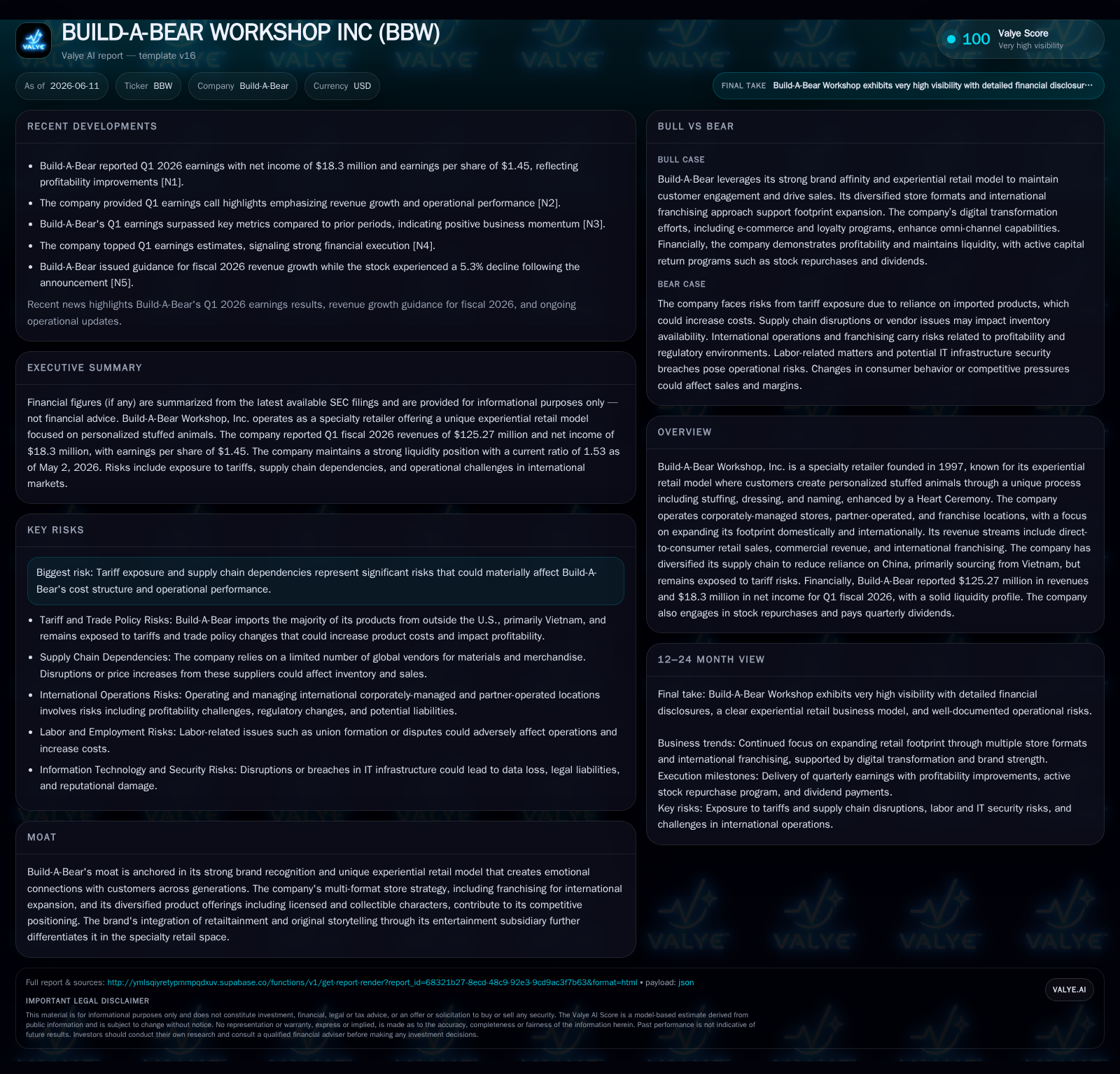
Build-A-Bear Workshop’s Q1 fiscal 2026 operating update reveals resilience in revenue and net income despite general economic uncertainties affecting discretionary spending. The company leverages its unique experiential retail model, combining customization and emotional connection, supported by a growing international franchise footprint and omnichannel expansion. Supply chain diversification from China to Vietnam mitigates tariff risks, although uncertainties persist regarding tariff refund timing. Growth is further propelled by licensed merchandise and retailtainment content that deepen customer engagement. Key risks include tariff exposure, consumer spending volatility, and challenges related to artificial intelligence integration.
Latest Quarterly Operating Update: Momentum Amid Macro Challenges
rward.
Experiential Retail Model Anchoring Brand Loyalty
At the heart of Build-A-Bear's business is its flagship experiential customization concept that allows consumers—primarily children but extending across generations—to create personalized stuffed animals via a hands-on process involving stuffing, dressing, naming, and culminating in the Heart Ceremony. This proprietary ritual enhances emotional attachment and brand affinity beyond traditional toy retailing paradigms [S1]. Such experiential retail fosters customer retention through repeat visits and word-of-mouth promotion while differentiating Build-A-Bear from mass-market competitors.
The direct-to-consumer (DTC) segment dominates revenue at approximately 90%+, encompassing corporately managed stores alongside its growing e-commerce platform that broadens omnichannel accessibility [S1][S22]. Licensed merchandise featuring popular characters complements custom offerings, increasing average ticket size through collectible appeal.
Multi-Format Franchise Footprint: Expansion Strategy in Action
Build-A-Bear strategically balances corporately operated stores with partner-operated franchises domestically and internationally to optimize capital deployment and expand geographic reach [S1][S2]. The international franchising segment grew its contribution sequentially in Q1 FY26 as the company deepened presence in Europe and other regions, facilitating access to diverse markets without incurring full operating costs typical for corporate stores.
This multi-format store strategy mirrors approaches by specialty retailers such as The LEGO Store which leverage franchising for global scalability while maintaining brand standards through controlled support systems. Franchise revenues foster scalability especially in higher-growth emerging markets where franchising proves more nimble compared with outright corporate store rollouts.
Supply Chain Diversification and Tariff Risk Mitigation
Tariff exposure historically linked to sourcing from China has prompted Build-A-Bear to diversify its supply chain primarily toward Vietnam suppliers—a move designed to reduce landed costs amidst uncertain U.S.-China trade dynamics [S2][S4]. The company successfully recorded an estimated $13.2 million receivable related to tariffs under the International Emergency Economic Powers Act (IEEPA) following favorable U.S. Supreme Court rulings earlier this year; of this, a $10.4 million benefit was booked in Q1 FY26 cost of goods sold along with inventory revaluation adjustments [S10][S25].
However, future cost pressures linked to existing tariffs on imports remain uncertain due to evolving trade policies including new tariffs announced outside IEEPA scope—the company notes this as an ongoing risk factor influencing gross margin stability.
Competitive Positioning Within Specialty Retail Peers
Build-A-Bear occupies a distinct niche within specialty experiential retail combining physical customization experiences with branded licensed merchandise backed by storytelling via its entertainment subsidiary. This model creates a moat bolstered by emotional connections akin to "American Girl" (Mattel), which similarly integrates brand affinity across generations through immersive product experiences.
Through international franchising models reminiscent of The LEGO Store’s global expansion tactics, Build-A-Bear scales its footprint while controlling capital costs. Its focus on curated product breadth coupled with "retailtainment" content fortifies differentiation against broader mass-market toy retailers.
Capital allocation priorities including share repurchases and dividend payments echo practices seen in branded specialty retail chains like Bath & Body Works where strong customer loyalty supports stable cash flow generation.
Growth Drivers: E-Commerce, Licensing, and Retailtainment
Expansion opportunities center on omni-channel sales penetration enhancement where digital platforms supplement physical store foot traffic — critical given sensitivity of mall-based venues to fluctuating consumer behavior [S1][S2]. In Q1 FY26, e-commerce sales contributed materially within the DTC segment aiding ticket size growth.
Licensed merchandise extensions leveraging popular intellectual properties augment collectible offerings attracting repeat buyers. Simultaneously, build-out of entertainment assets aims to weave narrative-driven retailtainment that can further deepen emotional engagement across age cohorts enhancing lifetime value.
Marketing initiatives targeting brand affinity improvement underpin efforts to boost repeat purchase rates and conversion efficiency—the company’s marketing ROI remains a key performance marker tied directly to revenue growth sustainability.
Risk Factors: Tariffs, Consumer Spending Swings, AI Integration
Multiple risk exposures necessitate close scrutiny: foremost is unpredictable discretionary consumer spending affected by inflationary environments which could constrain overall demand for non-essential experiential products [S2]. Coupled with this is lingering tariff uncertainty impacting cost structure—while refund progress provides relief on past tariffs, future duties could erode margins if supply chain adjustments lag policy shifts.
Additionally, evolving use of artificial intelligence within operations presents novel legal, reputational, data security risks alongside potential execution challenges that might impair customer engagement levels or competitive stance if not effectively integrated [S2].
Dependency on mall/store foot traffic inherently ties results partially to location-specific economic cycles while rapid shifts in consumer preferences require agile product development responsiveness.
What Investors Should Monitor Next
Key upcoming watchpoints include quarterly guidance updates reflecting any changes in discretionary spending trends; expansion metrics encompassing new franchise openings or corporate store growth potentially driving geographic revenue diversification; ongoing e-commerce penetration statistics monitoring channel mix shifts; marketing spend effectiveness gauged through ROI assessment; resolution timelines for outstanding tariff litigation or refund processes affecting inventory costing; as well as progress integrating AI technologies without incurring material disruption.
A transparent cadence on these milestones will offer directional insight into Build-A-Bear's capacity to navigate discretionary market volatility while leveraging its differentiated experiential model.
Financial Overview: Liquidity, Profitability, and Capital Allocation
As of May 2026 quarter-end, Build-A-Bear reported cash and equivalents totaling about $26.25 million alongside current assets near $147.8 million against current liabilities approximating $96.6 million yielding a solid current ratio near 1.53—a healthy liquidity position supportive of operating needs [F1][S2]
Gross profit margin improvement in Q1 FY26 reflected both favorable tariff refund impacts and continued productive cost management endeavors [S16], driving operating income before taxes close to $23.9 million versus last year's $22.9 million trend.
Capital returns continue via quarterly dividends coupled with opportunistic share repurchases consistent with noted board authorizations enhancing shareholder value over time.
This analysis synthesizes publicly available disclosures as of June 2026 without speculation beyond verified filings or credible news sources. It aims to provide foundational insights into Build-A-Bear Workshop’s operating model dynamics within the specialty experiential retail sector context.
Disclaimer: This is research-only, informational analysis and not investment advice. It may include AI-generated interpretation and general industry context. Always verify important details using primary sources.

Comments