
Cross-Border Strategy and Liquidity Strength Define Twelve Seas Investment Co III’s Path Forward
Twelve Seas Investment Co III maintains strong liquidity and leverages extensive cross-border expertise as it pursues a critical business combination deadline by late 2027.
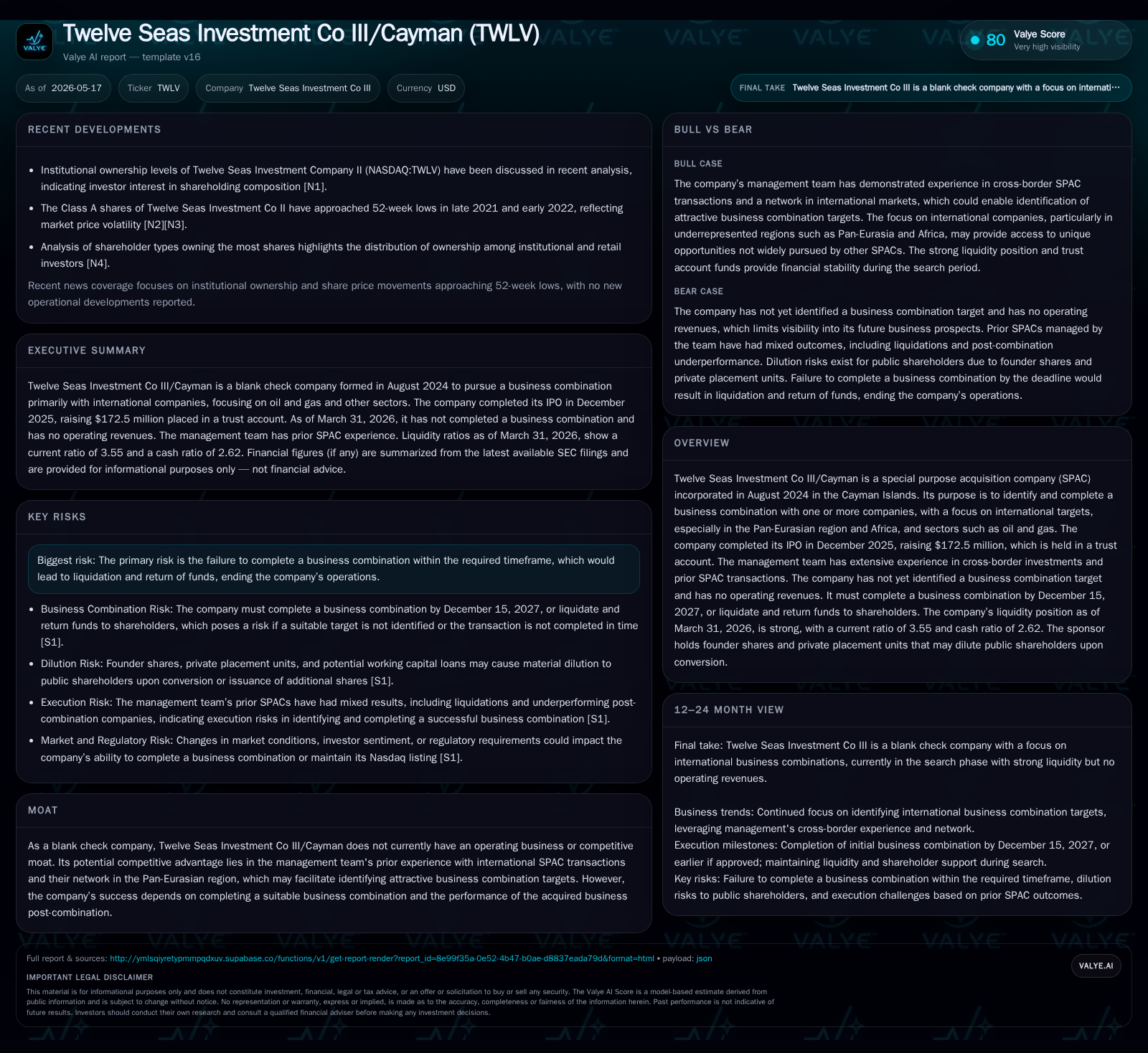
In its latest quarterly filing dated May 15, 2026, Twelve Seas Investment Co III reaffirmed its stable financial position while continuing the search for an international business combination target. With no operating revenues to date, the SPAC’s core value lies in its liquidity—more than $495,000 in cash—and its management's deep experience in Pan-Eurasian and African markets. The company faces a structural deadline to complete a deal by December 15, 2027, or face liquidation. Industry trends in cross-border SPAC deals and regulatory complexities frame both opportunities and risks for this blank check vehicle moving forward.
Latest Operating Update: Stability Amid Waiting
Twelve Seas Investment Co III’s May 15, 2026 quarterly filing ([S2]) underscores a status quo operational picture: no announced business combinations or definitive merger targets have emerged yet. This inert transactional state is typical for blank check companies early post-IPO but gains significance given the finite timeline to complete a deal by December 15, 2027. Financially, the company holds firm footing with $495,520 in cash and equivalents as of March 31, 2026 ([F1]), backed by a robust current ratio of 3.55 reflecting liquid current assets over liabilities. This solid liquidity profile enables Twelve Seas to sustain administrative operations and due diligence activities while remaining primed for target evaluation or acquisition steps. The absence of new risks flagged also signals operational discipline in navigating this pre-combination phase without incurring material adverse developments ([S2]).
Business Model and Acquisition Mandate
Operating as a Cayman Islands exempted special purpose acquisition company (SPAC), Twelve Seas Investment Co III’s core model revolves around aggregating capital via an IPO ($172.5 million raised December 2025) held in trust until deployed through an initial business combination ([S1]). This structure creates a risk-mitigated framework where shareholders effectively invest in the management team’s ability to identify compelling overseas acquisition candidates rather than direct operating revenues or product sales—which do not exist for TWLV at this stage. The company intends to focus acquisitions outside the U.S., primarily targeting mature profitable enterprises in sectors like oil and gas where management believes value creation potential exists through disciplined buyout, operational improvements, or strategic growth initiatives ([S1]). Private placement units augment sponsor capital alignment but await conversion contingent on transaction completion.
Revenue growth under this model translates into realized value post-business combination when the acquired enterprise generates cash flows; pre-combination, revenue metrics are irrelevant as no commercial operations exist. The SPAC operates principally on managing the trust account prudently while scouting viable targets that fit their geographic and sector criteria before the mandated deadline compels either deal closure or liquidation—a defining structural limiter shaping strategic urgency.
Management Experience and Strategic Network
A distinguishing strategic asset for TWLV resides in its executive leadership’s extensive cross-border investment pedigree. CEO Dimitri Elkin alongside CFO Jonathan Morris spearhead efforts informed by prior successful SPAC engagements and deal executions spanning Pan-Eurasia to Africa ([S1]). The board further reinforces this capability with independent directors such as Julian Vickers, Bob Foresman, Greg Nelson, and Olga Klimova who carry deep experience investing internationally across diverse geographies ([S1]). This collective expertise fosters access to potential pipeline targets including sovereign wealth funds, family offices, global industrial conglomerates with non-U.S. shareholding structures—entities typically less penetrated by traditional U.S.-centric private equity.
Such relationships provide not merely sourcing advantages but potentially enable enhanced due diligence insights on regulatory environments and local market dynamics which often present complexity in cross-border transactions. While TWLV lacks operating revenues or product lines creating recurring customer lock-in pre-merger, its differentiated approach rests on the strategic alignment of experienced sponsors with global networks primed to execute sophisticated acquisition strategies amid complex geopolitical terrains.
Industry Context: SPAC Trends and Cross-Border Deal Dynamics
Within the broader ecosystem of special purpose acquisition companies, TWLV’s positioning illustrates salient themes shaping SPAC investor appetite today. While SPAC issuance had peaked earlier this decade domestically, cross-border targets remain underserved yet attractive for sponsors seeking diversification beyond overheated U.S. sectors.
Challenges persist around heightened regulatory scrutiny from multiple jurisdictions extending deal timelines and complicating disclosures necessary under foreign listing standards post-business combination.
Valuation difficulties arise given disparate accounting standards and less publicly available information on private foreign entities targeted in Pan-Eurasia or Africa; these factors tend to compress sponsor incentives requiring negotiated PIPE (private investment in public equity) rounds concurrent with deals to bridge funding gaps while signaling credibility to public shareholders. TWLV must therefore navigate a nuanced sponsor-investor alignment balancing the cost of time-sensitive deadlines against securing accretive transactions that withstand global market volatility pressures.
Growth Drivers: Target Sectors and Geographic Reach
TWLV's indicated focus sectors primarily include oil and gas alongside proven industries validated through management’s historical investment track record ([S1]). These sectors benefit from ongoing demand resilience influenced by global energy consumption patterns despite intermittent price swings driven by geopolitical conflicts or transition policy debates.
The company’s geographic emphasis on Pan-Eurasian markets opens access to resource-rich economies complemented by evolving regulatory frameworks favorable for inbound capital investments.
Key Risks and Constraints: Timeframes and Market Volatility
The defining constraint facing TWLV is the hard deadline imposed by SPAC regulations mandating completion of an initial business combination by December 15, 2027 ([S1][S2]). Failure triggers mandatory liquidation—returning funds to shareholders minus operational costs—and termination of the enterprise without return beyond cash escrow balances adjusted for expenses incurred.
Secondary risks encompass market volatility impacting deal pricing pulses especially amid geopolitical tensions impacting targeted regions; such fluctuations can deter sellers demanding premium valuations or delay negotiations subject to shifting currency risk parameters.
Regulatory hurdles spanning multiple jurisdictions introduce uncertainty regarding transaction approvals or timing which may compress Sponsor flexibility amid a shrinking time window. The lack of operating revenues also means that TWLV depends entirely on capital deployment outcomes rather than organic income streams limiting any margin of error during this critical phase.
Monitoring Signals: Milestones and Market Indicators
Key signals warranting investor attention include formal announcements identifying one or more definitive business combination targets accompanied by detailed term sheets reflecting valuation expectations ([S2][S1]). Successive PIPE funding arrangements would confirm external investor confidence necessary to supplement trust account proceeds ensuring transaction completion capability.
Regulatory clearance updates within targeted jurisdictions serve as barometers for anticipated closing timelines given cross-border deal complexity. Changes in sponsor ownership stakes or management composition could signal shift in strategic priorities affecting deal execution tempo.
Collectively these markers offer practical insight into TWLV’s progression from capital aggregation vehicle toward an operating entity forged through successful integration of acquired businesses.
Financial Overview: Cash Reserves and Capital Structure
As of March 31, 2026 ([F1]), Twelve Seas Investment Co III held approximately $495K in cash balanced against current liabilities near $189K resulting in a current ratio around 3.55—a healthy liquidity cushion well above minimum coverage thresholds typical for SPACs in early post-IPO stages ([F1]). Total debt remains minimal at approximately $60.5K from prior periods compared against substantial cash demonstrating negligible leverage exposure ([F1]).
This fiscal posture underscores prudent treasury stewardship preserving capital primarily allocated within trust accounts pending deployment against eligible business combinations ([S2]). Such disciplined financial management ensures adequate runway supporting continued operating costs related to target search efforts without jeopardizing fiduciary obligations toward public shareholders prior to transaction consummation.
This analysis relies exclusively upon information sourced from Twelve Seas Investment Co III/Cayman's recent SEC filings complemented by sector-specific contextual insights relevant to international special purpose acquisition companies without making speculative assumptions about unrevealed data points.
Disclaimer: This is research-only, informational analysis and not investment advice. It may include AI-generated interpretation and general industry context. Always verify important details using primary sources.

Comments