
CV Sciences Battles Regulatory Shifts While Leaning on +PlusCBD™ and Plant-Based Growth
CV Sciences’ latest quarterly update highlights revenue pressures amid evolving hemp regulations, balanced by brand leadership and new product expansion.
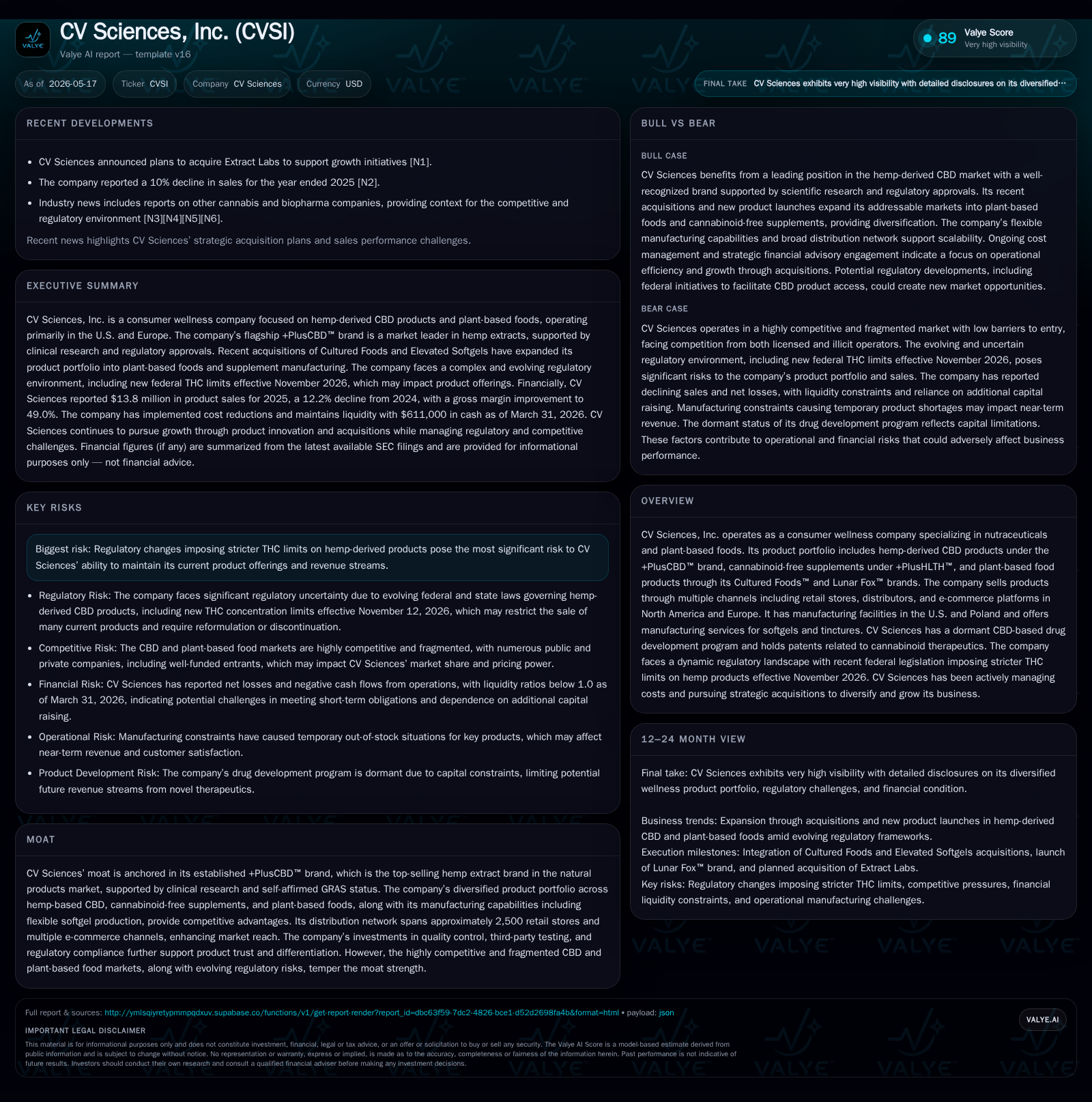
In the first quarter of 2026, CV Sciences, Inc. reported continued challenges tied to regulatory headwinds and softer sales volumes, with product revenues declining due to market contraction and stricter THC limits scheduled for late 2026. The company’s core +PlusCBD™ brand remains the top hemp extract line in natural products retail, buttressed by clinical research and GRAS certification, while recent acquisitions in plant-based foods and softgel manufacturing diversify its portfolio. Industry fragmentation and the pending federal hemp regulations create uncertainty, making strategic cost management and new product innovation critical to sustaining growth. Financially, CV Sciences maintains modest leverage with a current ratio slightly below 1.0 but carries negative operating cash flow, underscoring capital raising needs.
Recent Operating Update: Q1 2026 Context
CV Sciences disclosed its latest operating metrics in the May 15, 2026 Form 10-Q [S2], building on a recent event filing dated May 14 [S3]. The disclosures confirm continued softness in product sales driven primarily by lower volumes rather than pricing shifts. This marks an ongoing trend from the full year ended December 31, 2025 where net product sales fell by roughly 12% compared to prior year levels [S1][S23]. Despite this top-line pressure, gross margins improved from ~45.6% to ~49% by year-end through production efficiencies including reduced shipping costs and refined manufacturing processes [S21].
At the same time, federal legislation passed in late 2025 sets a new THC limit threshold of no more than 0.4 milligrams per container starting November 13, 2026 [S7]. This presents a clear strategic constraint that compels CV Sciences to assess reformulation needs or product repositioning across its hemp-derived portfolio — especially as products compliant under this rule currently make up only a small share of total market offerings. The company is actively evaluating operational impacts related to raw materials sourcing, supply chain adjustments, labeling revisions, and regulatory compliance measures [S7].
Cost reduction initiatives have rolled out ongoing workforce resizing and vendor spending scrutiny alongside a pause on certain R&D efforts including for its dormant drug candidate CVSI-007 program [S10][S7]. These moves underscore management’s prioritization of achieving an efficient consumer products platform amidst external headwinds.
Business Model Overview
CV Sciences derives revenue from developing, manufacturing, marketing, and selling consumer wellness products centered on nutraceuticals and plant-based foods [S1]. Its core revenue generator has historically been hemp-derived CBD products sold under the +PlusCBD™ brand — recognized as the top-selling hemp extract line within natural products retail channels based on SPINS data [S1]. This flagship brand benefits from proprietary clinical research validating benefits for healthy users plus the self-affirmed GRAS status which helps differentiate it in a commoditized CBD landscape.
The company offers diversified product lines:
- +PlusCBD™: Includes softgels, tinctures, topicals, gummies targeting general consumer wellness.
- +PlusHLTH™: A newer cannabinoid-free supplement range focused on optimized health formulations launched in 2024 [S24].
- Cultured Foods™: Acquired December 2023 subsidiary based in Poland producing European-distributed plant-based protein foods aimed at vegan/gluten-free demographics.
- Lunar Fox™: A U.S.-market focused plant-based brand launched January 2025 offering shelf-stable natural foods with flexibility to address flexitarian consumers interested in healthier alternatives.
Manufacturing capabilities expanded through May 2024 acquisition of Elevated Softgels LLC — providing encapsulated softgel production facilities domestically in Colorado which caters to CBD as well as broader supplement industries [S1][S24]
Revenue is generated through multiple channels including approximately 2,500 brick-and-mortar stores primarily distributed B2B along with direct-to-consumer e-commerce platforms both in North America and Europe [S14]. The diversified channel strategy aids reach but also requires balancing scale efficiencies across different customer bases.
Industry Structure and Competitive Position
The hemp-derived CBD market remains intensely competitive with low barriers to entry compounded by murky federal regulatory frameworks causing wide variation at state levels [S1][S25]. Pressure emerges not only from licensed operators but also unregulated market participants complicating customer loyalty dynamics.
CV Sciences’ moat centers around brand equity of +PlusCBD™, bolstered by science-backed credibility rarely matched by competitors who often compete primarily on price or informal claims. Its commitment to quality assurance protocols includes rigorous third-party ISO certified lab testing at ingredient receipt through final product release plus adherence to FDA-level Good Manufacturing Practices (GMP) guidelines enhancing trustworthiness amidst consumer skepticism [S13].
Competitors range from vertically integrated multi-state cannabis firms (where applicable) to specialized supplement producers lacking pharmaceutical-grade research backing. Peer comparisons indicate CV Sciences’ strength lies within its blend of clinical validation combined with flexible manufacturing through Elevated Softgels — enabling rapid innovation cycles for new dosage forms. However, fragmentation persists owing to fast-evolving regulation impairing scale consolidation.
Growth Drivers
Brand Extensions & New Products
Nearly 40% of net revenue achieved during calendar year 2025 came from new products launched since January 1, 2023 across its four key brands — demonstrating emphasis on pipeline refreshment that targets emergent consumer preferences including cannabinoid-free supplements (+PlusHLTH™) and plant-based foods (Cultured Foods™, Lunar Fox™) [S21][S14]
Geographic Expansion & Channel Diversification
Cultured Foods anchors European distribution expansion into natural plant-protein segments where demand is structurally trending upward due to dietary shifts toward veganism or flexitarianism. Lunar Fox’s U.S. launch aims at tapping similarly growing retail interest in shelf-stable plant-based snacks serving health-conscious consumers broadly [S14]. Continued penetration across both B2B retail partners plus digital commerce platforms provides multiple revenue levers.
Manufacturing Capacity & Efficiency Gains
Ownership of Elevated Softgels enhances operational control over critical softgel production associated with CBD oils as well as other nutraceuticals responsive to shifting consumption patterns [S13][S21]. This vertical integration not only improves gross margins but accelerates time-to-market for product innovations requiring encapsulation technology distinctiveness
Regulatory Evolution & Medicare Prospects
While existing regulatory risks are material downsides (discussed below), potential federal progress such as Medicare coverage proposals for hemp-derived CBD starting possibly April 2026 could open new reimbursement pathways that significantly expand demand if adopted at scale [S25]. However details remain sparse creating near-term uncertainty
Risks / Watchpoints / Growth Constraints
- Federal THC Regulation Compliance: The November 2026 mandated reduction in permissible THC content per container threatens substantial reformulation costs or revenue loss since many current products exceed these limits. This restricts product line flexibility until compliance is demonstrated [S7].
- High Market Fragmentation & Competition: Low barriers encourage entrants eroding pricing power; illicit operators exacerbate margin compression requiring sustained brand investment just to protect share [S1].
- Liquidity Pressures: Current ratio near parity (~0.96) with negative operating cash flows highlight ongoing funding needs for working capital expansion or acquisitions needed for growth acceleration; refinancing risks exist without guaranteed capital access [F1][S2][S3].
- Patchwork State Regulations: Differing state restrictions create complexity in distribution planning—as California’s emergency orders restricting detectable THC remain extended—limiting sale ability within key markets affecting certain products adversely [S8].
- Dormant Drug Development Program: The CVSI-007 cannabinoid-based therapeutic project is currently inactive due to funding difficulties reducing optionality from higher-margin pharma opportunities despite holding cross-border patents [S10].
- Supply Chain Concentration: While global sourcing strategies exist with European/U.S growers secured, trade tariff fluctuations impacting Chinese components used may cause cost uncertainties requiring mitigation strategies such as price adjustments or alternative supplier development [S1].
What To Watch Next
- Progress on formulation changes ahead of November 2026 federal THC threshold enforcement — milestone signposts include regulatory filings/notifications or launch of compliant variants.
- Sales trajectory trends in Q2/Q3 fiscal quarters post first-quarter update indicating recovery versus continuing volume declines.
- Expansion success metrics related to Cultured Foods European footprint scaling and Lunar Fox U.S. retail acceptance indicated by distributor agreements or repeat orders.
- Cash flow improvements or additional capital raises to support operating liquidity given suboptimal current ratio.
- Further strategic acquisitions or divestitures as guided by Maxim Group advisory engagement aimed at optimizing the consumer wellness platform.
- Timing/details from CMS Medicare coverage pilot programs for hemp-derived CBD influencing long-term demand fundamentals.
Financial Profile Snapshot
As of March 31, 2026 balance sheet figures show total debt approximates $72,000 against cash buffers derived from prior periods suggesting modest net debt negativity of approximately $539,000 while current assets stand at roughly $5 million offset by liabilities near $5.18 million yielding a current ratio slightly below one (0.96) [F1]. Full year ended December 31, 2025 financials manifested negative operating cash flow near $0.4 million alongside an accumulated deficit exceeding $87 million reflecting sustained losses since inception though net loss reduced compared prior years largely through expense controls [S1][S5][S6]. Gross margin improvement approaching half is notable relative to industry peers who often operate compressive pricing environments with more volatility.
CV Sciences continues working toward positive adjusted EBITDA through mix shift into higher margin categories like softgels/plant-based foods combined with cost discipline efforts highlighted in recent filings while maintaining readiness for regulatory-driven portfolio transitions necessitating capital flexibility.
This analysis reflects information publicly available as of May 15–17, 2026 drawn directly from SEC filings cited herein without expressing investment opinions or forecasts. Readers should consider official filings for comprehensive details before forming conclusions about CV Sciences’ business prospects or financial condition.
Disclaimer: This is research-only, informational analysis and not investment advice. It may include AI-generated interpretation and general industry context. Always verify important details using primary sources.

Comments