
Credo Technology Strengthens AI-Driven Connectivity with Acquisition and Expanded Portfolio
Credo reports robust fiscal 2026 growth driven by proprietary SerDes innovations and new DustPhotonics acquisition, amid customer concentration risks.
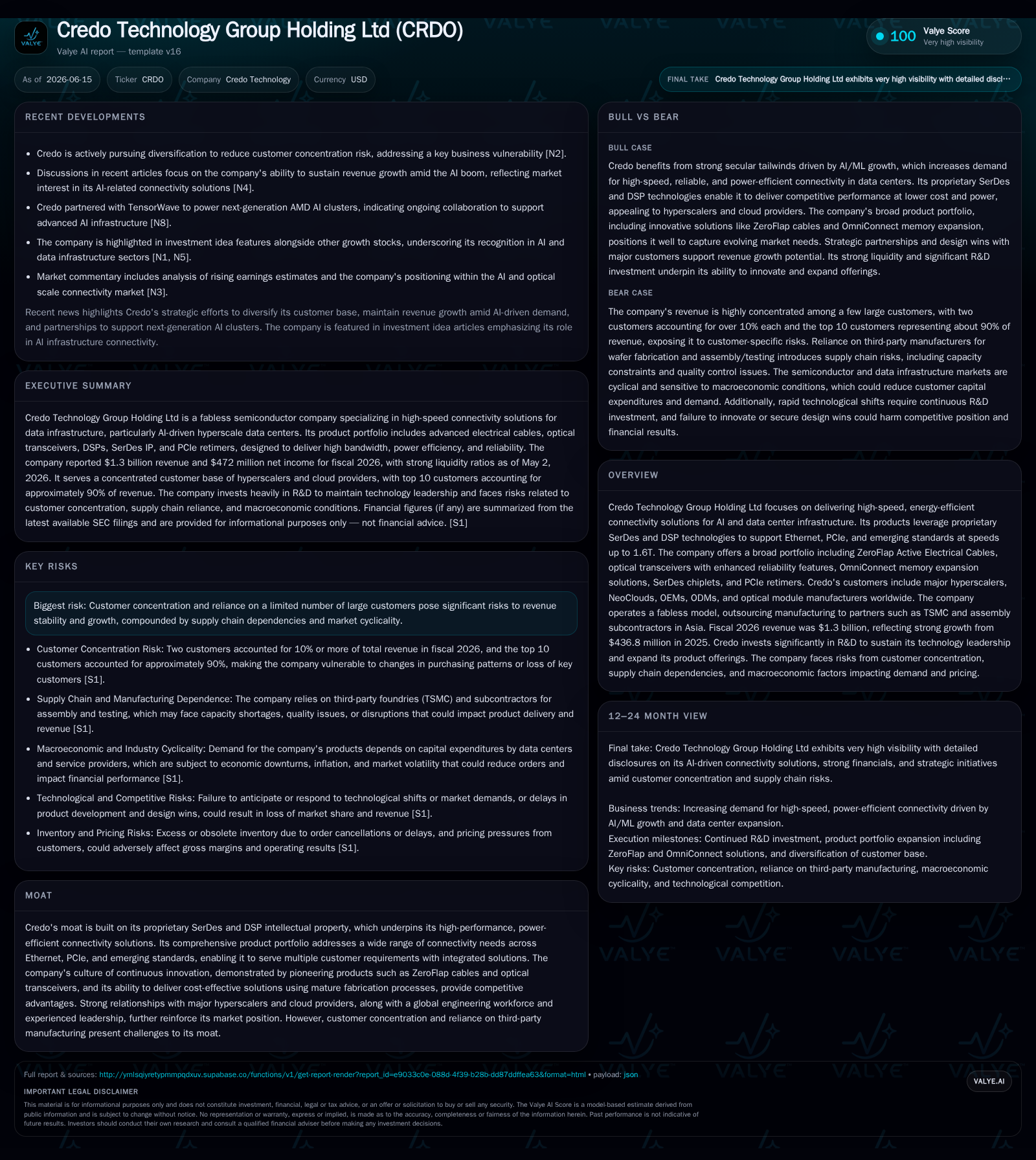
In its latest quarterly and annual filings, Credo Technology Group Holding Ltd demonstrated strong fiscal 2026 growth, propelled by rising demand for high-speed, energy-efficient connectivity solutions in AI and data center infrastructure. The company's fabless semiconductor model focuses on proprietary SerDes and DSP technologies enabling innovative products such as ZeroFlap Active Electrical Cables and optical transceivers. Credo's recent acquisition of DustPhotonics signals strategic expansion into optical interconnects to better serve hyperscalers and NeoCloud customers, though concentration on a few large clients and supply chain dependencies remain key risks. Growth is driven by escalating AI workloads, bandwidth needs, and advanced standards adoption, with ongoing investment in R&D and customer engagement critical to sustaining technology leadership.
Recent Operating Update
The June 1, 2026 event filing also confirmed reaffirmation of the company’s robust operational execution alongside detailed financial disclosures demonstrating improved operating cash flows and solid balance sheet liquidity supporting ongoing R&D investments [S3][F1]. These developments emphasize Credo’s multi-pronged strategy to deepen technology integration capabilities while expanding scale in performance-critical segments.
Business Model Overview
Credo operates as a fabless semiconductor company specializing in designing proprietary high-speed Serializer/Deserializer (SerDes) integrated circuits and Digital Signal Processors (DSPs) that underpin its differentiated connectivity solutions for AI-centric data centers and cloud providers. Its revenue stems from sales of physical hardware such as ZeroFlap Active Electrical Cables (AECs), optical transceivers enhanced for reliability via zero-flap technology, memory expansion solutions under the OmniConnect brand, PCIe retimers, SerDes chiplets plus licensing IP tied to its core SerDes designs [S1][S15]
This model capitalizes on leveraging advanced signal processing IP coupled with innovative hardware implementations optimized for power efficiency—an imperative for data center deployments handling extreme bandwidth demands while managing thermal constraints. By outsourcing wafer fabrication primarily to TSMC and assembly/testing to subcontractors in Asia, Credo maintains a focused cost structure emphasizing design differentiation over capital-intensive manufacturing [S1][S15].
The PILOT software platform adds another dimension through real-time telemetry enabling predictive integrity checks that minimize link failures (“link flaps”) which are costly disruptions in hyperscale networks. This generates value beyond physical product sales by enhancing system uptime—importantly addressing reliability challenges endemic to commodity interconnect systems [S1][S15]
Industry Structure and Competitive Position
Credo operates within the highly specialized subset of the semiconductor market encompassing data center interconnectivity where key competing dynamics revolve around power-performance trade-offs at ultra-high signal rates over copper and optical media. Its competitive moat is anchored in decades of proprietary SerDes/DSP IP enabling power-efficient implementations at speeds up to 1.6 Terabits per second.
The company serves a concentrated customer base dominated by hyperscalers and emerging NeoCloud operators who dictate rigorous technical specifications across Ethernet (including 400G+), PCIe Gen5/6 lanes, as well as nascent protocols like UALink that demand tight integration across system levels. Credo’s ability to field broad portfolios spanning electrical cables (AECs), optical transceivers featuring noise-tolerant PAM4 DSP modulation techniques, memory expansion interposers, alongside active retimers places it favorably against incumbents that may focus on narrower chip-only or cable-only products.
While large fabless peers such as Broadcom or Marvell also participate in these segments, Credo’s emphasis on low-cost legacy process nodes combined with high-value-added system-level innovation (like ZeroFlap technology) positions it uniquely within hyperscaler procurement ecosystems that prize both cost containment and operational reliability.
Customer relationships translate into embedded designs that often cascade down supplier tiers including OEMs/ODMs producing rack-scale systems leveraging Credo’s solutions. However, the dependence on a few primary customers intensifies exposure risk—a structural hallmark of this segment given the dominance of mega cloud operators who control volume flows.
Growth Drivers
Several macro trends underpin deeply structural growth prospects:
- AI/ML Workload Explosion: AI model parameter counts escalating into trillions drive enormous interconnect bandwidth requirements at low latency across front end servers through scale-out clusters.
- Hyperscale Data Center Expansion: Continuous buildout of cloud infrastructure globally augments volume demand for high-speed connectivity components tailored for energy efficiency.
- Technology Migration: Transition from established Ethernet speeds toward higher-speed variants (e.g., from 100G to multiple lanes at 400G or beyond) necessitates next-gen SerDes/DSP silicon plus new cable/transceiver form factors.
- Integrated System Solutions: Customers increasingly seek holistic offerings combining active cables with embedded retimers plus telemetry software platforms offering differentiated uptime guarantees.
- Emerging Applications: Memory extension (OmniConnect) and scale-in networking further broaden total addressable market beyond traditional front-end compute links.
These drivers manifest quantitatively via KPIs such as per-lane Gbps throughput gains coupled with steady improvements in power consumption per bit transmitted—areas where Credo underscores its competitive strengths through ongoing R&D expenditure highlighted in filings [F1][S1].
Risks and Growth Constraints
Despite robust momentum there are salient risks shaping execution:
- High Customer Concentration: Two customers each contributed >10% of revenue in fiscal 2026; top ten accounted for ~90%. Loss or reduced purchases from any could materially disrupt revenues given lack of long-term minimum purchasing commitments [S1][S15].
- Order Variability: Sales made predominantly on purchase order basis allow customers cancellation or deferral with limited penalty causing volatile quarter-to-quarter bookings.
- Supply Chain Dependencies: Reliance on third-party foundries (TSMC) and assembly subcontractors introduces exposure to capacity constraints or geopolitical disruptions affecting delivery timelines.
- Rapid Innovation Needs: Sustaining technology leadership requires substantial continuous R&D investment amid aggressive competitor efforts possibly eroding technological gaps.
- Regulatory Environment: Export controls particularly concerning sales into key Asian markets introduce compliance costs plus risk of restricted market access impacting revenue sources.
- Market Cyclicality: Data center capex cycles may cause temporary fluctuations in order patterns reflective of broader IT spending trends.
Key Watchpoints
Investors following Credo should monitor:
- Quarterly sales trends reflecting hyperscaler purchasing cadence changes post AI-driven expansions.
- Integration progress and cross-selling potential accruing from DustPhotonics acquisition expanding optical product mix.
- Timing for new product releases aligned with PCIe Gen6 adoption or next-gen Ethernet standards rollout.
- Updates regarding efforts toward mitigating customer concentration through diversification or contract structuring.
- Operational metrics covering manufacturing yield improvements alongside reduction in link flap incidents validating PILOT platform benefits.
- R&D spend trajectory sustaining innovation pipeline crucial for maintaining differentiated serdes/dsp advantages.
Financial Profile Briefly Contextualized
This financial footing supports technical investments that underpin ongoing innovation cycles essential to sustain competitiveness against larger industry peers while managing risk concentrations inherent to hyperscale-driven markets.
Disclaimer: This analysis presents factual operating context based on publicly filed SEC documents without investment research views.
Disclaimer: This is research-only, informational analysis and not investment advice. It may include AI-generated interpretation and general industry context. Always verify important details using primary sources.

Comments