
Sentient Brands Leverages Acquisition Strategy and Exclusive Licensing Amid Liquidity Challenges
Recent quarterly filings highlight Sentient Brands’ acquisition-driven growth and operational integration within a competitive consumer packaged goods landscape.
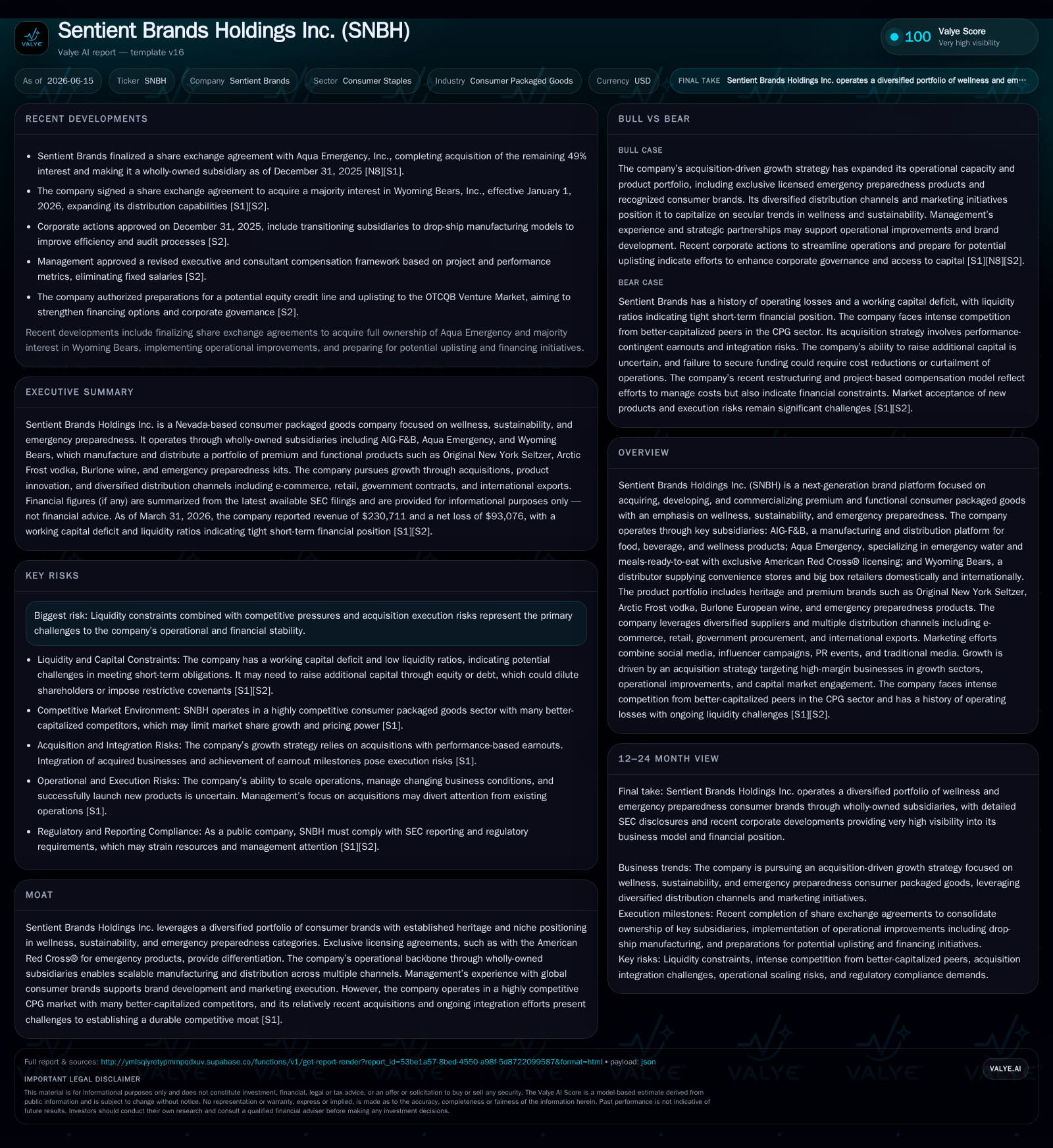
Sentient Brands Holdings Inc. (SNBH) is advancing its strategy of building a premium and functional consumer packaged goods platform through acquisitions and exclusive licensing deals, most notably with the American Red Cross for emergency preparedness products. The latest 10-Q confirms ongoing operational integration of key subsidiaries and highlights leadership transitions that affect execution risk. While SNBH’s diversified brand portfolio taps secular growth trends in wellness and sustainability, liquidity constraints and competitive pressures weigh heavily on the company’s path toward profitability. Its multi-channel distribution across e-commerce, wholesale, retail, and government contracts underpins growth opportunities, but material risks emerge from early-stage operating history and capital structure limitations.
Recent Operating Update
Sentient Brands Holdings Inc. (SNBH) filed its latest quarterly report (Form 10-Q) on May 14, 2026 [S2], providing updates on the ongoing integration of critical subsidiaries acquired in late 2025. A significant leadership development was the resignation of Interim CEO George Furlan effective April 24, 2026 [S3], introducing potential instability as the company executes its acquisition-driven expansion strategy. The company is actively transitioning major operating units—AIG-F&B (manufacturing platform), Aqua Emergency (emergency preparedness), and Wyoming Bears (distribution)—into wholly-owned subsidiaries to streamline operations and strengthen control [S1][S8].
The latest filings emphasize Sentient Brands’ focus on scaling its manufacturing and distribution infrastructure via these acquisitions while pursuing product innovation aligned with wellness, sustainability, and emergency preparedness categories. The company continues to explore unlocking operational leverage through moving to a drop-ship fulfillment model aimed at reducing inventory on subsidiary balance sheets and simplifying audit processes, reflecting an effort to improve margin profiles and working capital management [S16][S27]
Business Model
Sentient Brands operates as a next-generation CPG platform primarily generating revenue by acquiring, developing, and commercializing branded consumer products through a combination of wholly-owned subsidiaries that handle manufacturing, distribution, and retail partnerships [S1][S20]. Its flagship subsidiaries include:
- AIG-F&B: Manufactures food, beverage, shelf-stable nutrition products serving brands like Original New York Seltzer and Arctic Frost vodka.
- Aqua Emergency: Specializes in emergency water supplies and meals-ready-to-eat (MREs), holding exclusive licensing rights from the American Red Cross®, targeting government agencies and institutional distributors.
- Wyoming Bears: A specialized distributor servicing convenience stores and big-box retailers both domestically and internationally.
Revenue mechanics revolve around product sales through direct-to-consumer e-commerce platforms, wholesale partnerships with large retailers, government procurement contracts for emergency products, and export channels. Pricing power derives from the premium positioning of certain brands (e.g., Arctic Frost vodka) and exclusivity agreements such as the American Red Cross® licensed product line [S20]. The company emphasizes product quality standards ensuring shelf stability, regulatory compliance, and consumer appeal—a critical necessity given the nature of emergency supplies.
Operationally, SNBH depends on diversified supplier networks for raw materials and packaging but leverages internal manufacturing capabilities via AIG-F&B to sustain supply chain control. Distribution channels span omnichannel retailing: e-commerce accelerates direct sales growth while wholesale tie-ins facilitate broad market penetration across traditional brick-and-mortar outlets [S20]
Industry Structure & Competitive Position
SNBH participates within the highly fragmented Consumer Packaged Goods (CPG) industry characterized by intense competition from well-established multinational corporations as well as nimble niche players specializing in wellness or emergency preparedness sectors [S1]. Competitors generally possess deeper capital resources and extensive brand recognition which pose ongoing challenges for SNBH’s market penetration.
However, exclusive licensing agreements such as that with American Red Cross® introduce a notable moat in emergency preparedness—a subsegment with raising consumer awareness driven by growing safety concerns globally [S20]. The portfolio’s blend of heritage brands like Original New York Seltzer alongside newer functional beverages leverages nostalgia while appealing to health-conscious consumers seeking shelf-stable nutritional options.
The company’s vertically integrated platform combining manufacturing (AIG-F&B) with distribution (Wyoming Bears) allows for potentially more agile responses to market demand shifts and cost controls compared to pure brand licensing or private label models. Still, scale remains limited relative to peer CPG companies with broader product assortments and deeper retailer relationships.
Growth Drivers
Sentient Brands targets multiple structural growth catalysts:
- Acquisition-Driven Expansion: Strategic bolt-on acquisitions underpin revenue growth by adding established brands with existing customer bases while expanding operational capacity through newly consolidated subsidiaries [S1][S8].
- Secular Trends in Wellness & Sustainability: Rising consumer preferences for clean-label functional nutrition products fuel demand for brands like Original New York Seltzer that emphasize natural ingredients [S23].
- Emergency Preparedness Market Growth: Heightened global disaster awareness boosts consumption of long-shelf-life water supplies and MREs sold under exclusive licensing partnerships aimed at institutional customers [S20][S23].
- Channel Diversification: Leveraging omnichannel retail including e-commerce accelerates access to younger demographic cohorts less engaged with traditional retail while maintaining wholesale relationships supports scaled reach.
- Operational Efficiency via Drop-Ship Fulfillment: Transitioning to a drop-ship model reduces physical inventory burdens on subsidiary balance sheets which could enhance cash flow conversion if successfully implemented [S16][S27].
Risks & Constraints
Despite these drivers, several key risks constrain SNBH’s near-term prospects:
- Integration & Execution Risk: With multiple recent acquisitions finalized over a short period—including staggered closings for entities like Aqua Emergency (partial interest mid-2025 to full ownership end of 2025)—there is operational complexity in standardizing systems, cultures, supply chains, and go-to-market strategies effectively [S8][S13].
- Leadership Transition Uncertainty: The abrupt resignation of interim CEO George Furlan in April 2026 may delay critical strategic decisions or disrupt momentum during a sensitive integration phase [S3].
- Highly Competitive CPG Environment: Competing against larger incumbents with superior marketing budgets and retailer access places stress on SNBH’s ability to maintain pricing discipline or shelf space [S1][S9].
- Dependence on Key Licensing Agreements: Reliance on exclusive licenses like American Red Cross® contracts could expose revenue streams to renewal or compliance risks.
- Market Acceptance & Brand Development Risk: As a relatively early-stage operator with limited historical financial performance track record—first consolidated revenues only appearing in late 2025—achieving sustainable brand heat remains challenging [S1][S26].
What to Watch Next
Critical milestones that will signal progress or emerging risks include:
- Appointment of permanent CEO or senior management additions strengthening execution capability post-Furlan departure.
- Quarterly revenue growth trajectories across subsidiaries demonstrating scalable top-line momentum beyond inaugural periods.
- Progression reports on drop-ship fulfillment model adoption impacting inventory turnover metrics and cost base.
- Earn-out milestone fulfillments associated with acquisition credits tied to subsidiary EBITDA or appraised value benchmarks serving as performance validation.
- Refinancing activities addressing liquidity constraints including potential equity credit lines or debt structures mentioned in recent disclosures [S15].
- Updates on American Red Cross® licensed product penetration especially within government procurement verticals reflecting differentiated revenue quality.
Financial Profile (Summary)
The low gross margin profile inherent to newly integrated manufacturing/distribution operations combined with investment spending related to product innovation contributes to negative operating income. Continued loss reduction depends fundamentally upon scaling core brand sales volumes across diverse channels while managing acquisition-related costs effectively.
This analysis synthesizes publicly available SEC filings up through mid-2026 focusing on verified operating facts without extending speculative forecasts or market valuations. SNBH presents an interesting case study on building a multi-brand CPG platform around thematic macro trends but faces pronounced liquidity constraints typical of early-stage acquisition vehicles integrating diverse consumer goods businesses under competitive headwinds.
Disclaimer: This is research-only, informational analysis and not investment advice. It may include AI-generated interpretation and general industry context. Always verify important details using primary sources.

Comments