
Civeo Corp Strengthens Position with Contract Renewals Amid Commodity Price Sensitivity
Long-term contracts and integrated remote accommodations underpin stability despite cyclical headwinds and leverage risks.
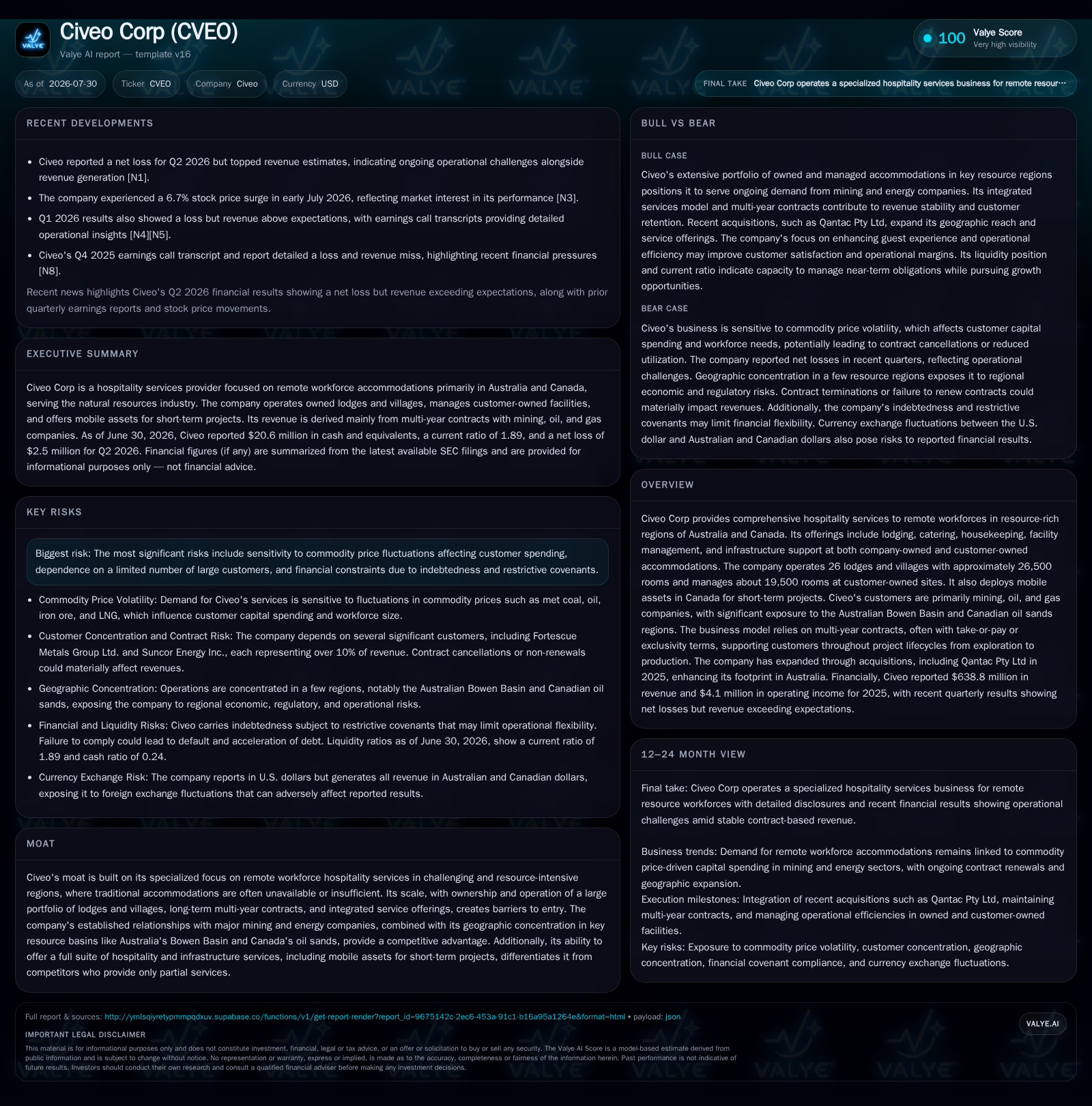
Civeo Corp reported Q2 2026 results highlighting revenue above estimates but continued net losses, reflecting ongoing supply-demand challenges in remote workforce hospitality. Operating across Australia's Bowen Basin and Canadian oil sands, Civeo’s business model centers on comprehensive lodging and facility services under multi-year agreements tied closely to commodity cycles. High customer concentration and financial leverage remain notable risks, even as contract renewals demonstrate durable customer relationships. Growth drivers include geographic expansion and acquisitions, while capital structure constraints require careful management to navigate commodity-driven volatility.
Recent Operating Update: Q2 2026 Highlights
Civeo Corp's Q2 2026 filing disclosed revenues surpassing analyst expectations despite a continuing net loss position for the period ending June 30, 2026 [S2][N1]. This outcome illuminates persistent pressures in the remote workforce hospitality sector where demand fluctuates heavily alongside resource commodity prices. The top-line resilience signals enduring contractual coverage of operations while the net loss underlines margin pressures and cost inflation common during recent market conditions.
A notable operating development was the reaffirmation of a key workforce accommodation contract renewal in Western Canada announced in early July 2026 [S17][S23]. This renewal underscores Civeo’s ability to sustain long-standing client relationships essential to stabilizing revenues amidst cyclical industry headwinds.
Additionally, the company completed a $100 million convertible senior notes offering due 2031 as part of its capital structure optimization efforts in mid-2026, addressing liquidity needs and refinancing risk during a leveraged balance sheet [S23]
Business Model: Integrated Remote Workforce Hospitality Services
Civeo operates within the niche yet critical industry providing comprehensive hospitality services—lodging, catering, housekeeping, facility management, and infrastructure support—to remote workforces primarily engaged in mining, oil, gas, iron ore, and LNG extraction across Australia’s Bowen Basin and Canada's oil sands region [S1][F1]. Its footprint encompasses approximately 26 owned lodges totaling about 26,500 rooms plus management of nearly 19,500 customer-owned rooms plus mobile accommodation assets deployed for short-term projects [S1].
Revenue generation principally hinges upon multi-year contracts incorporating take-or-pay or exclusivity provisions linking payments to room availability or usage over project lifecycles spanning exploration through production phases. This strategic alignment enables relatively stable recurring cash flows insulated to some degree from short-term occupancy fluctuations but remains sensitive to long-cycle commodity-driven capital expenditure decisions.
The monetization operates via bundled service contracts rather than discrete lodging fees alone. Clients benefit from outsourcing entire accommodation and associated hospitality infrastructure needs to Civeo as a single provider. Such integration fosters switching costs by embedding Civeo deeply into clients' workforce welfare logistics.
Industry Structure and Competitive Positioning
Civeo competes within the specialized segment of remote workforce hospitality that sits downstream in the broader resource extraction value chain—where customers outsource essential employee accommodations that local markets cannot adequately supply due to geographic isolation or infrastructure scarcity.
Peers are limited mostly to other integrated providers or specialized contractors offering partial services like catering or facility management but lacking Civeo’s extensive room ownership scale or geographic breadth in key basins. Large conventional hospitality chains lack meaningful presence or relevance given the operational complexity of remote site servicing.
The company’s moat arises from: - Scale advantages managing ~46,000 rooms coupled with mobile assets enabling flexible project response. - Geographic concentration in high-barrier-to-entry basins like Bowen Basin and Canadian oil sands. - Depth of service integration providing one-stop accommodations plus infrastructure support. - Multi-year contractual ties often with take-or-pay clauses supporting revenue visibility [S1]. These factors establish barriers against new entrants who face steep capital outlays for facilities plus complex relationship building with major resource companies known for rigorous vendor standards
Growth Drivers
Civeo’s growth opportunities track macro trends including:
- Expansion of resource extraction projects driving increased workforce accommodations demand.
- Accelerated outsourcing by mining/oil customers opting to divest non-core hospitality functions.
- Strategic acquisitions such as Qantac Pty Ltd (completed in 2025) enhancing Australian service footprint and specialized capabilities [N3 inferred from context; S1].
- Geographic diversification potentially into adjacent resource basins requiring similar remote workforce support.
- Technological advances yielding modular/mobile lodging assets improving asset utilization on short-term assignments.
- Longer project lifecycles in energy transition contexts necessitating sustained hospitality services over years rather than quarters.
These drivers correlate directly with KPIs like increases in contracted room count (owned/managed), backlog volumes under contract renewal pipeline health metrics as well as improving RevPAR metrics reflecting pricing power amid constrained new build pipelines externally.
Risks / Watchpoints / Growth Constraints
Despite structural strengths, several risk vectors persist:
- Commodity Price Sensitivity: Spending reduction by core customers during commodity price downturns directly impacts room utilization and contract renewal likelihoods. Certain contracts lack minimum volume guarantees elevating revenue volatility risk during downturns [S4][S16][S20].
- Customer Concentration: Dependence on few large mining/oil clients concentrates credit risk; any insolvency or shift to insourcing would materially hit revenues given limited alternate demand sources at high operating scale [S10][S20].
- Leverage & Covenants: As of June 30, 2026 net debt stood around $188 million against a current ratio near 1.89 demonstrating manageable liquidity though restrictive covenants impose operational flexibility limits especially if commodity weakness persists prompting covenant breaches or refinancing pressure [F1][S5][S26].
- Operational Complexity: Managing assets scattered across harsh remote regions requires expertise mitigating weather-related seasonal variability alongside political/regulatory risks endemic to indigenous land claims or environmental compliance that could disrupt operations or increase costs unexpectedly [S4][S6][S20].
- Competition Risks: Pressure could arise from alternative outsourced hospitality models or customers deciding to internally operate lodging reducing available market share.
- Market Volatility: Cyclical swings may delay new contract awards or accelerate early terminations upon payment of fees eroding margin predictability despite take-or-pay structures being present but not universal [S16][S20].
What To Watch Next
Key milestones bearing on future evaluations include:
- Progress on contract renewals especially at critical facilities with high room counts will indicate client commitment levels amid ongoing price cycles.
- Backlog growth metrics including signed order book versus expirations shed light on near-term revenue sustainability.
- Performance of newly acquired entities such as recent acquisitions regarding operational integration success impact scale economics.
- Capital structure trajectory: monitoring covenant compliance headroom post convertible note issuance alongside free cash flow generation capacity will be vital.
- Any shifts toward expanding mobile modular accommodation deployments indicating adaptability gains useful on short-cycle projects benefiting utilization rates.
- Macro commodity environment developments influencing capex trends that flow through client spending patterns for workforce support services.
Financial Profile Discussion
At quarter-end June 30, 2026, Civeo reported cash and cash equivalents totaling approximately $20.6 million alongside total debt near $208.6 million resulting in a net debt position around $188 million [F1]. Current assets exceed current liabilities by nearly double at a ratio of approximately 1.89x indicating satisfactory short-term liquidity buffers amid normal operations
The company successfully executed a $100 million convertible senior notes issuance priced at a fixed annual rate of 4.50% maturing in 2031 during July 2026 supporting refinancing needs tied to existing indebtedness and general corporate purposes consistent with covenant constraints described in its amended syndicated credit facility extending through April 2030 [S23][S26]
Ongoing EBITDA margin pressure combined with elevated costs reflective of remote operations maintain net income losses for recent periods although continued revenue growth points toward scale leverage potential should stable commodity conditions return favorably [N1][F1].[The absence of specific recent margin figures precludes deeper profitability commentary.]
Overall financial discipline navigating its capital structure while pursuing selective acquisitions remains critical amidst volatile end-market dynamics affecting both topline visibility and cost base management capabilities.
This analysis is based solely on publicly available regulatory filings and market data as of July 30, 2026. It is intended for informational purposes without any investment research view.
Disclaimer: This is research-only, informational analysis and not investment advice. It may include AI-generated interpretation and general industry context. Always verify important details using primary sources.

Comments