
Trinity Industries Navigates Freight Cycles with Leasing and Railcar Manufacturing Scale
Recent quarterly results highlight Trinity’s continued portfolio balance in a cyclical railcar market.
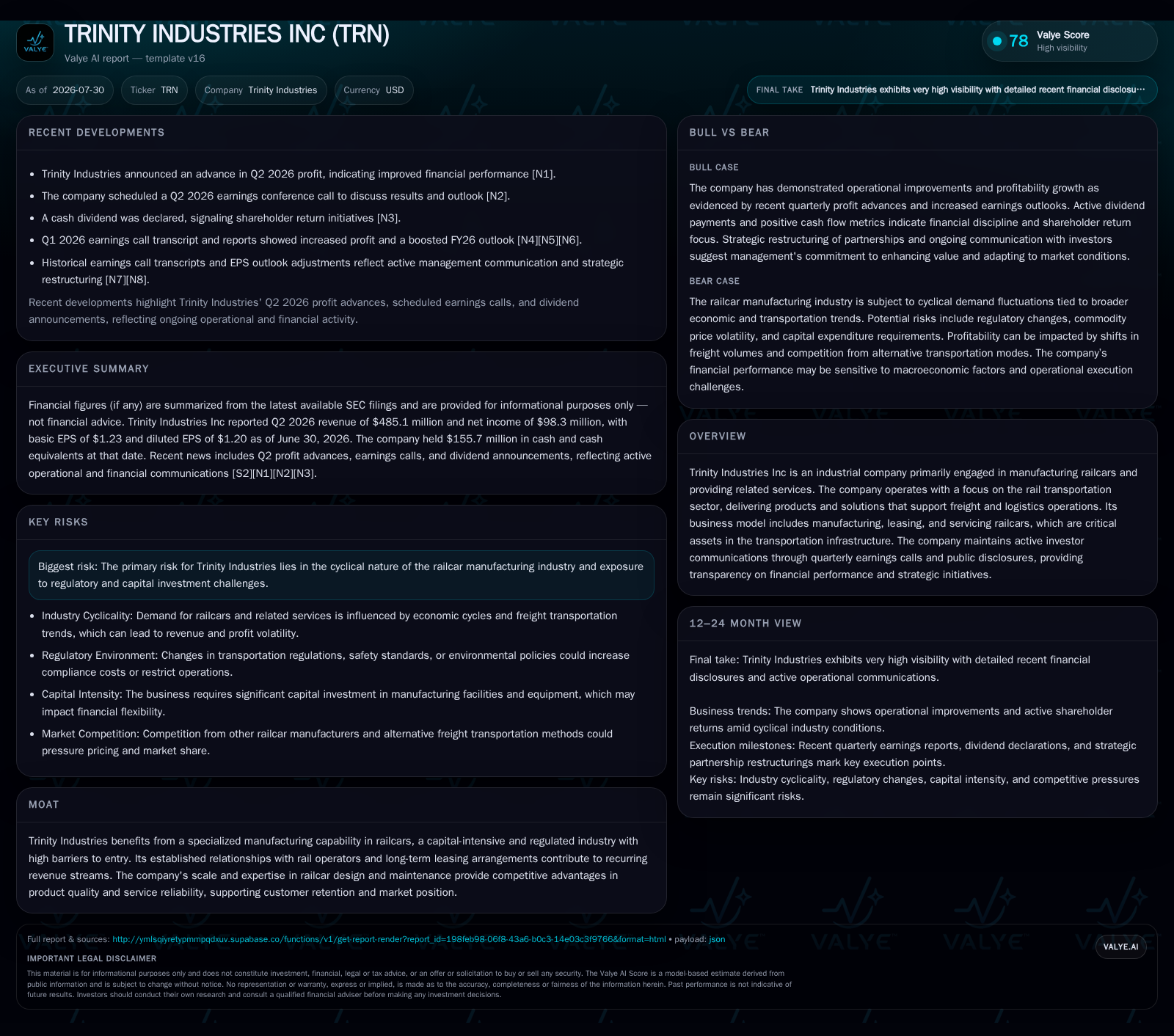
Trinity Industries Inc reported operating results for Q2 2026 reflecting the dual nature of its business model: capital-intensive freight railcar manufacturing balanced by a stable leasing portfolio. The company benefits from significant barriers to entry and recurring revenue from leasing, partially mitigating rail freight cyclicality. However, raw material costs, regulatory changes, and freight volume fluctuations remain key risks that shape profitability and backlog dynamics. Ongoing investments in manufacturing capacity and fleet maintenance services are critical growth levers to capture freight infrastructure spending and aging equipment replacement cycles.
Recent Operating Update: Balancing Manufacturing Volume with Leasing Stability
Trinity Industries' latest quarterly report for Q2 ended June 30, 2026, underscores a nuanced performance profile grounded in its integrated manufacturing and leasing business model. According to the 10-Q filing dated July 30, 2026, management highlighted that while new railcar orders face headwinds from cyclical freight demand softness, stable lease portfolio occupancy cushions revenue variability typical of this sector [S2]. A concurrent Form 8-K elaborated on these points during the earnings call the same day, reinforcing management's focus on operational execution amid external volume fluctuations [S3][N1]. This near-term update is crucial as it reflects ongoing efforts to optimize fleet utilization rates while navigating raw material inflation across production lines.
An important takeaway from the quarter is management's emphasis on leveraging the leasing business's recurring revenue streams to offset manufacturing segment cyclicality. Given the capital-intensive nature of building rolling stock assets, consistent lease income contributes substantially to cover fixed overheads and preserve operating margins during weaker order periods [S2]. This dynamic affirms Trinity's strategic positioning within the capital-heavy railcar manufacturing ecosystem.
Business Model: Integrated Railcar Manufacturing and Leasing
Trinity Industries operates primarily across two synergistic but distinct revenue streams: manufacturing freight railcars sold or leased long-term to customers in the transportation logistics sector, notably freight rail operators; and managing a sizeable leasing portfolio that generates steady operating lease revenue backed by multi-year contracts [S1]. Revenue from new railcar production fluctuates with order intake driven by underlying freight volumes, replacement cycles of aging fleets, and regulatory mandates for upgraded rolling stock safety and efficiency standards.
Lease portfolio revenues provide a more predictable cash flow base but require active asset lifecycle management through maintenance and repair services—another pillar of Trinity’s business that supports customer retention and longer equipment service lives. This aftermarket focus not only stabilizes utilization metrics but also creates ancillary margin opportunities beyond initial sales or lease contracts. The company's ability to maintain high occupancy rates in its leasing fleet mitigates risks of idled capital common in this space.
This dual-revenue approach helps Trinity manage industry cyclicality where new railcar manufacturing is sharply correlated with macroeconomic freight demand cycles. Specifically, while new orders may ebb during downturns when shippers reduce capacity additions, lease revenues tend to be more resilient due to contracted terms. Nonetheless, both segments are exposed to regulatory compliance costs—for example EPA mandates on emissions or DOT safety standards—that require regular product enhancements impacting design and capital expenditure budget allocations.
Industry Structure and Competitive Position
Railcar manufacturing is a specialized segment marked by high entry barriers owing to heavy capital investment requirements in factories outfitted for large-scale steel fabrication and assembly. Regulatory certification processes further limit entrants. Within this context, Trinity stands alongside peers such as Greenbrier Companies and FreightCar America (now less prominent), benefiting from scale economies in production capacity utilization as well as an extensive leasing footprint.
Competition centers not just on pricing but increasingly on product innovation—including developing railcars that offer greater fuel efficiency or accommodate evolving freight types—and aftersale support services. Customers’ decision-making balances upfront purchase price against total lifecycle costs encompassing maintenance schedules, downtime risk reduction via superior engineering, and long-term service agreements.
Trinity’s established relationships with major freight operators are vital competitive assets that support contract renewal likelihoods within leasing portfolios. These relationships also facilitate feedback loops into product development improving fit-for-purpose design adaptations—a differentiation factor against smaller or less diversified players.
Growth Drivers: Freight Volume Trends and Fleet Replacement Cycles
Industry growth drivers for Trinity include structural increases in freight volumes attributable to broader economic expansion along with shifts toward more environmentally-friendly transport modes favoring rail over trucking for bulk movements. Such trends underpin demand for additional rolling stock capacity.
Concurrently, aging freight car fleets necessitate replacement investments which provide durable order backlog support relatively independent of short-term volume swings. Infrastructure investments by public entities in rail networks also create indirect pull factors increasing usage intensity of railcars thereby stimulating aftermarket maintenance service expansion.
Long-term leasing popularity is another growth lever since customers aim to limit upfront capital outlays while maintaining fleet flexibility—demanding increasingly sophisticated leasing solutions blending equipment availability with comprehensive maintenance programs. Technological progress in sensor-based predictive maintenance platforms also offers upsell avenues into subscription-style aftermarket services enhancing revenue predictability.
Risks and Constraints: Cyclicality, Commodity Costs, Regulation
The most prominent structural risk facing Trinity is the volatility of demand linked to general economic cycles impacting freight volumes. Reduced production or shipping activity typically depresses new railcar orders sharply. Operating leverage inherent in heavy fixed-cost manufacturing amplifies profitability through these cycles but can magnify downturn impacts.
Raw material cost fluctuations—particularly steel—affect input cost bases directly influencing gross margins unless corresponding price pass-throughs are feasible within contract constraints. Regulatory shifts necessitating technological redesigns or retrofits could impose unplanned expenses disrupting planned capital deployment.
Credit risk related to leasing counterparties must be vigilantly monitored given the concentration among large industrial shippers vulnerable to economic stresses. Additionally, competition from alternative transport modes such as trucking poses secular demand erosion threats if not counteracted by regulatory incentives or infrastructure improvements favoring rail.
What to Watch Next: Backlog Trends, Lease Portfolio Metrics, Capex Execution
Key forward-looking metrics include tracking changes in order backlog size as an early indicator of demand momentum or weakness. Increases would signal sustained manufacturer visibility; declines might foreshadow margin pressure. Similarly, observing lease portfolio occupancy rates and average lease durations informs on recurring revenue health—critical given their role in smoothing operating cash flow.
Capital expenditure plans targeting plant modernization or expansion warrant attention since they reflect management’s confidence in capturing future demand opportunities but also impact near-term free cash flow generation capacity.
Given elevated leverage ratios relative to industry peers—a normal feature given asset-heavy models—any signs of deteriorating liquidity metrics or refinancing risk would represent a caution point requiring close scrutiny [F1][S2]
Financial Profile Discussion
Financially, Trinity operates a capital-intensive business with notable fixed asset investments required for sustained manufacturing operations alongside a sizeable leased asset base under long-term contracts supporting recurring revenue streams [F1]. As of June 30, 2026, the company held cash & equivalents of approximately $156 million against total debt of about $5.47 billion as reported cumulatively at year-end December 31, 2025—implying net debt just over $5.3 billion [F1]. This net leverage level indicates substantial financing needs typical for industrial firms owning large fleets of rolling stock assets leveraged onto relatively stable contractual cash flows.
It is important that Trinity manages its balance sheet prudently given the heavy reliance on debt-backed asset portfolios. Adequate liquidity buffers paired with staggered maturity profiles help mitigate refinancing risks amid interest rate environment oscillations.
Disclaimer: This analysis does not constitute investment advice or research views. It is based solely on publicly available information including SEC filings up to July 30, 2026.
Disclaimer: This is research-only, informational analysis and not investment advice. It may include AI-generated interpretation and general industry context. Always verify important details using primary sources.

Comments