
Huntington Ingalls Advances Naval Shipbuilding Backlog Amid Persistent Execution Challenges
HII’s latest quarterly report reveals growth in contract backlog and stable revenues driven by key U.S. Navy shipbuilding programs but underscores ongoing risks from labor and supply chain bottlenecks.
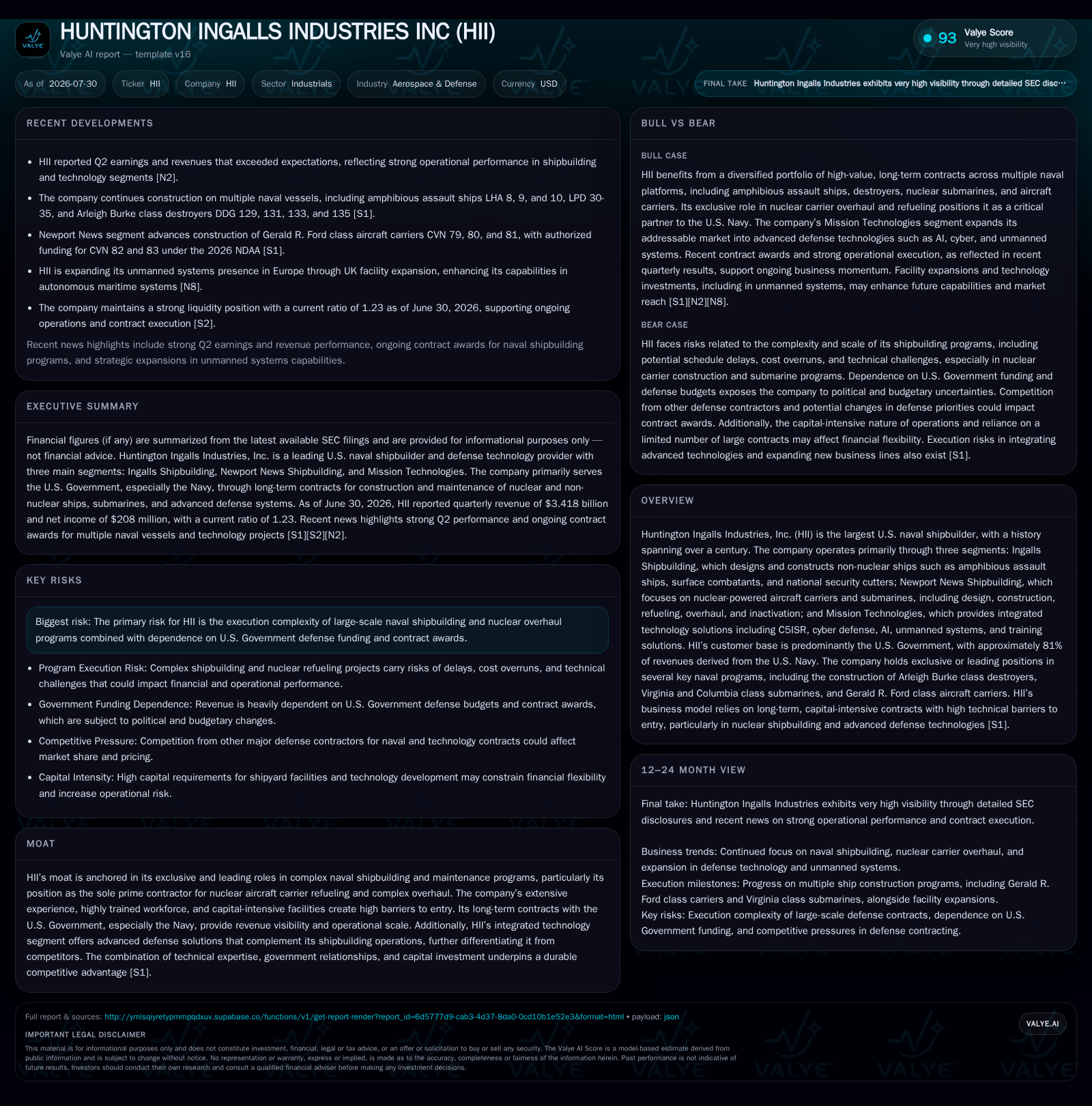
Huntington Ingalls Industries (HII) reported Q2 2026 results reflecting robust progress on long-term naval shipbuilding contracts, anchored by exclusive roles in nuclear aircraft carrier overhaul and a broad portfolio of amphibious and surface combatant vessels. The company's operational model relies heavily on government defense contract awards and progress billings tied to complex, capital-intensive manufacturing. Despite strong revenue stability, HII continues to face industrywide pressures from skilled labor shortages and supply chain disruptions which introduce execution risk and margin volatility. Strategic investments in facilities and integrated defense technologies aim to sustain its competitive moat anchored in exclusive prime contractor positions, while future growth depends on sustained U.S. defense appropriations and effective program management.
Latest Quarterly Update Anchors Stable Revenue during Execution Risks
Huntington Ingalls Industries’ (HII) Q2 2026 reporting period confirms steady operating momentum driven largely by its core naval shipbuilding contracts with the U.S. Navy, which accounts for approximately 81% of total revenues—a figure consistent with previous periods emphasizing government dependency [S2][S1]. The company’s revenues reflect progress billings aligned with multi-year contracts for constructing non-nuclear surface combatants, amphibious assault ships at Ingalls Shipbuilding, as well as nuclear-powered carriers and submarine work at Newport News Shipbuilding. Despite inflationary pressures affecting labor and materials costs, reported results show resilience bolstered by federal defense spending appropriations [S2][N3].
However, the filings highlight persistent execution challenges typical in capital- and labor-intensive naval manufacturing. Labor availability remains constrained, including recruitment difficulties and retention of a highly skilled workforce critical for complex ship assembly and nuclear refueling projects [S1]. Supplier lead times elongate due to supply chain disruptions exacerbated by inflation-driven raw material price volatility.
Business Model: Contract-Driven Naval Shipbuilding with Integrated Defense Technologies
HII operates through three primary segments: Ingalls Shipbuilding focuses on non-nuclear vessels such as amphibious assault ships (LHA) and surface combatants; Newport News Shipbuilding handles nuclear-powered aircraft carriers and submarines, including their design, construction, refueling, overhaul (RCOH), and maintenance; Mission Technologies offers advanced military systems encompassing C5ISR capabilities, cyber defense solutions, AI applications for battle management, unmanned autonomous platforms including UUVs (unmanned underwater vehicles), and virtual training environments [S1].
Revenue principally flows from long-term government contracts awarded by the U.S. Department of Defense (DoD), predominately the Navy. These contracts involve milestone-based progress billings linked to project deliverables such as design completion stages, fabrication increments, or ship launches. This structure yields revenue visibility anchored in sizeable backlog values that represent work to be performed under secured contracts [S1][S2]. The complexity of these contracts—especially for nuclear vessels—creates significant barriers to entry because prime contractors must maintain highly specialized facilities alongside a trained workforce able to handle both routine assembly and technically demanding RCOH activities.
Mission Technologies’ contribution extends beyond vessel construction margins; it diversifies HII’s revenue base into recurring service agreements for integrated defense technology solutions that complement naval operations. This segment adds scale through innovation in command-and-control infrastructure crucial for modern multidomain warfare concepts.
Industry Structure Favors Large Scale Prime Contractors with Specialized Expertise
The U.S. naval shipbuilding industry is a concentrated market dominated by contractors with exclusive or leading roles in producing distinct vessel classes. Huntington Ingalls stands as America’s largest naval shipbuilder by volume of classes produced historically—notably unique as the sole provider of nuclear aircraft carrier overhaul services—a position providing significant competitive moats due to capital intensity, regulatory oversight, proprietary processes, security clearances, and skilled human capital requirements.
Peers include General Dynamics Electric Boat specializing in Virginia-class submarine production as well as other major defense primes operating integrated naval segments such as Lockheed Martin or Northrop Grumman whose portfolios partially overlap through systems integration or smaller vessels. However, HII distinguishes itself by breadth across non-nuclear warships combined with exclusive nuclear overhaul capabilities alongside integrated technology services.
This structural landscape enforces long lead times for new contract awards predicated on congressional budgeting cycles. Companies must manage extended construction schedules—often spanning multiple years per vessel—with tight regulation compliance creating additional complexity.
Growth Drivers: Government Funding Stability Anchors Long-Term Contract Backlog
A critical growth vector lies in the company’s expanding contract backlog fueled by continued U.S. Navy modernization efforts sanctioned under FY2026 defense appropriations totaling $26 billion earmarked for shipbuilding programs [S1]. Recent contract wins include long-lead material procurements for LHA 10 helicopter carrier construction alongside sustained funding allocations within Virginia-class submarine orders.
The emphasis on maritime industrial base resilience reaffirms government intent to maintain a robust domestic supplier network amidst geopolitical tension escalation internationally. Investment incentives enshrined in policy frameworks stimulate capital expenditures for advanced manufacturing tools aiming to shorten production cycles while increasing output quality.
Technological advancement forms an additional layer of growth potential. Mission Technologies innovates within AI-enabled command platforms, electronic warfare architectures, cyber resilience strategies, and unmanned system deployment advancing naval tactical advantages [S1]. Recent supply chain disruptions have extended long-lead-time materials intervals causing potential delays.[S1] Labor shortages create throughput constraints directly impacting project milestones; resolving these demands continuous workforce development initiatives including apprentice programs.
Financial exposure also ties closely to federal budget cyclicality despite generally bipartisan support for defense spending increases.
Pricing pressures emerge from inflation across raw materials inputs forcing some margin compression risks absent effective contract repricing mechanisms or productivity gains.
Program cancellations or delays driven by shifts in strategic priorities or fiscal constraints could materially affect backlog utilization rates adversely affecting future revenue streams [S1]
What To Watch Next: Backlog Evolution And Delivery Milestones Will Signal Execution Trajectory
Key near-term indicators include order intake announcements reflecting new contract awards or modifications that replenish backlog value essential for future revenue clarity.[S2] Monitoring progress billing trends relative to projected schedule targets will provide insight into production throughput health especially across RCOH milestones for nuclear carriers.[S2]
Further developments around labor market conditions—particularly if attrition rates stabilize or improve—would alleviate bottlenecks currently impacting delivery cadence.[S1]
Capital expenditure updates focusing on facility upgrades or digitalization projects present operational efficiency catalysts worth tracking given their potential impact on reducing build cycle times.[S1]
Additionally, evolving political signals regarding appropriations levels post FY2026 will remain central given their influence over near- to mid-term funding certainty [S1]
Financial Profile Discussion
At quarter-end June 30, 2026, HII reported current assets of approximately $3.24 billion compared with current liabilities near $2.63 billion resulting in a current ratio of about 1.23—a moderate liquidity buffer typical within capital-intensive manufacturing sectors reliant on milestone billing structures [F1]. Total debt stood around $2.7 billion net of cash equivalents roughly $10 million reflecting leverage consistent with ongoing capital spending requirements related to facility maintenance and upgrading [F1].
Operating margins remain influenced by cost controls amid inflationary pressures; however, strong government demand underpins stable top-line performance measured against trailing annual revenues exceeding $12 billion as per latest full-year data available reconciled through related earnings commentary [F1][N3]
In sum, financial stability complements its operational profile marked by large-scale government contracting dynamics enabling Huntington Ingalls Industries to maintain its leadership role within the U.S. naval shipbuilding ecosystem under evolving economic conditions.
Disclaimer: This analysis is based solely on publicly available information including recent quarterly filings dated July 30, 2026 ([S2], [S3]), annual report filed February 5, 2026 ([S1]), related news releases ([N3]), and companyfacts financial metrics ([F1]). No forward-looking statements or investment advice are offered herein.
Disclaimer: This is research-only, informational analysis and not investment advice. It may include AI-generated interpretation and general industry context. Always verify important details using primary sources.

Comments