
DiamondRock Hospitality’s Portfolio Optimization and Operational Metrics Signal Sector Resilience
DiamondRock’s Q2 2026 results highlight continued revenue growth and disciplined asset management within a cyclical hospitality REIT industry.
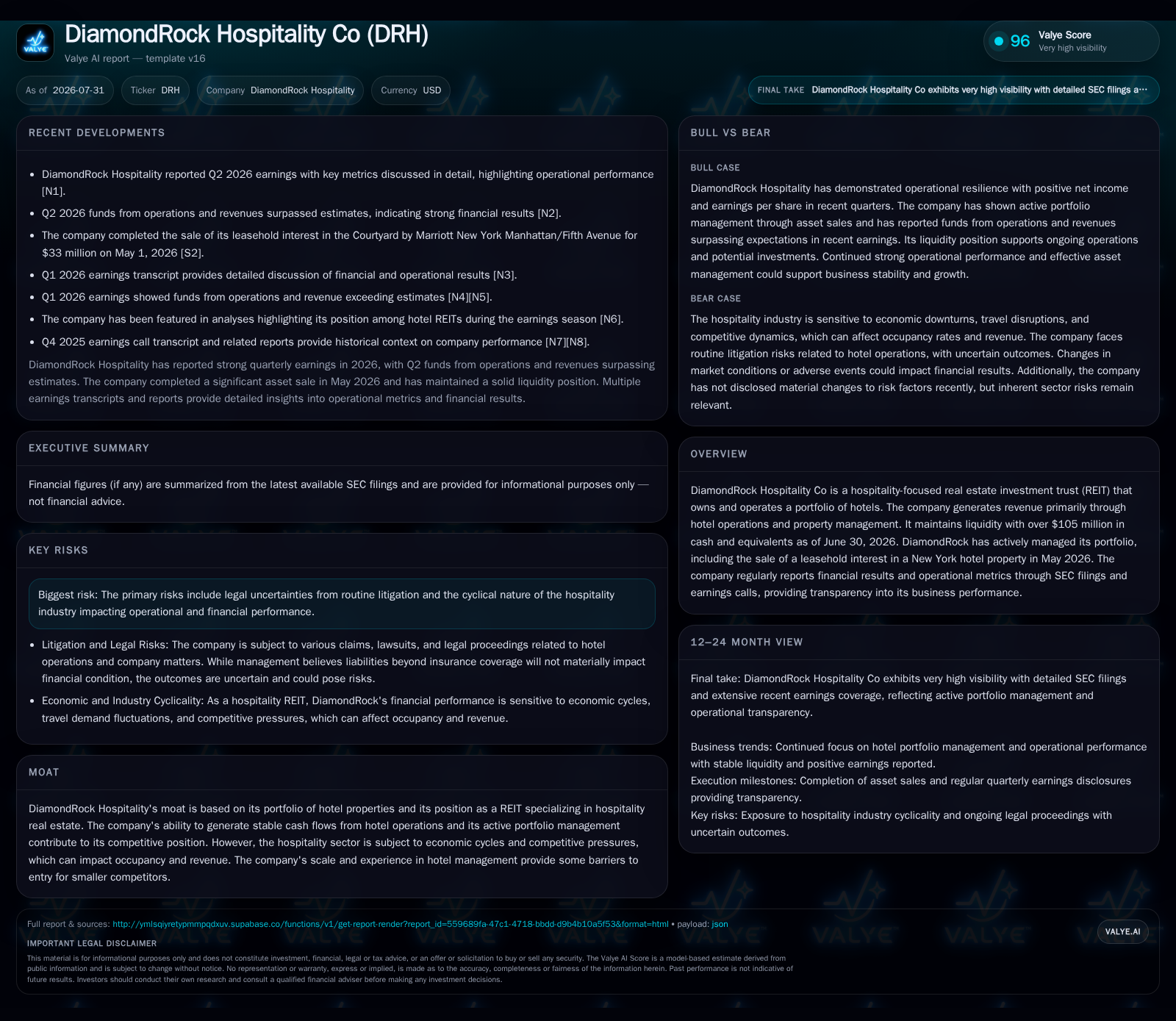
DiamondRock Hospitality Co reported Q2 2026 results showing solid revenue and funds from operations gains, supported by active portfolio management including a recent leasehold interest sale in New York. The company’s operations reflect ongoing recovery dynamics in travel demand, evidenced by steady occupancy and RevPAR trends, against a backdrop of macroeconomic cycles influencing the hospitality sector. Liquidity remains sufficient with $106 million cash on hand, while total debt stands at $1.1 billion, highlighting the importance of capital structure management amid rising interest rates. Key near-term focus areas include sustaining operational momentum, managing portfolio repositioning, and navigating sector headwinds tied to economic fluctuations and litigation exposure.
Recent Operating Update: Q2 2026 Performance and Portfolio Moves
DiamondRock Hospitality Co’s latest quarterly filing (10-Q for period ended June 30, 2026) reveals that the company continues to capitalize on recovering demand in the hospitality market. Reported revenues and funds from operations (FFO) exceeded expectations due to improvements in key operating metrics such as occupancy rates and average daily rates (ADR) across its hotel portfolio [S2], [N2]. This performance aligns with broader industry rebound trends post-pandemic but also reflects DiamondRock's active asset management strategy.
A notable development during Q2 was the sale of a leasehold interest in a New York hotel property completed in May 2026 [S1]. This disposition illustrates DiamondRock’s ongoing commitment to portfolio optimization—buying high-potential assets while shedding non-core or lower-yielding properties to enhance overall returns. Such transactions bolster liquidity and enable reinvestment into more strategically attractive holdings.
Liquidity remains robust with $105.98 million cash and equivalents available as of June 30, 2026, against a total debt load approximating $1.1 billion at the same date [F1]. Maintaining this balance is critical amid an environment marked by rising interest rates where refinancing costs can pressure margins if not carefully managed.
Business Model: Revenue Mechanics and Strategic Positioning
As a hospitality-focused REIT, DiamondRock primarily generates income through ownership and operation of hotel assets. Revenue streams stem mainly from room rentals complemented by food & beverage sales, event hosting fees, and property management services under existing hotel management agreements. The typical customer base includes transient business travelers, group bookings for events/conventions, and leisure tourists.
Revenue per available room (RevPAR), occupancy rate, and ADR are pivotal KPIs directly influencing revenues. Higher occupancy combined with increased ADR improves RevPAR—a key driver of net operating income (NOI) and FFO. DiamondRock’s business model hinges on managing its assets to maximize these metrics through both operational enhancements (often via third-party operators) and strategic capital expenditures designed to modernize properties.
Operating margin expansion depends not only on top-line growth but also on controlling fixed costs and leveraging scale economies within the portfolio. Property-level margins can fluctuate with seasonality and local market conditions but tend to normalize over business cycles given effective management agreements. The REIT structure necessitates distributing most taxable income as dividends; thus sustaining sufficient cash flow coverage is crucial.
Industry Structure and Competitive Positioning
Hospitality REITs sit at the nexus of real estate investment expertise and hospitality operations acumen. Compared with pure hotel operators like Marriott or Hilton—which rely heavily on brand loyalty and global distribution systems—REITs like DiamondRock are capital allocators focusing on owning real estate while outsourcing daily operations to third-party managers under contracts.
Within this sub-sector, peers such as Host Hotels & Resorts (HST) command greater scale with more extensive portfolios spanning multiple geographies. Pebblebrook Hotel Trust offers contrast with specialization in urban upscale hotels. DiamondRock’s position reflects a well-curated portfolio emphasizing premium locations aimed at business travelers and affluent leisure segments.
Competitive differentiation arises from asset quality, geographic diversification preventing localized downturn risk, relationships with reputable management companies ensuring operational efficiency, and prudent capital deployment decisions balancing acquisitions against asset dispositions. This layered approach builds barriers for smaller entrants lacking scale or capital strength.
Growth Drivers
Key growth catalysts for DiamondRock mirror broader hospitality industry dynamics but also reflect idiosyncratic execution factors:
- Travel Demand Recovery: Sustained global economic expansion supports increased corporate travel budgets alongside growing leisure spending. As long as macroeconomic conditions remain stable or improve modestly, demand for upscale lodging should accelerate occupancy gains.
- Portfolio Acquisitions/Dispositions: Selective asset purchases can enhance portfolio yield profiles while divestitures free up capital from less attractive holdings or mature investments nearing cycle peaks.
- Hotel Operational Efficiencies: Collaborations with top-tier hotel managers allow implementation of cost controls alongside guest experience innovations that boost pricing power.
- Capital Expenditures: Reinvesting into property renovations enhances competitiveness against newer supply entering markets.
- Segment Expansion: Movement towards lifestyle or boutique branded hotels can capture younger demographics willing to pay premiums.
- Refinancing Opportunities: Favorable interest rate environments enable lower borrowing costs bolstering net returns.
- Technology Adoption: Improving property operating platforms improves guest retention via enhanced service delivery.
Collectively these factors contribute incrementally to improving net operating income (NOI) margins and subsequently FFO growth potential—all highly valued metrics within REIT investor circles.
Risks and Watchpoints
Like many hospitality-related entities, DiamondRock confronts several structural risks:
- Economic Cyclicality: Periods of downturn compress travel budgets reducing occupancy/ADR metrics transiently impacting cash flow stability.
- Competitive Pressures: Entry of new hotels or alternative lodging options like Airbnb exerts downward pressure on pricing power unless countered by superior asset positioning or branding.
- Interest Rate Sensitivity: Rising rates increase cost of debt servicing amplifying refinancing risk especially for higher leverage profiles.
- Litigation Exposure: Routine legal proceedings related to hotel operations carry potential financial impacts though currently assessed as manageable without material effect per management commentary [S1], [S2].
- Operational Costs: Labor shortages or inflationary wage pressures can squeeze margins if offsetting pricing improvements are limited.
- Regulatory Compliance: Zoning laws or safety standards pose operational constraints potentially requiring incremental investments.
Monitoring evolving occupancy patterns along with ADR trends versus industry benchmarks provides early indication of demand-related risks materializing. Likewise tracking leverage ratios ensures capital structure resiliency amid funding market volatility.
What To Watch Next
Near-term milestones pivotal for assessing DiamondRock’s trajectory include:
- Quarterly updates on operating metrics (occupancy rate trends, ADR changes) which directly impact top-line revenue sustainability [N1].
- Disclosures regarding further portfolio changes signaling shifts in strategic focus or capital allocation priorities.
- Refinancing activity announcements that could alter interest expense burden or liquidity profiles amidst fluctuating credit markets.
- Legal proceeding disclosures clarifying any emerging risks beyond routine litigation noted so far.
- Market-wide indicators such as convention calendar robustness impacting group bookings important for urban core hotels within the portfolio.
Management commentary during earnings calls will be essential for qualitative insights into competitive positioning adjustments or new partnership arrangements enhancing property utilization rates.
Financial Profile Discussion
DiamondRock holds liquidity represented by approximately $106 million in cash equivalents at quarter-end June 30, 2026, juxtaposed against roughly $1.1 billion in total debt obligations yielding a net debt level near $994 million [F1]. This leverage level places emphasis on continued strong operational cash flows measured through funds from operations (FFO) to service debt efficiently while enabling recurring dividend distributions consistent with REIT requirements.
The balance between maintaining conservative leverage ratios to preserve access to capital markets versus judicious usage of debt for accretive acquisitions sits at the core of financial strategy amid rising rate environments [S1]
This analysis dissects publicly available information up through mid-2026 filings without predictive claims or investment research views. It underscores how DiamondRock Hospitality navigates cyclical hospitality market forces through strategic asset optimization coupled with disciplined financial management characteristic of leading hospitality REITs.
Disclaimer: This is research-only, informational analysis and not investment advice. It may include AI-generated interpretation and general industry context. Always verify important details using primary sources.

Comments