
Roblox Scales Amid Rising Engagement and Persistent Profitability Challenges
Roblox’s Q2 results highlight continued user growth and monetization gains, tempered by substantial operating losses and regulatory complexities.
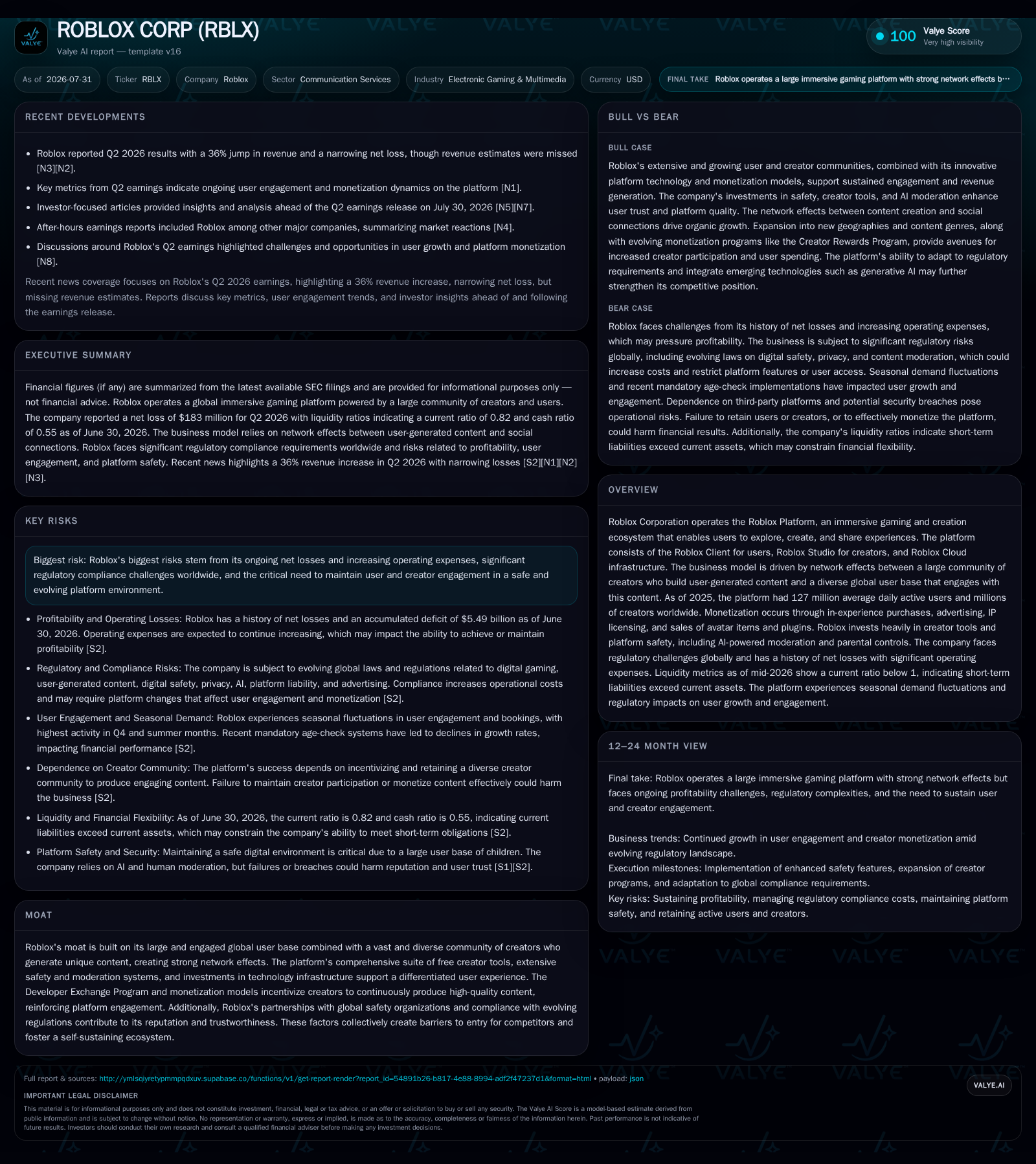
Roblox Corporation’s latest quarterly filing reveals ongoing expansion in daily active users driven by its powerful network effects between creators and users. Monetization through virtual goods sales and advertising is accelerating, yet the company remains in a net loss position as operating expenses rise with investments in AI moderation and new experience genres. Regulatory pressures around child safety globally continue to impose cost burdens and operational risks. Roblox’s platform strength rests on a broad creator ecosystem incentivized through its Developer Exchange program, but the path to profitability is weighted by high content moderation costs and capital expenditures in cloud infrastructure.
Recent Operating Update Highlights
The company also disclosed ongoing efforts to broaden its audience by supporting "novel" game genres that depart from classic Roblox titles’ mechanics, aiming at older demographics. This strategic diversification aligns with management’s focus on expanding both creator participation and consumer retention outside its historically younger user base [S1]. Crucially, Roblox highlighted its AI infrastructure enhancements designed to accelerate creator workflows while simultaneously reducing exposure to inappropriate content—an increasingly vital competitive moat given mounting global regulatory scrutiny that impacts operational costs worldwide.
Business Model Overview
Roblox operates a multi-sided platform centering on an ecosystem where millions of creators use Roblox Studio—a freely available creative toolset—to build immersive experiences consumed by a growing global user base via the Roblox Client. The digital economy thrives on social interactions; users customize avatars with purchasable virtual goods such as clothing or accessories, enriching personalization while driving incremental revenue. Monetization mechanics rely predominantly on in-app purchases denominated in Robux virtual currency, which converts into real-world payouts through the Developer Exchange program incentivizing creators with revenue shares.
Advertising introduces a complementary revenue stream where brands integrate placements into popular experiences. Intellectual property licensing for branded collaborations also contributes marginally but reflects expanding diversification efforts. Importantly, revenue recognition follows bookings amortized over estimated customer lifetimes or item consumption rates due to the platform's recurring engagement nature [S1]. This model underscores that while bookings might spike following viral successes or seasonal events, reported revenue trends are smoother and tied intimately to user retention metrics.
Margins hinge significantly on balancing high gross profit from virtual goods against escalating R&D outlays for platform development and moderation technology investments crucial for user trust—especially given the predominantly underage demographic. The dynamics of customer acquisition cost (CAC) relative to lifetime value (LTV) remain pivotal in determining sustainable profitability as Roblox competes for attention during numerous interactive entertainment alternatives.
Industry Structure and Competitive Positioning
Within the interactive digital entertainment sector focused on user-generated content platforms, Roblox distinguishes itself through the scale of its creator community paired with advanced safety protocols. Its primary peers encompass Epic Games (operating Fortnite), Unity Software (creator tools), Take-Two Interactive (content publishing), Snap Inc. (social/gaming hybrid), and Tencent broadly across gaming ecosystems. Unlike traditional game publishers controlling IP licenses centrally, Roblox’s leverage lies in enabling independent creators who fuel diverse content supply feeding an engaged user audience.
Roblox's moat is fortified by:
- Network effects coupling creator incentives with a large daily active user base enhancing the appeal for both parties,
- Industry-leading safety measures employing proprietary AI-powered moderation frameworks like Roblox Sentinel,
- A comprehensive platform combining creation tools, client experience, and cloud infrastructure allowing seamless scaling.
This contrasts with competitors who may excel in engine technology or exclusive content offerings but lack Roblox’s degree of user/community interdependence intertwined with rigorous child-safe environments—a critical aspect given regulatory trends globally affecting platforms popular among younger users.
Growth Drivers
Roblox identifies multiple levers fueling growth going forward:
- User Base Expansion: Geographic diversification beyond core North American/European clusters into emerging markets with mobile accessibility improvements boosts addressable market size.
- Creator Community Growth: Enhancing free creation tools lowers entry barriers attracting new developers while established creators increase content volume and quality.
- AI Innovations: Investment into generative AI accelerates content production cycles reducing creator effort for richer experiences; simultaneously AI enhances automated policy enforcement minimizing manual moderation overheads.
- New Experience Genres: Developing "novel games" appealing to older audiences aims to broaden demographic reach significantly beyond predominantly child-focused profiles.
- Monetization Evolution: Rolling out integrated advertising solutions paired with strengthening of branded IP deals diversifies revenue streams away from sole reliance on virtual goods.
- Platform Enhancements: Improved social features intensify engagement per DAU translating into higher average revenue per user (ARPU).
- Partnerships: Collaborations with entertainment franchises elevate brand cachet thus attracting new user cohorts willing to transact within these experiences.
These drivers are underpinned by positive feedback loops common in platform businesses: more high-quality content attracts more users who contribute monetization converting into greater rewards for creators fueling further ecosystem growth.
Risks and Watchpoints
Several factors could constrain Roblox’s growth trajectory or impair financial outcomes:
- Profitability Pressures: Historically high net losses stem from sizable R&D spend especially for moderation technologies essential yet costly to maintain at scale; achieving sustainable margins remains uncertain [S2].
- Regulatory Compliance: Increasing global enforcement of child protection laws imposes operational complexity impacting features rollout timing or geographic availability while inflating costs [S1].
- User Retention Volatility: Engagement depends heavily on compelling content freshness; failure to sufficiently incentivize creators or shifts in consumer preferences could erode DAUs or session lengths.
- Content Moderation Failures: Any perceived lapse undermining safety damages brand reputation disproportionately given sensitivity around children’s online spaces.
- Competitive Intensity: Emerging platforms integrating social gaming with advanced AR/VR elements or established gaming publishers aggressively courting creator communities could siphon off key segments.
- Infrastructure Scaling Risks: Technical issues including downtime or latency degradation deteriorate user experience affecting retention adversely.
- Legal Proceedings: Ongoing intellectual property disputes or privacy litigations could divert resources or cause reputational harm.
Monitoring changes in key engagement KPIs such as DAU growth rates, ARPU trajectories particularly from advertising uptake, creator participation metrics, moderation incident statistics, and regulatory developments will provide insight into potential inflection points or headwinds ahead.
What to Watch Next
Investors and analysts should focus on:
- Quarterly updates reflecting adoption rates of new game genres aimed at adults,
- Effectiveness of AI-powered moderation reflected in reduced violation incidence rates,
- Revenue contribution shifts indicating successful expansion into advertising or IP licensing,
- User session length trends signaling stickiness improvements,
- Updates on regulatory compliance status especially across Europe,
- Progress reports on infrastructure enhancements improving platform stability,
- Changes in developer exchange payout volumes illustrating creator economic health,
- Management commentary revealing adjustments to cost structures amidst scaling demands.
These datapoints collectively clarify whether Roblox can maintain its unique ecosystem advantages while trending toward operational profitability amid escalating industry complexities.
Financial Profile Discussion
As of June 30, 2026, Roblox held approximately $991 million in cash and equivalents [F1]. Total debt was about $1.17 billion as of December 31, 2025, with net debt around $183 million [F1]. Current assets were approximately $4.5 billion compared with current liabilities near $5.5 billion, resulting in a current ratio of 0.82 [F1]. This indicates some short-term liquidity pressure, which may be mitigated by the company’s prospects for healthy cash flow generation if revenue scaling continues. The company’s net losses remain significant, reflecting ongoing heavy investment cycles focused on platform development including AI moderation tooling and marketing costs aligned with strategic expansion efforts [S2]. Close attention to quarterly adjusted EBITDA margins alongside cash burn rates will be critical going forward as Roblox balances aggressive reinvestment against paths toward breakeven dynamics.
This analysis synthesizes publicly filed SEC disclosures alongside sector context without offering investment research views or projections by Valye News standards.
Disclaimer: This is research-only, informational analysis and not investment advice. It may include AI-generated interpretation and general industry context. Always verify important details using primary sources.

Comments