
Portland General Electric Expands Regional Footprint Amid Regulatory and Capital Challenges
PGE’s recent acquisition and rate case developments underscore growth ambitions balanced against regulatory and financial risks.
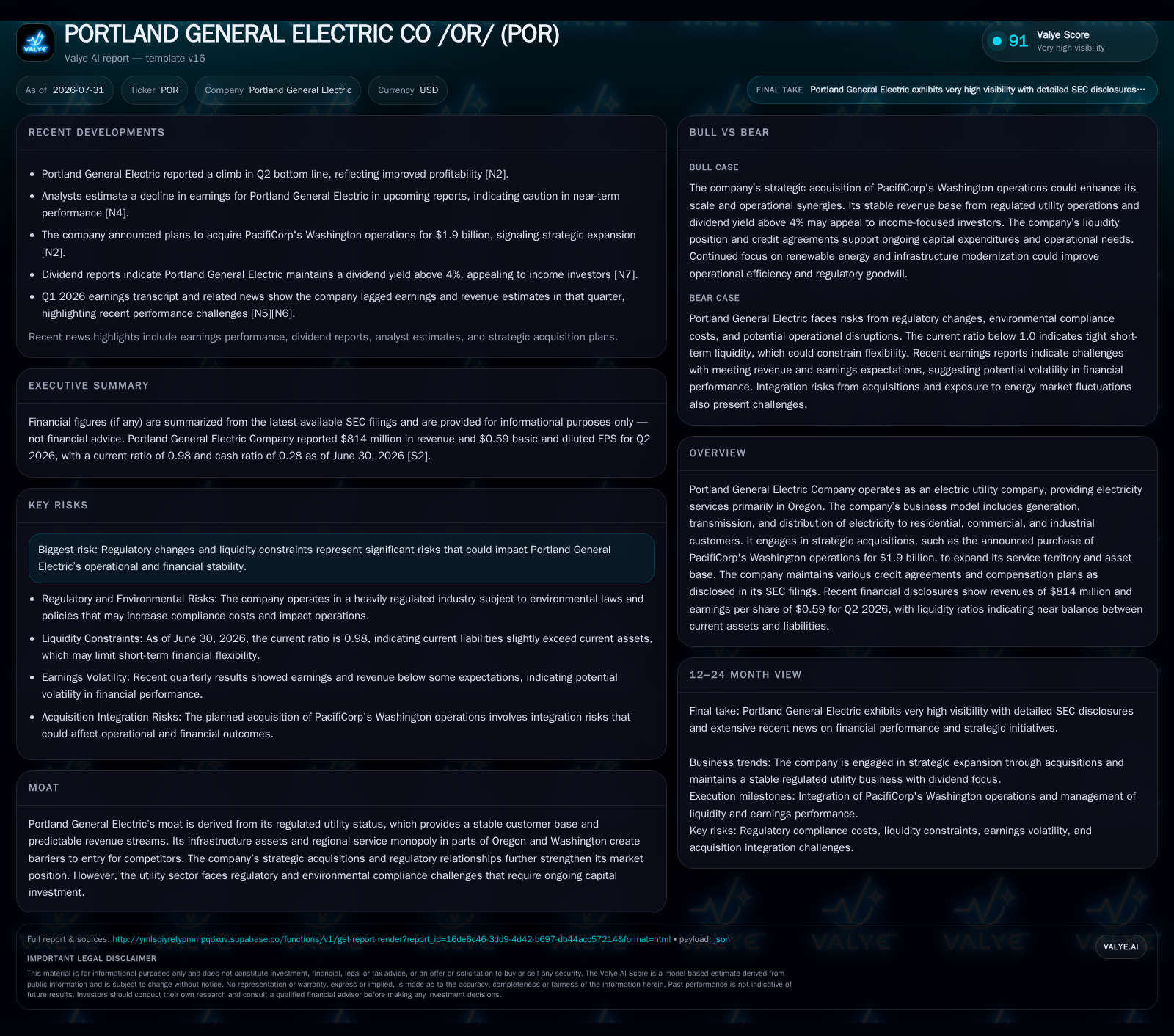
Portland General Electric Company (PGE) reported Q2 2026 results reflecting ongoing stability in revenues from its regulated electric utility operations primarily in Oregon, while executing a significant $1.9 billion acquisition to expand its service territory into Washington. The business model leverages a regulated rate base with consistent cash flow underpinned by tariff-based electricity delivery. PGE’s growth is driven by strategic asset purchases and regulatory support for infrastructure modernization amid decarbonization mandates, but remains exposed to regulatory risk and capital intensity pressures. Monitoring rate case outcomes, integration progress, and liquidity metrics will be critical to assessing sustainable earnings growth.
Recent Operating Update
Portland General Electric (PGE) disclosed Q2 2026 financials showing revenue of approximately $814 million and an earnings per share (EPS) of $0.59, reinforcing the company’s steady cash generation from its regulated utility operations primarily serving residential, commercial, and industrial customers in Oregon [S2]. These figures reflect the underlying business model's reliance on regulated tariffs and consumption volumes rather than discretionary sales, providing revenue visibility.
The quarter also highlighted material strategic advancement with PGE’s execution of an asset purchase agreement valued at $1.9 billion to acquire PacifiCorp's electric transmission, distribution, and generation assets serving multiple counties in Washington State including Lewis and Yakima [S22]. This transaction notably broadens PGE’s service territory beyond Oregon, adding generation facilities comprising combined cycle gas turbines and wind farms. The closing consideration is subject to adjustments based on final regulatory asset valuations
Importantly, there have been no material changes to the company’s risk factors since the prior annual report filing; regulatory scrutiny, capital investment demands, wildfire-related liability exposure remain central uncertainties [S2], [S1]. Rule 10b5-1 trading plans adopted by top executives further indicate internal governance rigor around stock transactions [S9].
Business Model Analysis
PGE operates as a vertically integrated electric utility encompassing electricity generation, high-voltage transmission grid operation, and low-voltage distribution networks delivering power primarily to Oregon customers. Revenues derive predominantly from regulated tariffs approved by state agencies such as the Oregon Public Utility Commission (OPUC), which set allowed returns on the company's rate base — essentially the depreciated value of assets used in service.
The company monetizes electricity delivery based on volumetric consumption (megawatt hours sold) multiplied by average revenue per kilowatt-hour (kWh), modulated by peak demand periods impacting capacity requirements. As a utility holding regional monopoly rights in most of its served districts, customer retention is stable barring substitution technologies or regulatory changes.
Capital expenditures are substantial due to ongoing needs for infrastructure upgrades that support grid modernization—including smart grid enhancements—and compliance with renewable portfolio standards promoting decarbonization through increased integration of wind and solar power assets.
The recent addition of PacifiCorp's Washington assets introduces new generation capacity (combined cycle gas turbines plus wind) thereby diversifying PGE’s energy mix but also adding complexity in operational management and regulatory compliance across two states.
Industry Structure and Competitive Position
The electric utilities sector in which PGE operates is characterized by heavy regulation with long-lived capital assets forming an entrenched regulated asset base (RAB). Vertical integration affords control over generation-to-customer delivery pathways but imposes capital intensity requiring efficient cost management.
Peer utilities like Duke Energy illustrate scale advantages across generation types while NextEra Energy showcases expansive renewable investments; regional players like Eversource focus on distribution-transmission synergies similarly faced by PGE.
PGE’s negotiated settlement for recovery of its Distribution System Plan (DSP) Alternative Recovery Mechanism (ARM) signals effective engagement with regulators to secure rate base growth ($218 million increase) at sustained return on equity levels (approximately 9.34%) maintaining profitability fundamentals though subject to final OPUC approval scheduled early in 2026 [S18]. This outcome underscores the criticality of regulatory decisions driving revenue trajectory more than market competition.
Growth Drivers
Strategic expansion via acquisition is a core growth vector as evidenced by the PacifiCorp deal that not only enlarges PGE’s customer base but enhances scale in generation assets — crucial for meeting increasing peak demand driven by regional population growth and electrification trends (e.g., electric vehicles).
Regulatory incentives tied to grid modernization initiatives foster capital deployment aimed at improving system reliability metrics (such as SAIDI/SAIFI) while enabling greater renewable penetration aligned with Oregon’s decarbonization targets.
Demand drivers also include residential heating electrification programs, commercial sector expansion, and industry energy efficiency protocols.
Continued investments supported by approved rate cases facilitate earnings stability through regulated margin capture on infrastructure upgrades that integrate distributed energy resources.
Operational KPIs like megawatt hours sold, system peak demand increases, and effective capacity utilization will be leading indicators for sustained top-line strength.
Risks and Watchpoints
Regulatory risk remains paramount given dependence on OPUC rulings for cost recovery rates and return parameters. Rate cases carry inherent uncertainty over allowed returns or disallowed costs impacting earnings predictability.
Capital intensity necessitates robust liquidity management; although current ratio near 0.98 denotes balance between short-term assets/liabilities, total debt approximating $4.68 billion indicates material leverage requiring refinancing discipline [F1]
Wildfire liabilities continue posing credit or insurance access challenges which could constrain future capital projects or elevate operating costs if liability regimes evolve negatively.
Acquisition integration risks loom around operational alignment of new Washington-era assets within existing systems while preserving service quality.
Commodity price fluctuations may influence fuel cost components even if largely passed through via rate mechanisms.
Technological disruptions such as increased behind-the-meter solar adoption or emerging storage solutions could pressure traditional load factors over time.
What To Watch Next
Key milestones include final OPUC decision expected around March 2026 on the DSP ARM docket confirming incremental revenues effective April 2026 [S18]. Progress reports on PacifiCorp asset acquisition integration post-closing will reveal synergy realization capability.
Monitoring quarterly megawatt hours sold figures alongside system reliability data will inform demand trends versus historical baselines.
Liquidity events such as debt refinancing or equity issuance activity tied to funding acquisition or capex pipelines require close attention given scale of investment commitments [S25]
Additional commentary from upcoming investor earnings calls may clarify management outlook on evolving regulatory environment impacts or updated adjusted earnings guidance assumptions.
Financial Profile Discussion
At mid-year June 30, 2026 snapshot metrics indicate current assets around $1.04 billion adequately cover current liabilities approximating $1.07 billion maintaining a current ratio just below unity at ~0.98 suggesting manageable near-term liquidity balances [F1]
Total debt sits near $4.68 billion with net debt after cash estimated at ~$4.39 billion reflecting significant leverage typical within capital-intensive utilities reliant on predictable regulatory cash flows for servicing obligations [F1]
Operating income reported most recently was about $555 million year-end 2025 supporting ongoing core profitability though net income detail is less current potentially affected by non-GAAP adjustments linked to recovery dockets [F1], [S24].
Capital expenditure demands connected to decarbonization efforts alongside financing costs emphasize criticality of regulatory-approved returns sustaining free cash flow conversion necessary for maintaining credit metrics consistent with investment-grade ratings.
Executive compensation policy adherence coupled with insider trading arrangements based on Rule 10b5-1 plans suggests stable governance frameworks supporting financial discipline [S9], [S16].
This analysis integrates latest SEC-filed disclosures through July 2026 relating to Portland General Electric Company without extrapolating beyond reported data or speculating on unverified forecasts. It contextualizes operating results within broader industry dynamics including regulation-driven business models typical among U.S.-based vertically integrated electric utilities.
Disclaimer: This is research-only, informational analysis and not investment advice. It may include AI-generated interpretation and general industry context. Always verify important details using primary sources.

Comments