
Four Corners Property Trust’s Stable Net Lease Model Faces Tenant and Financing Challenges
Latest quarterly results highlight continued portfolio diversification but underscore headwinds from tenant concentration and rising interest costs.
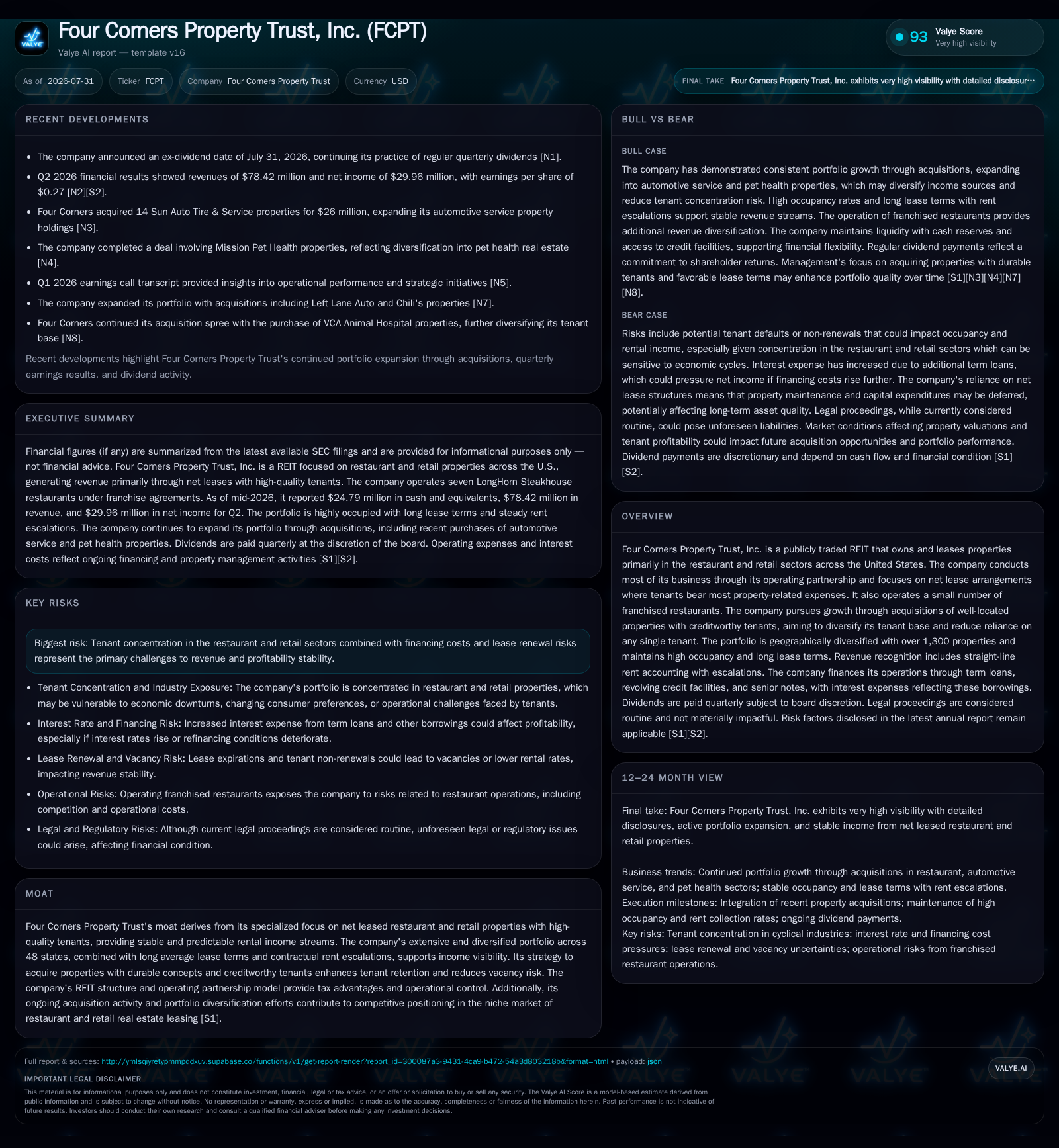
Four Corners Property Trust, Inc. (FCPT) reported its Q2 2026 results revealing solid occupancy and a geographically diversified portfolio of over 1,300 net-leased retail and restaurant properties. However, funds from operations (FFO) and revenues lagged estimates, partly reflecting retail sector pressures and elevated financing expenses. The company’s business model centers on acquiring high-credit tenants with long lease terms under triple-net leases that enhance cash flow predictability but remain exposed to restaurant sector dynamics and lease renewal risk. Its sizable debt load coupled with prevailing interest rates shapes its financial flexibility, while ongoing acquisition activity supports growth ambitions. Key near-term focus areas include tenant credit quality trends, lease renewal metrics, and management’s ability to optimize capital structure amid the current market environment.
Recent Quarterly Operating Update Highlights Portfolio Strength Amid Earnings Miss
In its latest quarterly filing for the period ended June 30, 2026, Four Corners Property Trust (FCPT) disclosed results reflecting continued strength in core portfolio metrics but also pressure on operating income indicators. Revenue recognition follows straight-line accounting with contractual escalations under its predominantly triple-net leases—where tenants bear property taxes, insurance, and maintenance—which supports stable income quality despite sector headwinds [S2][S3]. However, reported funds from operations (FFO) and total revenues modestly missed consensus estimates as some tenants in the restaurant sector faced operational difficulties, impacting rent collection timing and renewal negotiations [S3][N2]. This shortfall underscores the inherent cyclical sensitivities lurking within FCPT's otherwise defensive rent roll concentrated in dining establishments.
The recent event filing emphasized no material change to the company's risk profile from the annual report but highlighted ongoing monitoring of tenant creditworthiness and lease renewal rates as key focal points. The ex-dividend date reminder shortly after quarters’ end reflects continued commitment to shareholder distributions though with cautious commentary around future payouts being dependent on operating cash flows amid external uncertainties [S2][N1]
Business Model Specifics: Triple-Net Leasing Anchors Stability With Sector Concentration Nuance
Four Corners Property Trust operates primarily as a net lease REIT specializing in restaurant and retail property ownership throughout the United States. The company manages an extensive portfolio exceeding 1,300 properties spanning 48 states which provides diversified exposure intended to mitigate concentration risk at both geographic and tenant levels [S1]. The net lease structure transfers most property-related costs—such as maintenance, taxes, and insurance—to tenants under triple-net (NNN) agreements, insulating FCPT from operational variability common to more hands-on real estate models.
Revenue arises mainly via monthly base rents subject to contractual rent escalations typically structured annually or at specified intervals over long average lease terms extending several years [S1]. This blend yields predictable rental income streams aligned with inflationary trends without requiring constant active property management interventions. Additionally, the company holds a small subset of franchised restaurant operations but these represent a minor component relative to overall leasing revenue
However, dependence on restaurant tenants introduces cyclical volatility related to consumer discretionary spending patterns which can fluctuate due to macroeconomic shifts or changing dining habits. Tenant creditworthiness directly influences default risk premiums embedded within FFO calculations; thus maintaining diverse tenant profiles is crucial for stability. The company's strategy deliberately targets well-capitalized operators with durable demand drivers to support ongoing occupancy and minimize downtime between leases.
Industry Structure & Competitive Positioning: Middle-Tier Net Lease Player Amid Established Peers
Within the broader Real Estate Investment Trust sphere, FCPT situates itself as a specialized net lease entity focused narrowly on retail and restaurant sectors—a niche characterized by stable but sector-sensitive cash flows. Peer comparisons include Realty Income Corporation (ticker O) and National Retail Properties (ticker NNN), both seasoned net lease REITs with even larger portfolios emphasizing retail diversification including service-oriented tenants which may offer differing risk profiles.
Compared with general commercial REITs managing office or multifamily assets requiring extensive operational inputs, net lease REITs like FCPT benefit from lower capex variability but face unique challenges tied closely to tenant industry health rather than property condition alone. Metrics such as occupancy rate (historically robust for FCPT), weighted average remaining lease term (WALT), tenant concentration indices, and same-store NOI growth serve as standard KPIs assessing durability across this competitive set.
Additionally, capital structure benchmarking is critical given these REITs' heavy reliance on debt financing; peer interest coverage ratios guide investor views on leverage tolerance within rising rate environments. Although FCPT maintains investment-grade rating profiles supported by hedging strategies on fixed-rate debt totaling over $1 billion outstanding [F1], sustained interest expense pressures remain a watchpoint particularly against peers employing more aggressive refinancing tactics or equity raises for balance sheet optimization.
Growth Drivers: Accretive Acquisitions & Lease Escalations Fuel Pipeline Expansion
Business expansion is principally driven through selective property acquisitions targeting well-located assets leased to creditworthy tenants under newly negotiated or assumed triple-net contracts. This acquisition-centric growth approach complements organic rental escalations inherent in existing leases that typically feature fixed or CPI-linked rent bumps scheduled throughout terms.
Geographic breadth reduces localized market downturn impact while tenant diversification curtails dependence on singular large operators—though concentrated exposure nonetheless persists within popular quick-service or full-service dining brands common in FCPT's portfolio mix [S1][S2]. Continued deployment of capital into acquisitions that meet underwriting criteria including yield accretion potential remains central to sustaining top-line growth absent major economic disruptions.
Lease renewal success rates also function as a proxy for portfolio health; favorable renewals minimize vacancy absorption costs while reinforcing income visibility across extended time horizons. The company’s ability to identify replacement tenants rapidly in markets exhibiting competitive demand for net leased sites serves as another operational lever enhancing FFO resilience.
Risks & Watchpoints: Tenant Sector Vulnerability And Financing Costs Under Scrutiny
Despite structural strengths, FCPT confronts notable risks primarily emanating from its tenant base composition heavily skewed toward restaurant operators exposed to evolving consumer preferences amid inflationary cost pressures impacting discretionary spending patterns [S1]. Should economic slowdowns intensify or pandemic-type disruptions recur intermittently affecting foot traffic volumes, revenue streams could experience stress via rental deferrals or defaults.
Furthermore, financing risks stem from substantial leverage standing near $1.27 billion alongside limited cash reserves at approximately $25 million as of Q2-end [F1], necessitating vigilant liquidity management amidst an environment marked by elevated borrowing costs. Interest expenses weigh heavily on net income margins; although hedging strategies moderate volatility somewhat, protracted rate hikes present persistent headwinds challenging dividend payout sustainability especially if acquisition volume slows reducing incremental scale benefits.
Lease renewal pricing power might be constrained should competitor supply increase or if new retail formats dilate demand for traditional store footprints–factors requiring active portfolio repositioning efforts by management through disposition or re-leasing strategies.
What To Watch Next: Lease Renewal Outcomes And Capital Allocation Moves
Key upcoming catalysts include monitoring subsequent quarterly releases for improvement or deterioration signals in same-store NOI growth and FFO trajectory relative to analysts’ estimates post recent shortfall disclosures [N2]. Updates around high-profile tenant renewals or vacancies will illuminate portfolio stability amid sector flux.
Acquisition announcements or dispositions will shed light on management's agility in reallocating capital effectively especially if macroeconomic uncertainty persists. Debt refinancing plans or amendments signaling adjustments in maturity profiles or interest rates may influence perceived financial risk profiles impacting valuation multiples assigned by investors relative to peers.
Dividend declaration adjustments beyond normal quarterly cadence could serve as bellwethers reflecting liquidity priorities balancing payout commitments against reinvestment needs.
Financial Profile Discussion
As of June 30, 2026, Four Corners Property Trust held approximately $24.8 million in cash and equivalents juxtaposed against roughly $1.27 billion in total debt resulting in net debt near $1.24 billion [F1]. This leverage level aligns with typical net lease REIT profiles but necessitates ongoing scrutiny given volatile market interest rates contributing notable expense burdens flagged during the quarter’s earnings discussion [S3]. Operating cash flows remain critical in funding distributions alongside capital expenditures related primarily to property improvements or leasing costs incurred during tenant transitions.
The company’s dividend policy maintains regular quarterly payments subject to board discretion contingent on available operating funds—a prudent approach given external uncertainties noted earlier [S1][N1]. Investors tracking FCPT should weigh distribution yield attractiveness against adjusted funds from operations (AFFO) coverage ratios when available for transparent assessment of dividend sustainability under prevailing conditions.
Overall liquidity appears sufficient for near-term obligations though medium-term refinancing timelines warrant attention especially if capital markets conditions tighten further affecting access costs or availability.
This analysis incorporates information from Four Corners Property Trust's latest SEC filings including their Q2 2026 Form 10-Q filed July 30, 2026 ([S2]), the recent earnings press release dated July 29,[S3], their latest annual report dated February 12, 2026 ([S1]), along with current financial metrics retrieved from companyfacts data ([F1]) and corroborated by relevant market news ([N1],[N2]). It leverages industry-standard real estate investment trust frameworks emphasizing net lease retail/restaurant models without making investment research views.
Disclaimer: This is research-only, informational analysis and not investment advice. It may include AI-generated interpretation and general industry context. Always verify important details using primary sources.

Comments