
HWH International Balances Nascent Marketplace Growth with Physical Venue and Education Expansion Amid Nasdaq Compliance Challenge
Latest quarter shows ongoing capital reliance and early-stage operational diversification in consumer marketplaces, cafés, and educational services.
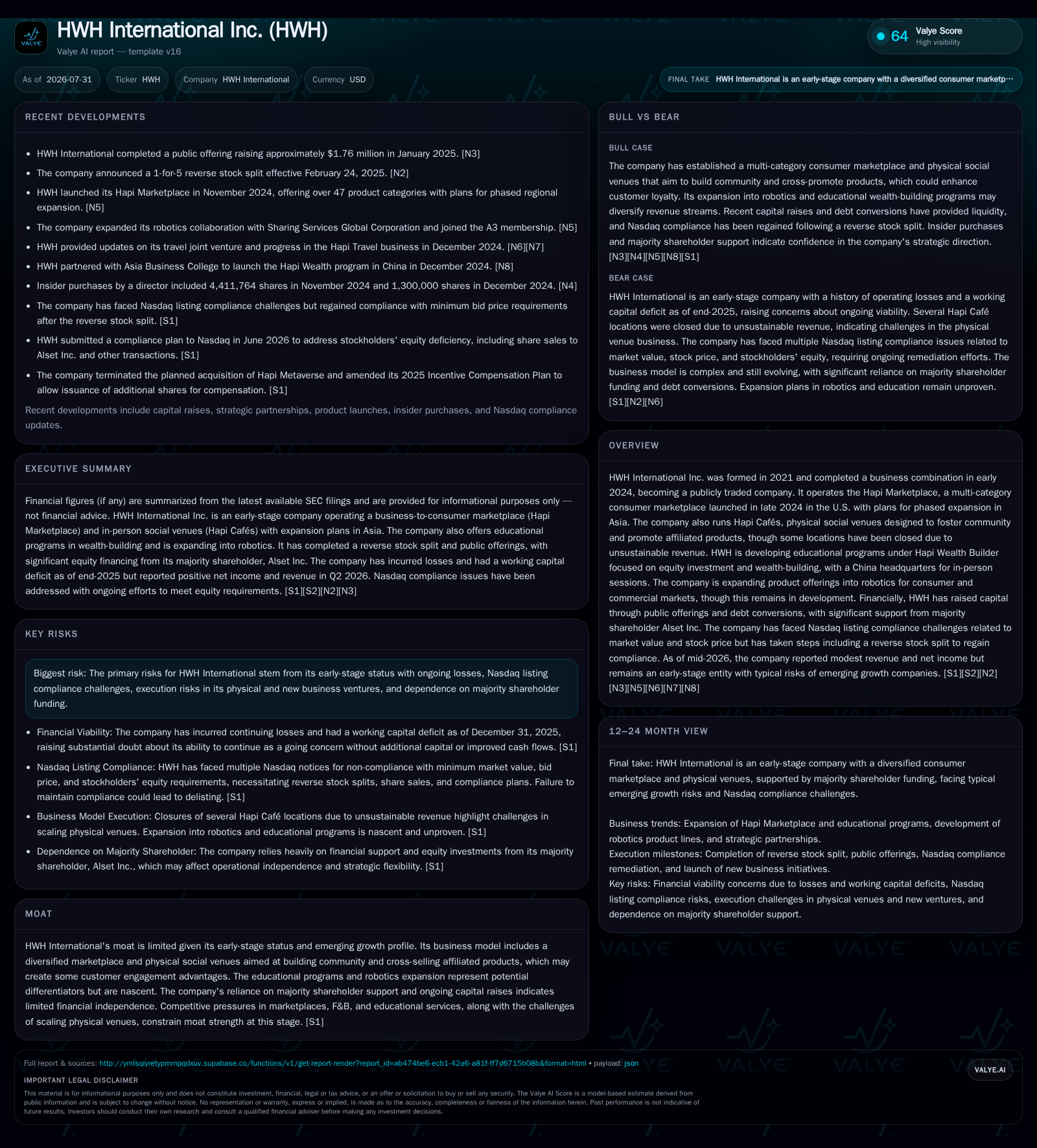
HWH International Inc., an emerging multi-category consumer marketplace operator with physical social venues and educational programs, reported continued early-stage losses and sustained dependence on majority shareholder financial support in its latest quarter. Having launched its Hapi Marketplace in late 2024, the company is expanding geographically and into robotics product offerings, while grappling with physical venue sustainability challenges demonstrated by café closures. Concurrently, HWH faces Nasdaq listing compliance pressure with a recent extension to meet stockholders' equity requirements. The firm’s diversified but immature business model, spanning online marketplace sales, food and beverage revenue from cafés, and educational program fees, highlights both growth ambitions and execution risks typical in this sector.
Recent Operating Update
In its July 30, 2026 10-Q filing, HWH International reported continued operational challenges typical of an early-stage diversified consumer services company. The company disclosed ongoing losses aligning with prior periods ([S2]). Latest balance sheet data confirm $1.5 million cash balances against about $340 thousand total debt as of June 30, 2026, yielding a healthy current ratio near 1.8—indicative of enough short-term liquidity but minimal margin for unforeseen operating stress ([F1]). Despite cash availability, the company remains dependent on Alset Inc., its majority stockholder, for financial support through credit facilities and equity investments as previously documented ([S1],[S5]).
Critically impacting near-term outlook, HWH received an extension from Nasdaq to August 31, 2026 to comply with minimum stockholders’ equity requirements needed to maintain listing status ([S3],[S24]). This regulatory deadline adds pressure on capital raising efforts and operational execution.
Business Model: Multi-Channel Consumer Services Platform
HWH International operates a multi-pronged business model consisting of an online consumer marketplace (Hapi Marketplace), physical social venues (Hapi Cafés), educational programs (Hapi Wealth Builder), and nascent product development in robotics. This approach attempts to blend scalable digital commerce with experiential retail and knowledge offerings.
Hapi Marketplace: Launched in November 2024 initially within the U.S., the marketplace offers over forty-seven product categories ranging from wellness to elderly care products. Revenue recognition likely occurs through direct product sales margins or commission models typical of B2C marketplaces. Phased geographic expansion into South Korea and Hong Kong is planned pending logistical setup such as payment gateway integration and regulatory approvals ([S1],[S9]). The marketplace’s gross merchandise volume (GMV) growth trajectory remains unquantified publicly but is central to top-line expansion.
Educational Programs: Under the Hapi Wealth Builder brand, HWH is developing specialized courses on equity investment strategies aimed at building customer wealth literacy and engagement. With an established headquarters in China geared towards physical workshops and digital content development underway domestically, this segment ties into personalized learning monetization models seen among education platforms where enrollment growth and course completion rates drive recurring or episodic fee income ([S1],[S11]).
Robotics Expansion: The company's intention to broaden product offerings into consumer/commercial robotics remains exploratory as of December 31, 2025. Progress here will depend heavily on research & development milestones, market acceptance trials, manufacturing capabilities, regulatory clearances, and eventual commercialization success ([S1],[S9]).
Overall monetization hinges on direct consumer spending via marketplace transactions; venue revenues derived from F&B margins; educational program fees or subscriptions; and potentially licensing or direct sales from robotics innovation.
Industry Structure and Competitive Position
The consumer services marketplace sector features high fragmentation given diverse product categories coupled with intense competition both online (e.g., Etsy, eBay) and offline (e.g., established café chains). Differentiation is challenging without scale economies or distinctive brand ecosystems.
Physical social venues like cafés require critical mass location networks to reach sustainable average revenue per location benchmarks akin to regional café chains that focus rigorously on same-store-sales growth metrics (). Closure of unprofitable sites may improve unit economics but limits brand exposure opportunities.
Educational service providers face scalability constraints unless digital content delivery can achieve broad adoption; regionalized workshop models limit reachable customer segments outside geographic hubs.
Robotics remains nascent; successful entrants are defined by innovation leadership combined with agile market entry.
Compared with peers spanning standalone marketplaces or F&B operators or education platforms alone, HWH’s hybrid model introduces complexity but may create cross-selling synergies if execution suffices.
Growth Drivers
Several vectors support potential scaling:
- Expanding product breadth within Hapi Marketplace alongside gradual Asian market entry could increase GMV substantially if logistics are nailed down.
- Increasing membership uptake driven by attractive affiliate benefits might lift customer lifetime value through discounts incentivizing more frequent purchases.
- Physical footprint growth of cafés may provide viral marketing channels once unit economics stabilize.
- Commercialization of robotics products could open new high-margin revenue streams yet requires significant R&D conversion.
- Educational program rollout taps growing consumer interest in personal finance literacy post-pandemic.
- Cross-selling opportunities across marketplace buyers engaged at cafés or enrolled in education could deepen engagement metrics like retention rates or repeat purchase frequency ().
- Capital injections—including recent $10 million securities purchase agreement—enhance operational runway for marketing investments linked directly to demand generation ([S24]).
Risks & Watchpoints
Primary risks include:
- Execution risk inherent in managing diverse channels combining digital commerce with brick-and-mortar venues plus education programming;
- Customer acquisition cost pressures amid competitive marketplaces constraining profitability;
- Continued dependence on majority shareholder funding amidst Nasdaq listing compliance deadlines inducing liquidity constraints;
- Sustained struggles to generate profitable revenue from physical cafés necessitating strategic rethink or downsizing;
- Uncertainty over market acceptance timing if robotics development delays occur;
- Regulatory risks impacting international expansions and educational service credentials;
- Dilution stemming from repeated capital raises influencing shareholder composition negatively ([S1],[S3],).
Monitoring retention trends across subscription membership tiers or increases in average order values will indicate traction progress. Foot traffic stabilization at cafés alongside expanded enrollment/completion rates in wealth-building courses signal validation milestones.
What To Watch Next
Upcoming milestones include:
- The September 30 quarterly report that must demonstrate Nasdaq stockholders’ equity compliance per extension terms;
- Further details or launch timelines concerning robotics products currently under development;
- Expansion announcements into Asian markets beyond initial phases for both marketplace presence and café rollouts;
- Enrollment figures or digital content release schedules tied to Hapi Wealth Builder’s education offerings;
- Subsequent capital raising outcomes affecting liquidity cushions needed for operational scaling.
Financial Profile Discussion
As of June 30, 2026, the company held $1.5 million cash against $339 thousand total debt resulting in negative net debt of approximately $1.17 million—indicative of manageable leverage levels at this stage ([F1]). Current assets stood at about $3 million versus current liabilities near $1.63 million yielding a stable liquidity ratio of approximately 1.8 times which should cover near-term obligations comfortably ([F1]).
Revenues remain modest with $867 thousand recorded for full-year ended December 31, 2025 whereas net loss was substantial at roughly $2.6 million reflecting investments across all business verticals without operational scale yet achieved ([F1]).
Funding history shows reliance on equity injections plus debt conversions mainly involving Alset Inc., underscoring significant related-party support critical for sustaining early-stage growth plans ([S1],[S5],[S6],[S24]). Effective cash burn management combined with successful attainment of Nasdaq compliance benchmarks will be necessary preconditions before profitability becomes attainable.
This analysis strictly reflects publicly filed data through July 2026 without forward-looking assurances regarding future company performance or prospects. It frames HWH International’s complex multi-channel consumer services strategy within prevailing industry dynamics emphasizing growth potential tempered by execution risk typical at this stage.
Disclaimer: This is research-only, informational analysis and not investment advice. It may include AI-generated interpretation and general industry context. Always verify important details using primary sources.

Comments