
National Fuel Gas Strengthens Dividend and Liquidity Despite Commodity Pressures
National Fuel Gas’s Q3 2026 results underscore the resilience of its integrated business model, supported by regulatory rate mechanisms and disciplined capital management.
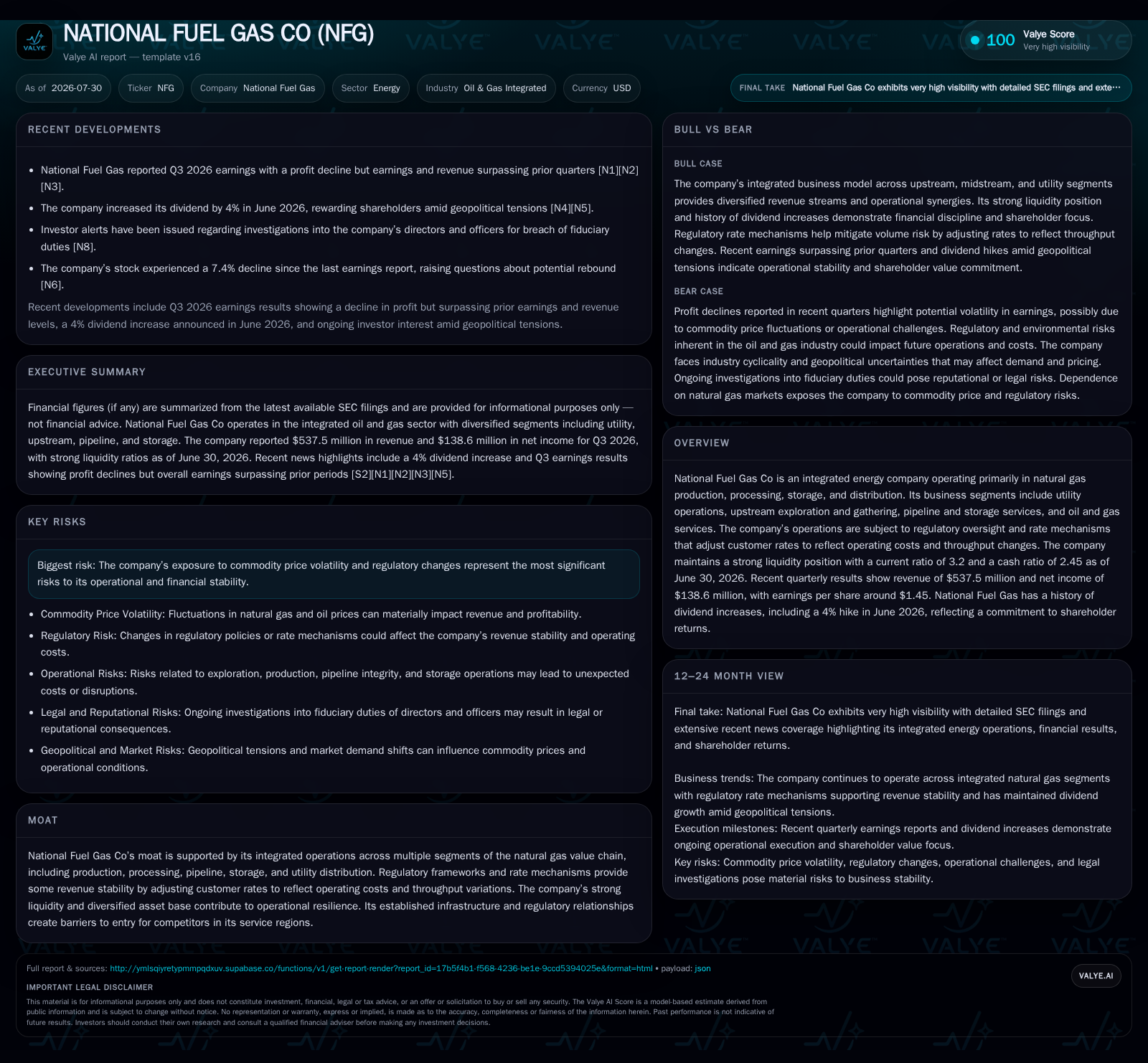
National Fuel Gas Co reported solid third-quarter 2026 financial results with revenues reaching $537.5 million and net income of $138.6 million, driven by an integrated natural gas value chain spanning upstream production, midstream pipeline and storage, and regulated utility distribution. The company raised its dividend by 4%, reflecting confidence in stable cash flows sustained through regulatory rate base adjustments that buffer commodity price volatility. Strong liquidity metrics with a current ratio of 3.2 enable ongoing infrastructure investments while maintaining financial flexibility. Going forward, monitoring throughput volumes and regulatory approvals will be key indicators of growth opportunities balanced against exposure to commodity price fluctuations and evolving regulatory frameworks.
Q3 Operating Pulse: Solid Results Back Dividend Commitment
National Fuel Gas Company (NFG) reported third-quarter 2026 revenues of $537.5 million alongside net income totaling $138.6 million, translating to earnings per share near $1.45—a result that surpassed consensus expectations according to Nasdaq reports [S2][N1][N2]. These figures reveal a steady operating rhythm supported by the company’s multi-segment integration which diversifies risk across the natural gas value chain.
Echoing this confidence, management declared a 4% dividend increase in June 2026, signaling strong underlying cash flow generation consistent with regulated utility earnings profiles [S3][N9]. The dividend boost aligns with National Fuel Gas's longstanding pattern of annual increases despite macroeconomic headwinds from volatile commodity markets.
Integrated Business Model: Navigating Production, Pipelines, and Utility Regulation
National Fuel Gas operates an integrated oil and gas business model combining upstream exploration and production activities with midstream pipeline transportation plus storage services and downstream regulated utility distribution primarily focused on natural gas [S1]. Upstream operations deliver production volumes subject to commodity price cycles yet enjoy partial mitigation through hedging arrangements detailed in recent filings [S2]. Midstream assets generate tariff-based revenue linked directly to pipeline throughput volumes rather than commodity prices, offering predictable fee income streams.
The utility segment distributes natural gas under a rate base regulation framework where customer rates adjust based on capital investments and throughput fluctuations—ultimately providing more stable earnings than typical open-market sales [S1][F1]. This vertical integration secures control over supply chains from production fields to end customers across residential, commercial, and industrial markets.
Regulatory Rate Mechanisms Cushion Revenue Volatility
Critical to National Fuel Gas’s earnings stability is the deployment of regulatory rate mechanisms within its utility operations that enable adjustments reflecting operating cost changes as well as throughput volume variances due to conservation or weather patterns [S1][S2]. These rate adjustments reduce earnings sensitivity to demand fluctuations, offering a cushion during periods of lower consumption or temporarily depressed production.
By maintaining constructive relations with regulators and successfully navigating rate case filings, the company ensures timely recovery of prudently incurred costs alongside returns on invested capital. The presence of such mechanisms balances operational margin pressures often seen in pure exploration companies lacking regulated utility insulation.
Managing Commodity Exposure via Diversification and Hedging
While National Fuel Gas’s upstream segment remains exposed to natural gas price volatility—which can materially impact profits—the diversification across midstream and downstream regulated operations limits overall corporate risk exposure [S1][S2]. The company has employed hedging strategies to stabilize commodity-related cash flow variability, as disclosed in their quarterly reports.
This layered exposure means that while short-term swings in energy prices may affect upstream results visibly in net income figures from quarter to quarter, fee-based segments provide steadier revenue streams supporting ongoing capital deployment and dividend distributions.
Infrastructure Investments: Capacity Growth vs Capital Discipline
National Fuel Gas continues capital expenditures targeting expansion of its pipeline assets along with enhancements in storage capacity—critical infrastructure components for meeting growing regional demand for natural gas delivery [S1][N8]. These investments are balanced against maintaining its robust liquidity position and prudent leverage levels.
Its current liquidity profile—with a current ratio standing at approximately 3.2 as of June 30, 2026—supports both ongoing infrastructure spending necessary for capacity growth and flexibility to manage unforeseen contingencies or market shifts without stress on financial health [F1][S2]
What Risks Could Pressure Margins? Commodity Prices and Regulation Watch
The company faces notable risks from fluctuating commodity prices impacting upstream profitability directly alongside potential regulatory developments that could alter pipeline tariffs or delay utility rate approvals [S1][N5]. Operational safety standards must be continually upheld given the capital-intensive nature of pipeline management where integrity incidents can lead to costly outages or penalties.
Inflationary pressures on operating expenses or extended project delays could impede margin expansion despite rate case recoveries; these factors necessitate close monitoring amid an evolving energy policy landscape emphasizing emissions reductions that might influence natural gas usage trends.
Soon to Watch: Milestones on Throughput Growth & Regulatory Approvals
Near-term catalysts include progress on regulatory approvals for new tariff requests tied to pipeline expansions as well as customer uptake driving higher throughput volumes across the midstream system [S3][N8]. Improvements in storage utilization rates would further enhance earned fee revenues providing incremental margin uplift.
These indicators serve as discrete performance markers confirming whether ongoing infrastructure investments translate into sustainable volume growth aligned with long-term strategic ambitions underpinned by regulatory compliance.
Financial Profile Discussion: Strong Liquidity Supports Strategy Execution
As of June 30, 2026, National Fuel Gas held approximately $1.24 billion in cash and equivalents alongside current assets totaling around $1.61 billion versus current liabilities near $504 million—yielding a strong current ratio of roughly 3.2 which underscores robust short-term financial flexibility [F1][S2]
This comfortable liquidity position combined with conservative capital management practices provides a solid foundation for balancing shareholder return priorities with reinvestment needs in a cyclical yet increasingly regulated industry environment.
Disclaimer: This analysis is for informational purposes only based on publicly available data sources including recent SEC filings and news reports at the time indicated. It does not constitute investment advice or research views.
Disclaimer: This is research-only, informational analysis and not investment advice. It may include AI-generated interpretation and general industry context. Always verify important details using primary sources.

Comments