
Deckers Strengthens Omnichannel Growth and Premium Brands While Managing Sourcing Risks
Deckers leverages its strong brand portfolio and omnichannel distribution to drive revenue and margin expansion amid supply chain concentration concerns.
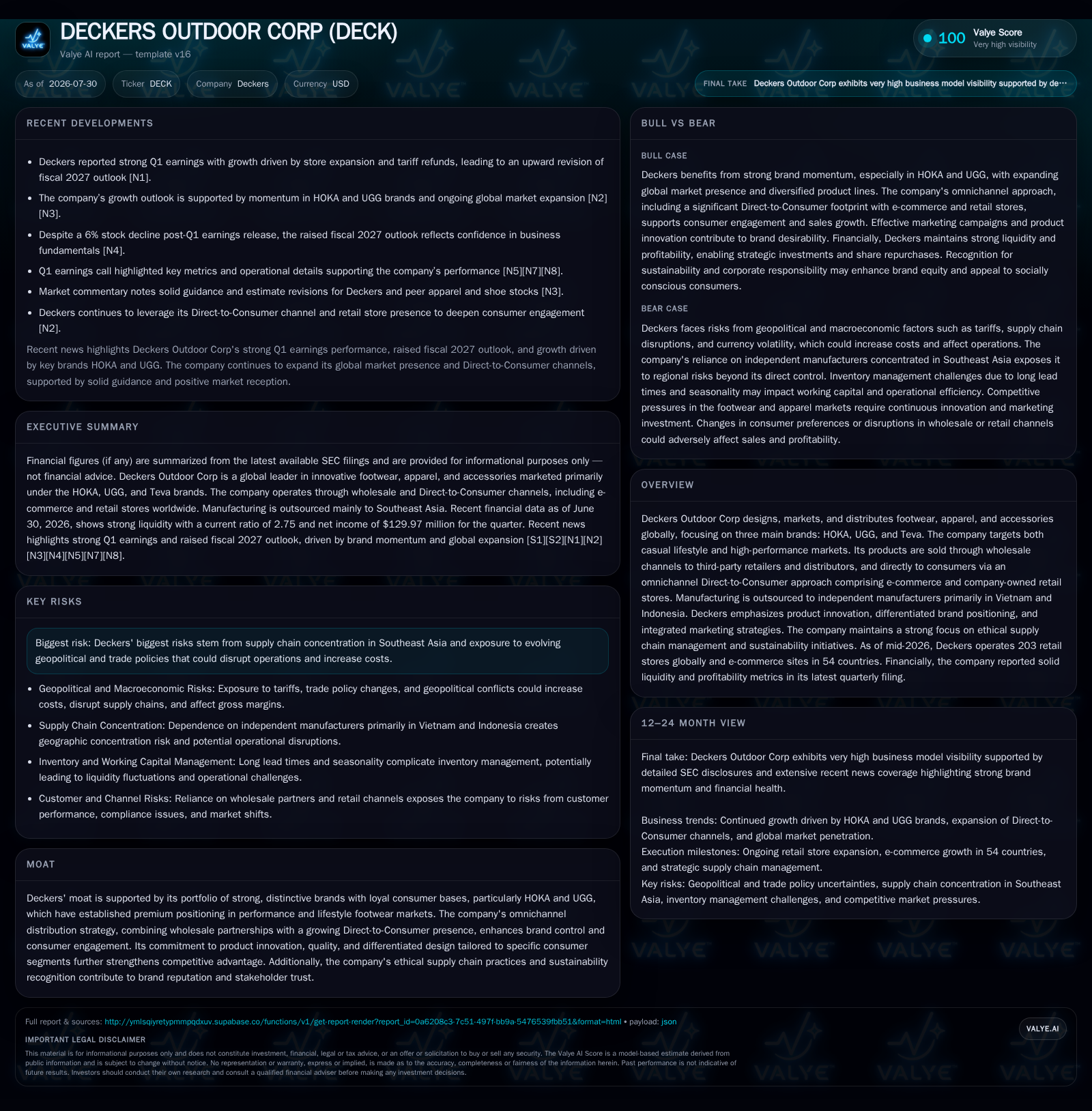
In its latest quarter ending June 30, 2026, Deckers Outdoor Corp demonstrated robust revenue growth driven by both wholesale and Direct-to-Consumer (DTC) channels, supported by standout performances from its HOKA and UGG brands. The company’s strategy combining product innovation, premium brand positioning, and omnichannel distribution—including expanding e-commerce penetration and retail store footprint—continues to underpin solid consumer demand globally. However, supply chain risks persist due to manufacturing concentration primarily in Southeast Asia, exposing Deckers to potential geopolitical and trade disruptions. Financially, the company maintains a strong liquidity position with no reported debt, supporting its operational flexibility going forward.
Recent Operating Update: Q1 Fiscal 2027 Highlights
Deckers Outdoor Corp’s fiscal Q1 ending June 30, 2026, showcased continued momentum across its key brands driven by a balanced sales mix between wholesale channels and a stronger Direct-to-Consumer (DTC) presence [S2][S3]. The company reported notable revenue gains facilitated by expanding its retail footprint globally to 203 stores alongside robust e-commerce operations active in 54 countries [S1]. These results emphasize Deckers’ effective execution of an omnichannel sales strategy that leverages both traditional wholesale partnerships with third-party retailers and direct engagement with consumers through owned physical stores and digital platforms.
Underlying this top-line strength is sustained consumer demand for the HOKA line of performance footwear as well as the iconic UGG lifestyle brand. Both brands benefit from ongoing product innovation investments supported by targeted marketing campaigns designed to deepen customer loyalty across diverse demographics [S1]. HOKA has broadened beyond its ultra-runner origins into trail, hiking, fitness, and lifestyle footwear categories while UGG continues to refine its fashion-forward offerings anchored in comfort and premium materials such as sheepskin sourced under fixed contracts to mitigate input cost volatility [S1].
Deckers’ ability to command premium price points with limited reliance on promotional discounting has strengthened gross margins despite inflationary pressures on raw materials [S2]. The company emphasizes differentiated design features coupled with quality assurance through outsourced manufacturing facilities concentrated primarily in Vietnam and Indonesia—regions posing potential risk amid evolving geopolitical tensions [S1]. This concentration necessitates vigilant supply chain management given the industry-wide exposure to trade policy shifts that could disrupt production or increase costs.
Business Model: Premium Branded Omni-Channel Distribution
Deckers operates as a global designer, marketer, and distributor of footwear, apparel, and accessories primarily targeting casual lifestyle consumers alongside performance-focused segments [S1]. Revenue is generated predominantly through two channels: wholesale sales to quality domestic and international retailers plus distributors; and DTC sales encompassing e-commerce websites spanning over five dozen countries plus branded company-owned retail stores worldwide.
This dual-channel model allows Deckers enhanced control over brand positioning while optimizing consumer reach. Wholesale partnerships extend scale efficiently but can dilute direct consumer insights or margin capture compared to DTC channels where Deckers owns the customer relationship end-to-end [N9][N10]. The firm reports an increasing contribution from DTC sales—a trend reflecting broader industry moves toward digital-native engagement reinforced by physical retail touchpoints
Manufacturing is fully outsourced to independent contractors in low-cost Southeast Asian nations, aligning with typical industry practices among branded footwear companies such as Nike or Skechers. This model supports scalable production without heavy fixed asset investment but comes with dependency risks including potential delays or cost escalations driven by labor market dynamics or tariffs [S1][S2]. Deckers partially mitigates material price volatility via fixed sourcing contracts for select inputs like sheepskin for UGG.
The company’s focus on differentiated product innovation—ranging from proprietary cushioning technology in HOKA shoes to seasonal fashion lines under UGG—enhances appeal across multiple customer segments. Marketing efforts emphasize authenticity tied to performance or lifestyle storytelling which helps maintain loyal consumer bases despite fickle fashion preferences common in the apparel industry [S1]. Sustainability programs aligned with ESG principles further enhance consumer perception in socially conscious buyer cohorts.
Industry Structure and Competitive Position
Within the broader Apparel, Footwear, and Accessories sector, Deckers occupies a specialized niche bridging premium lifestyle brands with high-performance athletic footwear lines. Its chief competitors include established global leaders like Nike (athletic performance), VF Corporation (multi-brand lifestyle outdoor), Columbia Sportswear (outdoor apparel/footwear), and Skechers (footwear-focused mass-market/premium segments).
The competitive landscape prioritizes brand equity strength supported by ongoing product innovation cycles that respond swiftly to shifting consumer tastes—including athleisure trends—and emerging technology integrations such as sustainable materials or comfort-enhancing designs. Moreover, companies use omnichannel distribution strategies increasingly blending wholesale reach with direct-to-consumer digital experiences plus selective retail store presence to boost brand intimacy while managing costs.
Deckers leverages its three core brands—HOKA’s growing international presence in run/outdoor specialty accounts; UGG’s iconic status enhanced by broad demographic targeting; and Teva’s outdoor action heritage—to diversify risk exposures while maximizing cross-segment coverage [S1]. This multi-brand portfolio acts as a natural hedge against short-term fashion or economic cycles impacting any single category.
Growth Drivers
Key drivers propelling Deckers’ expansion include:
- Expansion of Direct-to-Consumer Channels: Accelerated rollout of e-commerce capabilities combined with opening new retail locations improves margins via better pricing control while enhancing data-driven marketing efficiency.
- International Market Penetration: Globalizing established brands like HOKA supports incremental revenue outside core North American markets fostering diversification.
- Product Line Innovation: Continuous introduction of new categories (e.g., trail/apparel extensions at HOKA) sustains consumer interest and justifies premium pricing.
- Premiumization Strategy: Focus on technical performance innovations coupled with lifestyle branding increases willingness-to-pay versus mass competitors.
- Sustainability & Ethical Sourcing: Recognized ESG initiatives bolster relevance among increasingly socially conscious consumers contributing indirectly to brand loyalty.
Monitoring these factors through external conditions plus internal indicators such as promotional discount rates or customer acquisition costs will be vital to maintaining sustainable growth trajectories.
What To Watch Next
Upcoming milestones for Deckers include quarterly updates on sales composition shifts between wholesale vs DTC channels which will indicate degree of margin improvement potential [N9]. New product launches especially extensions within HOKA running/trail categories will serve as markers for innovation effectiveness. Watch for guidance commentary relating to supply chain stability given ongoing external geopolitical developments that might affect Southeast Asian manufacturing hubs [N10]. In addition, progress on sustainability goals tracked via formal recognitions or independent ESG ratings will reflect evolving consumer engagement strategies.
Overall execution against these fronts over the next two quarters will confirm whether recent positive momentum remains durable beyond near-term transitory tailwinds evidenced so far.
Financial Profile Discussion
As of June 30, 2026, Deckers exhibited a robust liquidity position with cash & equivalents totaling approximately $1.6 billion against current liabilities near $1.06 billion resulting in a strong current ratio of about 2.75—signaling ample short-term financial flexibility [F1]
In conclusion, Deckers stands positioned with strong brand assets executing an omnichannel distribution model that effectively captures evolving consumer preferences for premium footwear while cautiously managing external supply risks. Continued progress across highlighted operational KPIs alongside financial robustness should enable disciplined scaling of its global footprint amid dynamic apparel sector challenges.
This analysis is based solely on publicly available information including SEC filings dated through July 30, 2026 ([S1], [S2], [S3]) supplemented by verified news sources ([N1]-[N14]) together with accepted industry knowledge frameworks. It does not constitute investment advice but aims to provide an informed view on Deckers’ business model dynamics within the current industry context.
Disclaimer: This is research-only, informational analysis and not investment advice. It may include AI-generated interpretation and general industry context. Always verify important details using primary sources.

Comments