
Dream Finders Homes Expands Footprint with Beazer Bid Amid Industry Headwinds
Dream Finders Homes reports solid H1 revenue and positive net income while navigating acquisition integration and sector challenges.
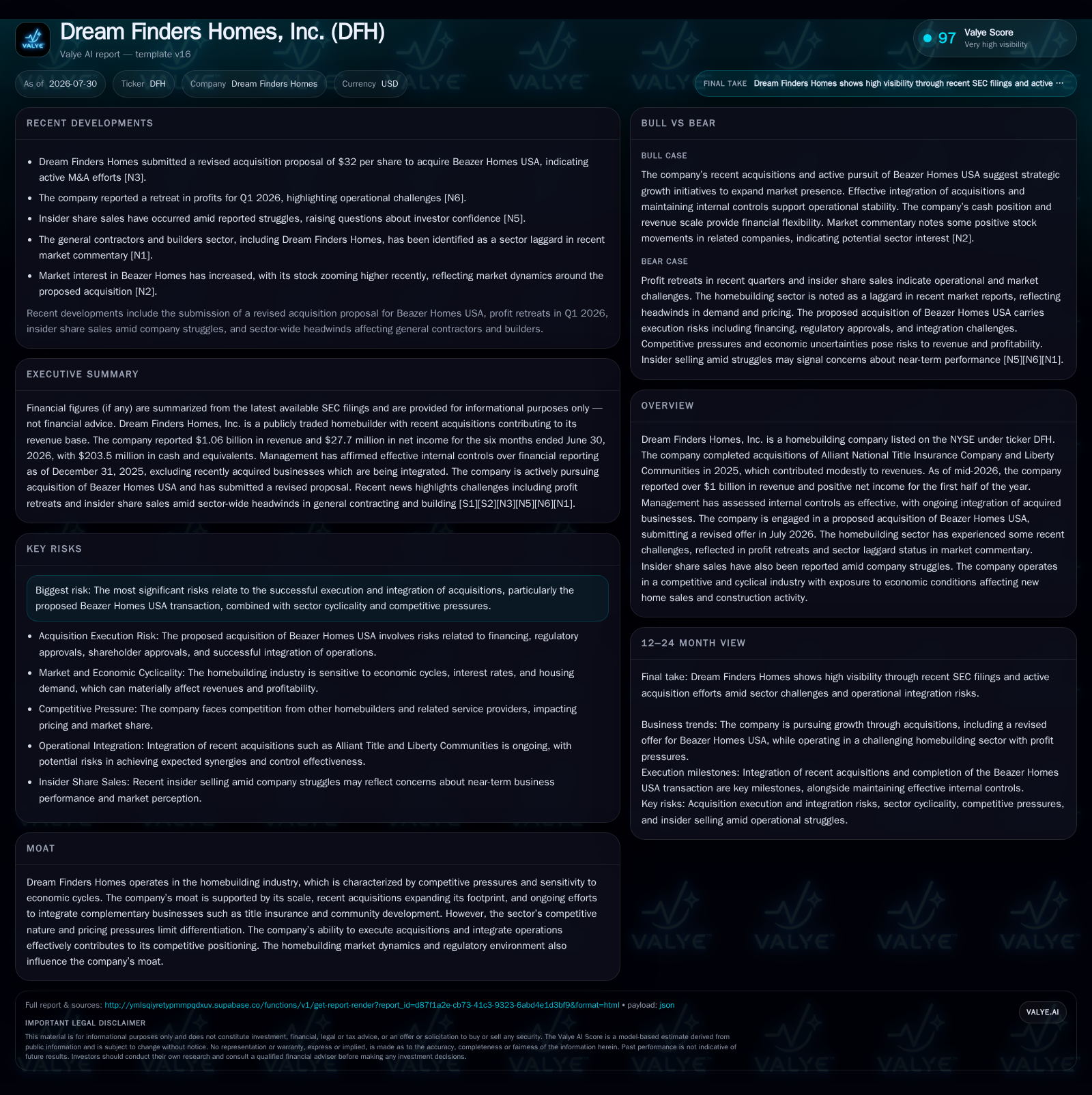
Dream Finders Homes, a publicly traded homebuilder, posted over $1 billion in revenue and positive net income for the first half of 2026, supported by recent acquisitions including Alliant National Title Insurance and Liberty Communities. The company is pursuing a strategic acquisition of Beazer Homes USA with a revised all-cash offer submitted in July 2026. While the sector remains cyclical and sensitive to interest rate trends, Dream Finders leverages scale and vertical integration efforts to bolster competitive positioning. Execution risks around acquisition integration and market cyclicality remain key watchpoints.
Recent Operating Update
Dream Finders Homes reported its financial results for Q2 2026 on July 30, 2026, announcing that revenue exceeded $1 billion for the first half of the year with positive net income—a milestone reflecting operational resilience during a challenging homebuilding environment [S2][S3]. This period marked continued execution on strategic acquisitions completed in 2025—specifically Alliant National Title Insurance Company and Liberty Communities—which contributed modestly yet meaningfully to revenues while broadening the company's service offerings beyond raw home construction into title insurance and community development sectors [S1]. Importantly, management characterized internal controls as effective despite these integration processes being ongoing.
A prominent near-term development was the submission of a revised all-cash acquisition proposal to purchase Beazer Homes USA for $32 per share in July 2026. This move underscores Dream Finders’ ambition to significantly enlarge its geographic footprint and asset base within the US residential construction landscape [N1][S7][S14]. The bid reflects management’s confidence in realizing operational synergies though uncertainties around regulatory approval, shareholder acceptance, and integration capabilities persist.
Business Model Analysis
Dream Finders operates primarily as a mixed-model homebuilder focusing on designing, constructing, and selling new single-family homes across various US regions. Revenue is chiefly generated through home sales recognized at closing upon customer ownership transfer. Monetization mechanics include pricing influenced by local demand elasticity, average selling price (ASP), volume of homes closed per period, cancellations impacting backlog convertibility, and customer deposits serving as early cash inflows.
The company's business model strategically integrates vertical services such as title insurance via Alliant National—capturing ancillary fee-based income—and community development through Liberty Communities—which likely enhances control over land parcels and lot readiness. This diversification can buffer cyclical fluctuations typical in residential real estate by adding more stable or recurring revenue streams.
Margins pivot heavily on efficient land acquisition strategies yielding cost-effective lot inventories balanced against zoning permissions and regulatory constraints. Controlling materials sourcing during supply chain inflationary pressures alongside effective project scheduling influences gross margin per home. Customer cancellation rates remain a critical metric tied directly to absorbed sales volume versus contracted backlog values.
Channel-wise, sales are conducted through company-employed sales agents interacting directly with end buyers. Financing partners may assist buyers but the company’s exposure to mortgage interest rate sensitivity materially affects buyer affordability and thus transaction velocity.
Industry Structure and Competitive Position
The homebuilding sector where Dream Finders competes is characterized by regional fragmentation alongside national players like D.R. Horton, Lennar Corp., and PulteGroup. Scale confers advantages through better land sourcing leverage and supply chain efficiencies; hence Dream Finders’ acquisition strategy aims to elevate its competitive scale relative to both national consolidators and dominant regional operators.
Price competition is intense with consumer choice driven by location desirability, product quality/features, timing/speed of delivery, financing accessibility, and brand reputation. Regulatory variability—especially around building permits issuance times or environmental/zoning hurdles—adds complexity to expansion into new markets.
The sector’s inherently cyclical nature ties closely to macroeconomic variables such as employment/wage growth trends and mortgage interest rate levels influencing housing starts activity nationally. Dream Finders’ diversification into title insurance reduces vulnerability slightly compared with pure-play homebuilders but cannot fully insulate earnings volatility associated with new housing demand cycles.
Growth Drivers
Key structural growth drivers for Dream Finders include demographic tailwinds like population increases driving household formations which underpin steady demand for new housing units. Historically low mortgage interest rates spur buyer affordability though recent macro tightening elevates risk.
Expansion into new geographic markets through strategic acquisitions such as Beazer would provide scale benefits while smoothing revenue volatility caused by localized economic downturns or regulatory disruptions. Integration of complementary businesses (title insurance/community development) supports margin improvement through cross-selling opportunities.
Innovation in design efficiency or construction methodologies could potentially shorten build cycles or reduce cost per home—a lever enhancing margins if implemented effectively.
Moreover, limited existing home inventory inventory at certain price points sustains demand for new builds despite broader economic slowdown signals reflected in recent sector laggard commentary [N2][N4].
Risks and Watchpoints
Significant risks encompass the successful execution of acquisitions – notably finalizing the Beazer Homes USA transaction amid complex regulatory approvals and shareholder negotiations - along with the challenge of integrating disparate corporate cultures without diluting operational focus or losing key employees [S4][S5]. Retention of talent post-merger remains a noted uncertainty.
Homebuyer cancellation rates directly affect conversion of signed contracts into closings; any unexpected spike could pressure revenues.
Interest rate volatility remains a paramount risk given its influence on mortgage affordability. An unfavorable trajectory would slow absorption rates potentially leading to inventory build-up or price discounting to accelerate sales.
Rising construction costs linked to labor shortages or raw material price inflation could compress gross margins if not offset by pricing power or productivity gains.
Regulatory hurdles related to land acquisition or zoning approvals might restrict agility in launching new communities or push up holding costs on undeveloped lots.
Recent insider share sales following share price weakness may reflect internal concerns or cash needs among executives but also warrant monitoring as potential market sentiment indicators [N5][N6]. Sector-wide profit retreats underscore heightened competitive pressures requiring disciplined cost management.
What to Watch Next
Critical near-term milestones include updates on progress securing requisite shareholder approvals for the Beazer acquisition alongside any regulatory feedback. Monitoring quarterly updates for changes in backlog values (contracted homes not yet closed) combined with cancellation rate trends will provide early signs of demand health.
Operational KPIs such as average selling price movements across regions served—or shifts in absorption rate—would elucidate Dream Finders’ pricing power amidst inflationary inputs.
Cost control initiatives responding to material/labor inflation should be visible in gross margin performance metrics over coming quarters.
Progress integrating Alliant National Title Insurance’s internal controls as well as Liberty Communities’ operations will also signal management’s capability at synergy realization beyond headline M&A announcements [S1].
Financial Profile Discussion
As of June 30, 2026, Dream Finders held approximately $203 million in cash and equivalents according to the latest available data [F1], providing solid liquidity support during this phase of acquisition pursuit and business expansion.
Capital allocation has included share repurchases authorized up to $100 million extending through mid-2027 which signal Board confidence though execution pace will depend on market conditions [S17]. Maintaining prudent balance sheet flexibility appears aligned with strategic priorities around M&A execution timing.
Overall, the financial standing supports continued operational investments with manageable risk despite sector cyclicality reflecting macroeconomic resilience balanced against exposure to evolving mortgage market dynamics.
This analysis is intended solely for informational purposes based on publicly filed documents as of July 30, 2026. It does not constitute investment advice or research views concerning any securities mentioned herein.
Disclaimer: This is research-only, informational analysis and not investment advice. It may include AI-generated interpretation and general industry context. Always verify important details using primary sources.

Comments