
Willis Towers Watson Advances AI Integration and Margin Expansion in Q2 2026
WTW’s latest quarter underscores growing revenue from advisory and brokerage, AI-driven product innovation, and disciplined cybersecurity risk management.
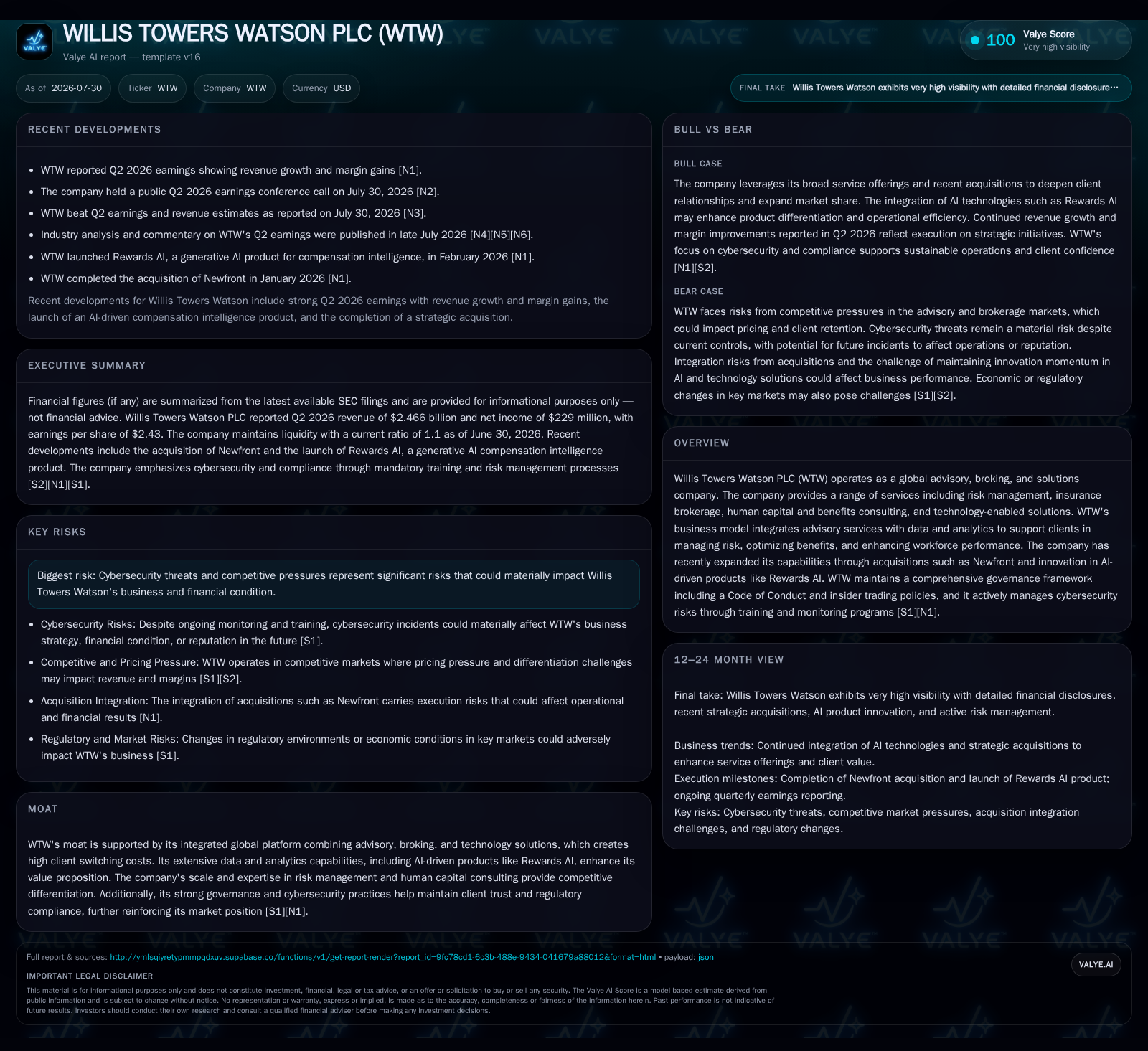
Willis Towers Watson PLC reported solid Q2 2026 results highlighted by revenue growth across advisory and broking services, aided by new AI-powered offerings such as Rewards AI. The company leverages a global platform integrating human capital consulting, insurance brokerage, and technology-enabled solutions to deepen client engagement and elevate switching costs. Despite competitive and cybersecurity risks, WTW’s ongoing investments in data analytics and acquisition synergies bolster its strategic moat. Key watchpoints include the pace of technology platform subscription growth, cross-selling effectiveness, and margin trends amid evolving service mix dynamics.
Recent Operating Update
Willis Towers Watson (WTW) posted its 10-Q for Q2 2026 on July 30, revealing continued momentum with revenue growth primarily fueled by its advisory services and insurance broking segments [S2]. The company reported gains exceeding analyst expectations both on top-line growth and operating margins [N1][N3]. Importantly, WTW’s new AI-driven offerings—highlighted by the Rewards AI platform—are beginning to contribute meaningfully to subscription revenues and client engagement metrics [S3][N1]. This reflects the company's strategic pivot toward integrating advanced data analytics throughout its service delivery.
The firm maintained rigorous cybersecurity protocols during the quarter; despite ongoing cyber threats typical of the financial advisory industry, no material incidents impacted operations or client trust [S1]. This underscores WTW’s investment in threat intelligence gathering, annual mandatory security training for employees, and stringent third-party risk oversight.
Business Model: Integrated Advisory, Broking, and Technology Solutions
WTW operates as a comprehensive global provider of risk management consulting, insurance brokerage services, human capital consulting, employee benefits advisory, and technology-enabled platforms [S1]. Its revenue streams derive from a blend of advisory fees charged on consulting engagements; brokerage commissions earned from placing insurance policies; subscription or licensing fees tied to proprietary data analytics tools; and project-based consulting revenues.
The company monetizes primarily through long-term contracts with corporate clients seeking to mitigate operational risks or optimize workforce performance. Critical operating levers include the volume and complexity of insurance placements driving brokerage commissions, consulting utilization rates impacting advisory fees, and adoption rates of technology platforms fueling recurring subscription income. High client retention rates combined with multi-year contracts create stable cash flow profiles.
A distinctive aspect of WTW’s model is embedding AI-driven analytics directly into client-facing solutions. Its Rewards AI product exemplifies this approach by enhancing employee benefits optimization through machine learning insights. Such innovations help improve cross-selling ratios between traditional consulting services and technology subscriptions while raising switching costs for clients reluctant to relinquish integrated systems [S3].
Industry Structure & Competitive Position
Within the financial services advisory and broking industry—whose peers include Marsh & McLennan Companies (MMC), Aon plc, Arthur J. Gallagher & Co. (AJG), and Mercer—WTW competes on scale, breadth of services, technological sophistication, and data analytics capabilities. Unlike some peers focusing predominantly on either broking or human capital consulting, WTW’s multi-segment integration strengthens its value proposition.
Its moat is reinforced by extensive global coverage combined with cutting-edge AI-enhanced platforms that augment traditional service lines [S1]. Data-driven decision tools differentiate WTW’s offerings in a sector where complexity of risk profiles demands customized solutions supported by robust analytics. Client switching costs are elevated due to integration of advisory counsel with embedded technology platforms that manage risk exposures or workforce metrics end-to-end.
However, intense competition remains a factor given commoditization pressures on brokerage commissions and consulting fees amid rival firms expanding their own digital toolkits. Regulatory compliance frameworks impose continuous operational diligence requirements that shape industry entrants’ cost structures.
Growth Drivers
Key secular trends supporting Willis Towers Watson’s growth include:
- Increasing complexity in global risk environments propelling demand for sophisticated advisory services across insurance placement and risk mitigation.
- Rising employer focus on workforce performance optimization boosts appetite for human capital consulting augmented by predictive analytics platforms such as Rewards AI.
- Accelerated adoption of AI and data-centric decision support tools heightens technology platform subscription revenue opportunities within existing client bases.
- Recent bolt-on acquisitions like Newfront broaden capabilities into adjacent market niches while enhancing cross-segment selling potential.
- Regulatory changes intensify compliance demands encouraging outsourcing of advisory tasks to specialized providers like WTW.
These drivers manifest through measurable KPIs such as improving consulting utilization rates indicating higher advisor productivity; expanding brokerage commissions showing broad underwriting activity; technology platform subscription growth signaling successful product uptake; longer average contract durations enhancing recurring revenue visibility; and improved cross-selling ratios reflecting deepening client wallet share.
Risks & Watchpoints
Despite strengths, several headwinds warrant vigilance:
- Cybersecurity threats remain persistent operational hazards. Although managed proactively with multi-layered defenses including mandatory annual training and third-party vendor assessments [S1], an unforeseen breach could materially damage reputation or trigger regulatory sanctions.
- Pricing pressure from competitors in both broking commissions and advisory fees may compress margins given industry commoditization trends.
- Client concentration risks exist due to reliance on large corporate accounts whose shifting strategic priorities might reduce discretionary spending on consulting or benefits services.
- Integration challenges following acquisitions create execution risks affecting synergy realization timelines or incremental operating costs.
- Economic downturns could dampen corporate expenditures on outsourced advisory functions thereby slowing revenue growth momentum.
- Technology obsolescence poses continual threat necessitating ongoing R&D investment to retain competitive edge in AI-driven analytics solutions.
Careful monitoring of these factors through KPIs like cybersecurity incident frequency reports; operating margin swings reflecting pricing dynamics; client renewal rates signaling retention health; backlog or pipeline figures denoting future demand visibility; and integration progress updates is crucial.
What to Watch Next
Investors should track near-term indicators such as:
- Rate of subscription growth for technology-enabled platforms including Rewards AI as a barometer of digital transformation success [S3].
- Cross-selling effectiveness measured by incremental service uptake beyond standalone brokerage or consulting contracts.
- Margin trends dissected by segment to identify effects of product mix shifts between higher-margin fee businesses versus lower-margin commission streams.
- Client retention statistics aggregated quarterly providing insight into relationship durability amidst competitive pressures.
- Realization of cost synergies post-Newfront acquisition gauged via free cash flow improvements or expense ratios.
- Regulatory developments influencing reporting obligations or compliance costs within core geographies served.
Concerted progress against these milestones would affirm WTW’s strategic execution while any deterioration may indicate mounting challenges requiring remedial action.
Financial Profile Discussion
As of 2026-06-30, Willis Towers Watson held approximately $1.63 billion in cash and equivalents [F1]. Current assets of $16.7 billion and current liabilities of $15.2 billion imply a current ratio near 1.1x for 2026-06-30 [F1], indicating manageable short-term liquidity coverage.
The company’s leverage reflects strategic capital allocation aimed at financing expansion initiatives including technology development plus integration costs related to recent bolt-on deals [S1].
This analysis synthesizes Willis Towers Watson's Q2 2026 disclosures highlighting structural strengths rooted in integrated advisory-broking-technology business model augmented by AI innovations. While facing classic industry risks such as cyber threats and competitive pricing pressures, WTW's scale combined with technological differentiation supports durable positioning within its global industrial landscape. Ongoing attention to subscription platform scaling, margin dynamics aligned with service shifts, acquisition integration success paths, and cybersecurity vigilance will inform prospective performance trajectories.
Disclaimer: This is research-only, informational analysis and not investment advice. It may include AI-generated interpretation and general industry context. Always verify important details using primary sources.

Comments