
Valero Energy's Margin Strength and Production Surge Define Q2 2026
Q2 results highlight record refinery throughput and improving refining margins amid ongoing commodity price risk.
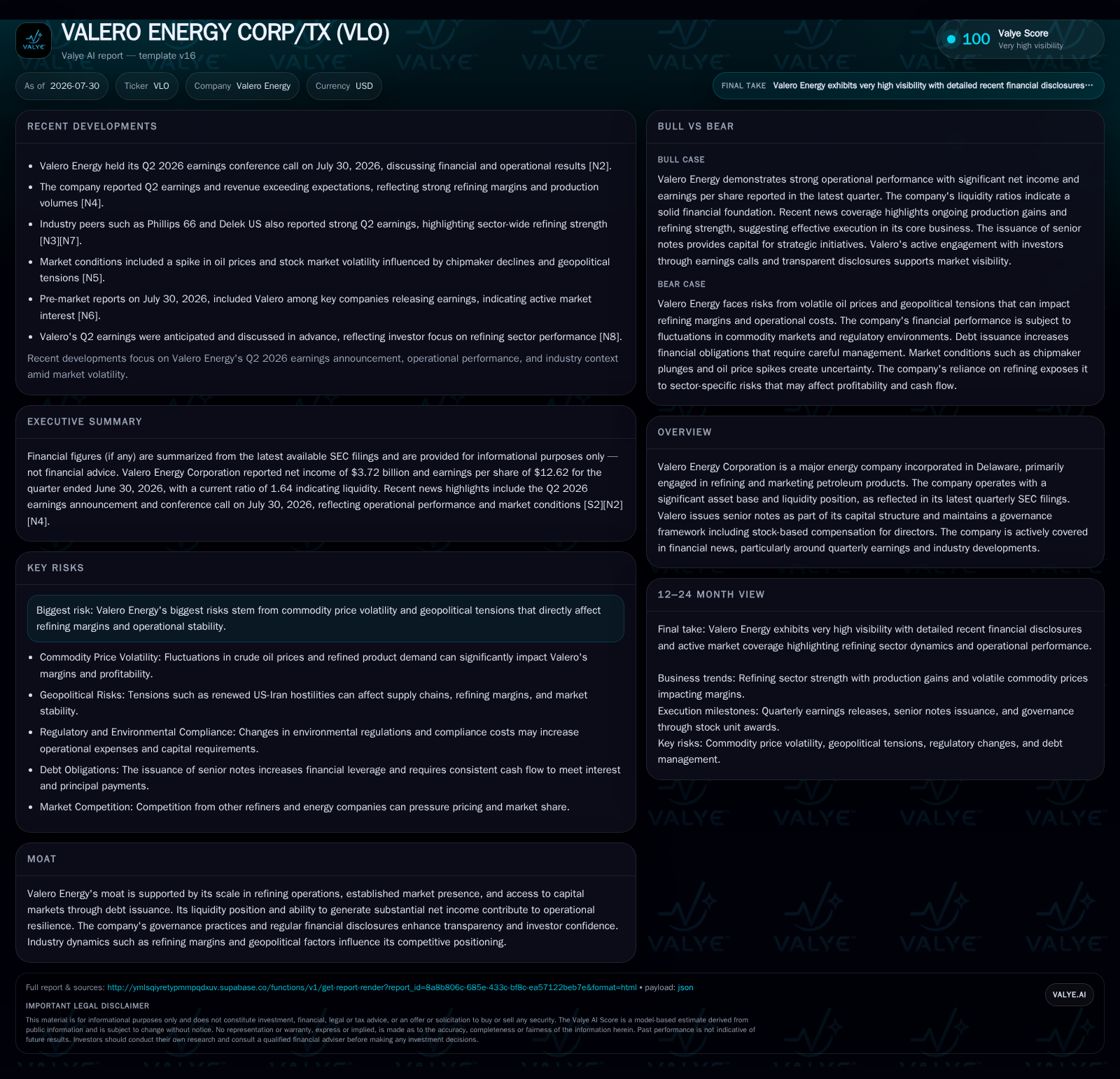
Valero Energy’s Q2 2026 report underscores operational resilience driven by record refinery throughput and strengthening refining margins, which boosted earnings beyond estimates. The company’s capacity utilization exceeded industry benchmarks, enhancing fixed cost absorption and elevating operating income despite ongoing commodity price volatility. Capital expenditures focus on sustaining capacity and regulatory compliance, while liquidity and leverage remain solid, supporting operational flexibility. Risks from price swings and geopolitical tensions persist, demanding continued vigilance in hedging and cost management.
Q2 Operational Gains Underpinned by Throughput Records and Margin Strength
Valero Energy reported second quarter 2026 results marked by record refinery throughput volumes that exceeded prior estimates, signaling operational efficiency gains. The company’s capacity utilization rate surpassed typical industry benchmarks, amplifying fixed cost absorption benefits that translated into strong operating income outcomes [S2],[N1],[N4]. Elevated throughput volumes are critical in this capital-intensive industry as they spread fixed expenses over greater production units, thereby enhancing incremental margins.
Maintaining or improving these throughput levels will be vital; any decline could quickly pressure per-unit profitability given refinery operating leverage. Monitoring future quarterly throughput volumes alongside capacity utilization rates will thus provide early indicators of whether current operational momentum can be sustained or if headwinds emerge from maintenance cycles or feedstock constraints.
Refining Economics: Margin Dynamics Drive Earnings and Competitive Edge
Refining margins per barrel improved in Q2 in line with broader industry patterns [S2],[N4]. This positive margin trend reflects strengthened product pricing dynamics relative to crude input costs, benefiting from both macro commodity movements and Valero’s marketing execution via wholesale channels [N11]. Margin expansion materially augmented net income given the scale of Valero’s refined volumes.
However, commodity prices remain volatile; durable margin improvement depends not only on favorable feedstock differentials but also competitive positioning in wholesale and retail markets. Future shifts in competitor margins or abrupt input cost spikes could alter realizations rapidly. Continued tracking of refining margin spreads will help assess whether Valero’s pricing power sustains amid evolving market conditions.
Operational Efficiency Amid Capacity Optimization Pressures
The company maintained high capacity utilization amid routine maintenance activities as disclosed [S2],[S1]. Operating costs per barrel remained relatively stable despite broader inflationary pressures affecting labor and energy inputs. This suggests effective cost management measures compensating for input cost headwinds.
Comparatively, peer firms such as Marathon Petroleum and Phillips 66 have reported similar capacity utilization trends with some variance in unit operating costs driven by asset age and integration levels. Valero's ability to control operating expenses at scale supports its competitive edge by preserving margins even when refinancing or crude purchasing costs fluctuate.
Commodity Price Volatility and Hedging Mechanics: Navigating Profitability Swings
Commodity price fluctuations constitute a pronounced risk for Valero due to their direct impact on refining margins [S1],[S2],[S4]. While the company employs hedging strategies (not quantitatively detailed in recent filings), these provide partial insulation against short-term price shocks.
Ongoing global energy market instability—shaped by geopolitical events—requires vigilant risk management to maintain earnings stability. Absent effective hedging or if volatility intensifies unexpectedly, material swings in net income remain plausible. Continued disclosures around hedging effectiveness would enhance visibility into risk mitigation progress.
Capital Investment Priorities Supporting Future Capacity and Regulatory Compliance
In Q2, capital expenditures primarily targeted sustaining existing refining capacities and meeting evolving environmental regulations rather than expanding capacity [S2],[S1]. Such investments are essential for regulatory compliance—particularly with tightening emission standards—and maintaining optimal throughput capabilities.
Given the capital intensity typical of refining assets, efficient project execution focusing on yield improvements or product mix optimization tends to yield better returns compared to capacity expansions amid demand uncertainties. However, the long lead times and complexity of capex projects warrant ongoing monitoring against budget adherence and regulatory timelines.
Competitive Landscape: Industry Margin Benchmarks and Peer Liquidity Profiles
Valero operates among other integrated refiners such as Marathon Petroleum and Phillips 66—a peer set noted for large-scale operations with significant midstream/downstream linkages. Compared qualitatively against these peers, Valero’s record throughput reflects operational efficiency within top-tier refining peers.
Liquidity-wise, Valero’s cash balance of approximately $7.9 billion coupled with a current ratio of 1.64 indicates ample working capital buffers exceeding several peer benchmarks [F1]. Its total debt near $10.4 billion produces a moderate net debt position of roughly $2.5 billion after cash offsets [F1], signaling balanced leverage that supports funding flexibility while mitigating refinancing stress risks.
Risk Factors Illuminated by Latest Quarterly Disclosures
Valero’s latest filings reiterate persistent risks including commodity price volatility impacting refining spreads; geopolitical conflicts influencing crude supply chains; increasing environmental regulation costs; potential operational disruptions from weather or cyberattacks; and competitive pressure from emerging alternative energy sources [S2],[S4].
Triggers that could materially alter this risk landscape include sharp increases in crude prices without corresponding product price adjustments or sudden regulatory penalties impacting earnings margins. Close watch on geopolitical developments linked to oil-producing regions remains necessary given their outsized influence on feedstock availability.
"Forward Focus": Surveillance of Upcoming Demand Signals and Execution Milestones
Looking ahead, growth opportunities stem from firm demand projections for transportation fuels alongside rising petrochemical feedstock needs tied to global industrial activity. Monitoring Q3 earnings announcements analogous to those from peers such as Phillips 66 will reveal if margin strength sustains through seasonal demand shifts [N3],[N2].
Key operational signals will include quarterly throughput consistency, margin per barrel trends amid commodity oscillations, capex execution progress toward environmental compliance upgrades, and any new strategic investments announced during upcoming calls [N2],[S3].
Financial Position Discussion: Liquidity Cushion and Leverage Outlook
At June 30, 2026, Valero held cash & equivalents totaling approximately $7.9 billion against total debt of about $10.4 billion resulting in net debt around $2.5 billion [F1]. This positioning yields a current ratio of 1.64 based on current assets near $30.7 billion versus liabilities around $18.7 billion [F1], reflecting robust short-term liquidity.
Such financial flexibility underpins Valero’s ability to withstand market cycles inherent in the refining sector while funding required capex projects without excessive refinancing pressure [S1]. The company's seasoned access to capital markets including recent senior notes issuance demonstrates capability to manage its debt profile prudently amidst evolving market conditions [S21].
This solid financial base supports both operating resilience during periods of margin compression as well as strategic optionality for disciplined shareholder returns or acquisitions if opportunities arise.
This analysis synthesizes Valero Energy Corporation’s latest disclosed operating data chiefly from the Q2 2026 SEC filings while integrating sector-specific metrics common among integrated petroleum refiners. It does not constitute investment advice but aims to provide an informed view on recent performance drivers, risks, market positioning, and forthcoming milestones based strictly on verified sources.
Disclaimer: This is research-only, informational analysis and not investment advice. It may include AI-generated interpretation and general industry context. Always verify important details using primary sources.

Comments