
Cigna Group Raises FY26 Outlook Following Pharmacy and Medical Integration Gains
Q2 2026 results showcase improved margins and revenue from Cigna's integrated healthcare platform, prompting an upward revision of full-year guidance.
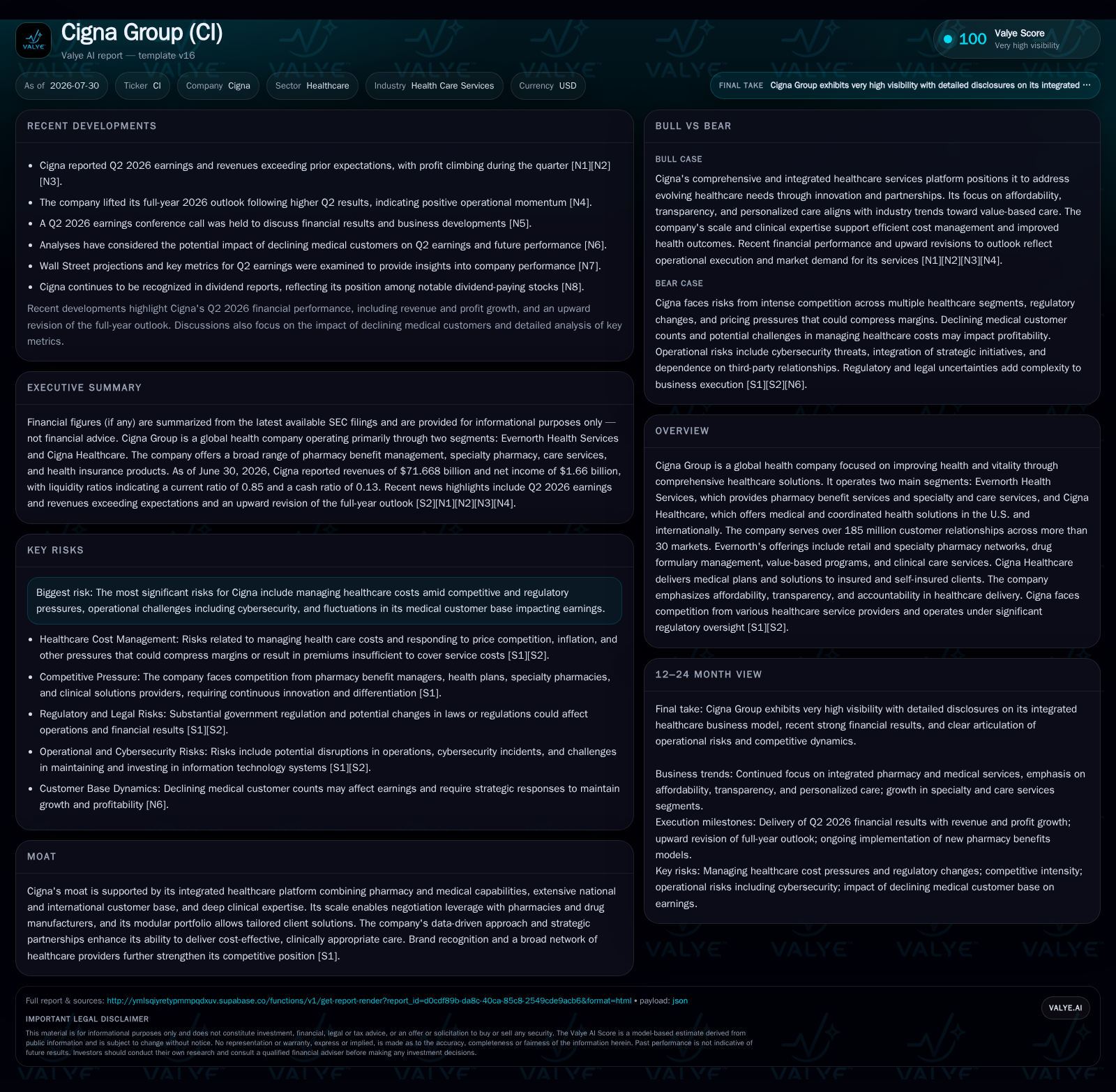
In its latest quarterly filing, Cigna Group reported stronger-than-expected adjusted revenues and margin improvements driven by Evernorth’s pharmacy benefit management services combined with Cigna Healthcare’s medical insurance offerings. These operational gains underpin a raised full-year 2026 outlook despite ongoing headwinds from a decline in medical customer enrollment. Cigna's integrated model leveraging data-driven formulary management and coordinated care continues to provide competitive scale advantages amid industry pricing pressure and regulatory complexity. Key risks remain around healthcare cost inflation, client retention, and contract negotiability. Upcoming contract renewals and clinical program engagement metrics will be critical to sustaining momentum.
Quarterly Momentum: Integration Drives Revenue and Margin Upside
While the company continues to face some pressure owing to a decline in medical customer enrollment—a dynamic partly attributable to ongoing competitive contracting—the margin uptick validates the durability of its integrated healthcare platform strategy that coordinates pharmacy benefit management (PBM) with medical coverage to optimize cost-effectiveness at scale.
Integrated Healthcare Model Balances Pharmacy Benefit Efficiency with Medical Coverage Complexity
Cigna operates through two primary segments contributing synergistically: Evernorth Health Services comprising pharmacy benefit management (PBM) and specialty care services; and Cigna Healthcare delivering comprehensive medical coverage both domestically and internationally [S1][S2].
The PBM business monetizes primarily through fees tied to managing drug formularies, negotiating rebates with pharmaceutical manufacturers, overseeing specialty drug utilization, and administering retail pharmacy networks. This fee-based model features less exposure to direct underwriting risk but depends keenly on controlling pharmacy benefit cost per member via effective clinical programs.
Conversely, the medical insurance business generates premium revenues that carry inherent risk due to unpredictable medical claims costs. Here, risk adjustment mechanisms alongside care coordination programs are central to managing the medical cost ratio—medical costs as a percentage of premiums—which must be kept within actuarial estimates to maintain underwriting profitability.
By integrating these segments, Cigna leverages scale advantages for negotiation leverage versus providers and manufacturers, while utilizing data-driven insights across the continuum of care—a structural moat also reflected in brand trust across approximately 185 million customer relationships worldwide [S1]. This dual-model approach mitigates the volatility typical in stand-alone insurance or PBM operators by blending recurring fees with risk-managed premiums.
Competitive Pressures Shape Contract Dynamics and Pricing Strategies
The broader managed care market is characterized by intense competition for client contracts often mediated by brokers or benefit consultants who push for lower pricing structures or greater rebate-sharing to employers seeking cost containment [S1]. Cigna faces rivals including large integrated players like UnitedHealth Group—also combining PBM services via Optum—and health insurers such as Anthem and Humana competing primarily on insurance product pricing.
Contractual negotiations increasingly emphasize transparency mandates and performance guarantees linked to value-based outcomes. While offering potential differentiation through integrated service capabilities, these conditions compress margins in both PBM fees (due to aggressive rebate sharing) and insurance premiums (due to price competition). Loss of major clients or unfavorable contract repricing could materially impact near-term earnings.
The three-year typical term length of major PBM client contracts adds cyclical timing complexity but also provides periodic opportunities for margin resets based on utilization trends or manufacturer rebate landscapes [S1]. Monitoring enrollment trends alongside renewal rates remains critical in assessing sustainability under these competitive dynamics.
Data-Driven Cost Management Supports Value-Based Care Initiatives
Cigna's ability to sustain acceptable loss ratios amid rising healthcare inflation hinges on its growing investment in clinical services integration and population health strategies [S1][S2]. AI-powered analytics enable granular formulary management targeting cost-effective therapies without compromising quality. Clinical engagement programs promote adherence and preventive care that reduce expensive acute interventions.
These efforts contribute directly to controlling the medical cost ratio despite expanding specialty drug usage—a key driver behind escalating pharmacy benefits costs industry-wide. Improved claims processing accuracy and turnaround time further buttress operational efficiency important for cash flow stability.
Regulatory compliance frameworks around value-based payments allow structuring incentive programs aligning provider reimbursements with outcomes rather than volume—an evolving standard expected to gain prominence fostering longer-term cost control [S1]
Growth Catalysts Emerging from Population Health and International Expansion
Structural tailwinds support continued demand for integrated healthcare solutions encompassing both pharmacy benefits and medical insurance plans. Demographic aging increases prevalence of chronic diseases requiring multi-disciplinary care coordination precisely aligned with Cigna's offerings [S1].
Additionally, expansion into over 30 international markets diversifies revenue sources beyond U.S.-centric employer-sponsored plans thereby mitigating domestic policy fluctuation impacts. Digital health innovations enhance patient engagement at scale which is critical for adapting complex global populations.
As awareness grows around affordability challenges alongside client demand for transparent pricing models, providers like Cigna positioned with modular portfolios combining clinical expertise stand well poised to capture incremental wallet share through tailored solutions blending technology with personalized services.
Market Risks: Cost Inflation, Client Retention, and Regulatory Oversight to Watch
Despite favorable recent momentum, several risks threaten profitability continuity. Erroneous pricing predictions amid shifting utilization patterns can precipitate elevated loss ratios severely squeezing margins if corrective actions lag [S1][S2]
Pharmaceutical pricing volatility remains a particularly acute risk given incremental specialty drug introductions outpacing rebate structures historically embedded in PBM models. Cybersecurity vulnerabilities pose operational threats given reliance on proprietary data flows essential for claims adjudication.
Regulatory recalibrations affecting coverage mandates or reimbursement rates introduce uncertainty as well impacting competitive premium setting especially within government-sponsored plan subsets indirectly competing within private employer pools.
Retention challenges accentuate earnings predictability concerns since clients frequently seek alternative bids during renewals preserving price sensitivity at all points along the value chain. Success depends on maintaining demonstrable value via cost containment paired with quality enhancement measures ensuring lock-in effects beyond transaction economics.
Upcoming Catalysts: Renewal Cycles, Guidance Updates, and Clinical Engagement Metrics
Looking ahead investors will monitor forthcoming client contract renewal outcomes closely as they encapsulate real-world responses to prevailing competitive pressures plus demonstrated efficacy of integrated service delivery.[S2][N4] Quarterly earnings announcements will remain barometers reflecting whether the midyear trajectory confirming the recently raised FY26 guidance sustains itself given dynamic economic factors influencing employer-sponsored insurance demand.[N4] Equally important will be metrics related to uptake rates within clinical programs—serving as early indicators of member engagement effectiveness promoting healthier outcomes which translate indirectly into lower claim liabilities boosting sustainable profitability.[S2] These signals collectively constitute actionable checkpoints validating or challenging current organizational assumptions underpinning the recent guidance refinement.
Financial Profile Discussion: Solid Liquidity Amid Balanced Leverage
As of June 30, 2026, Cigna holds $6.3 billion in cash & equivalents against total debt approximating $29.1 billion resulting in net debt around $22.8 billion along with a current ratio near 0.85 indicating tight but manageable short-term liquidity positioning consistent with capital-intensive healthcare service providers of comparable scale [F1]
Such leverage levels reflect ongoing investments supporting growth initiatives segmented across healthcare technology capabilities alongside expanded geographic footprint deploying capital where yield prospects align with strategic priorities. Adjusted operating income trends point toward resilient core profitability enabling servicing of debt obligations without encroaching on operational liquidity cushions. No immediate refinancing risks were flagged suggesting financing flexibility remains intact allowing measured deployment of resources vital for innovation frontiers while navigating sector cyclicality.
Disclaimer: This analysis is intended solely for informational purposes based on publicly available data including SEC filings dated through July 30, 2026. It does not constitute investment advice or research views concerning securities of The Cigna Group or any other entity.
Disclaimer: This is research-only, informational analysis and not investment advice. It may include AI-generated interpretation and general industry context. Always verify important details using primary sources.

Comments