
Crocs Expands Stock Repurchases While Leaning into Iconic Comfort Footwear Growth
Crocs Inc. reported solid Q2 2026 results with continued brand innovation and an amplified $1.5 billion stock buyback authorization.
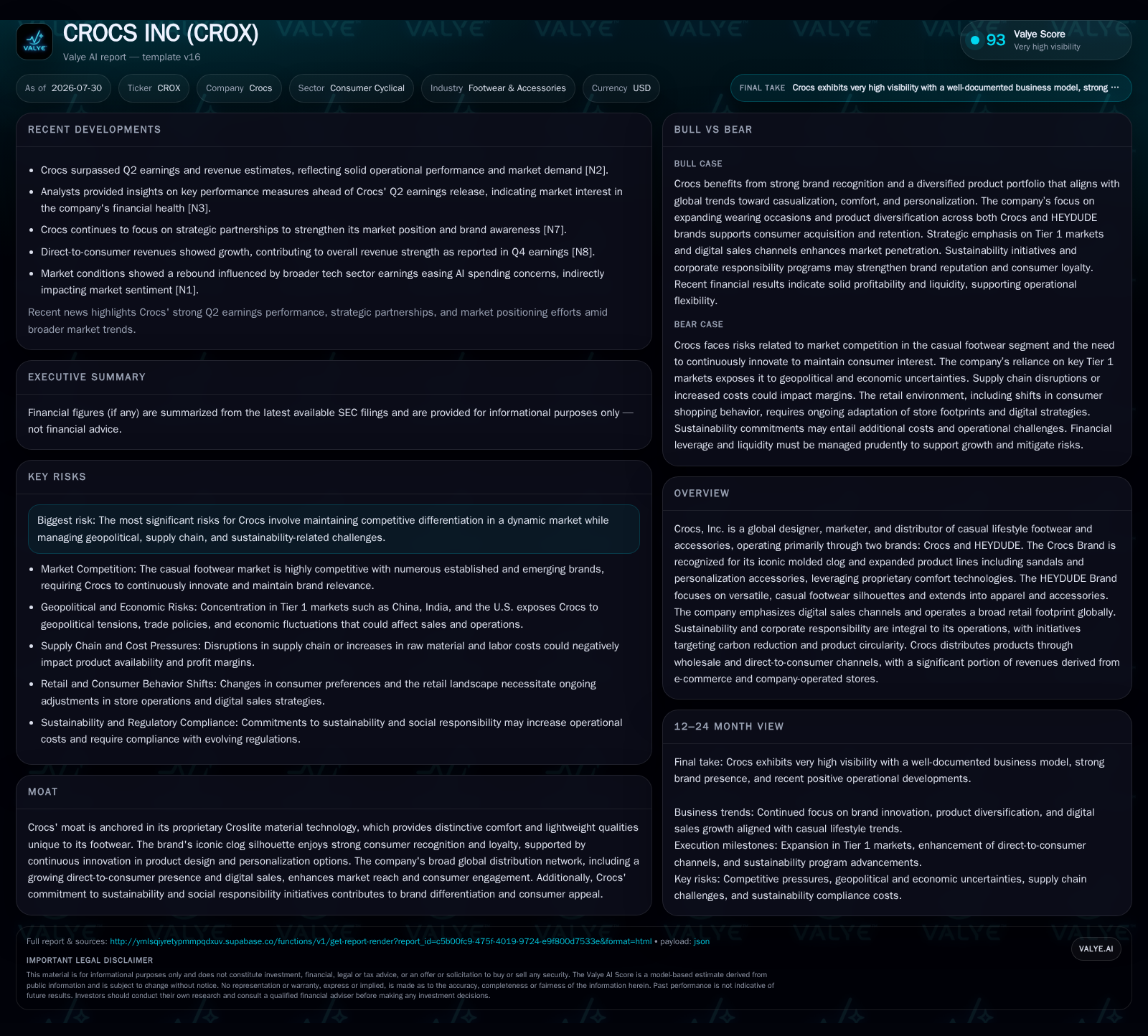
In its latest quarterly filing, Crocs, Inc. reinforced its market-leading position in casual lifestyle footwear through sustained product innovation and geographic expansion. The company emphasized strategic growth in its iconic clog silhouette and personalization accessories, alongside HEYDUDE’s casual footwear diversification. Crocs increased its stock repurchase program by $1.5 billion, reflecting confidence in cash flow generation despite leverage levels. The footwear retailer balances wholesale and direct-to-consumer channels with a rising emphasis on digital sales and sustainability initiatives, while navigating typical industry risks such as consumer preference shifts and supply chain pressures.
Latest Quarterly Operating Update
Crocs Inc.’s Q2 2026 performance reflected sustained momentum in both top-line growth and profitability, with the company surpassing revenue and earnings estimates outlined in its July 30 SEC filings [S2], supported by market commentary praising key metrics like same-store sales growth and e-commerce strength [N3], [N4]. The company’s financial disclosures reveal no material changes in risk factors but underscore strategic capital deployment via a substantial increase in share repurchase authorization by $1.5 billion—expanding total repurchase capacity to $2.0 billion—signaling management’s confidence in enduring free cash flow generation despite existing net debt of approximately $1.16 billion as of June 30, 2026 [S3], [S4], [F1].
Business Model: Proprietary Comfort Technology Fuels Differentiated Casual Footwear
At its core, Crocs operates as a designer, marketer, and distributor of casual lifestyle footwear primarily through two brands: Crocs and HEYDUDE. The business model relies on a blend of wholesale partnerships alongside growing direct-to-consumer (DTC) retail stores and e-commerce platforms that contribute a significant portion of consolidated revenues, reflecting effective digital channel maturity [S13], [S25].
Revenue is generated principally from product sales encompassing the iconic molded clogs powered by proprietary Croslite™ material technology which confers unique soft cushioning and lightweight comfort characteristics difficult for competitors to replicate convincingly. This proprietary comfort technology underpins strong brand loyalty and justifies accessible yet value-aware price points across broad demographics.
Crocs amplifies this appeal via extensive personalization offerings predominantly through Jibbitz™ charms accessories—a lucrative revenue adjunct enhancing unit economics by increasing average selling prices (ASPs) without major incremental cost. Product portfolio diversification extends into sandals, wedges, flips, slides for varied casual wearing occasions catering to all family segments—a strategic move defending against cyclicality inherent in single-product-concept businesses [S13], [S14], [S26].
The HEYDUDE Brand complements this with versatile casual loafers plus lifestyle extensions into sneakers, boots, and dress-casual shoes leveraging ergonomic insoles and flexible outsole technologies designed for ease-of-use and urban comfort-focused customers primarily concentrated in the U.S. market where stabilization remains imperative as per management commentary [S14], [S26].
Marketing strategies revolve around digital-first campaigns integrating brand collaborations (e.g., Pokémon, MLB) to reinforce relevance amongst younger consumers while cultivating social media engagement that drives DTC acquisition efficiencies.
Industry Structure and Competitive Positioning
Crocs operates within the global footwear industry marked by consumer-driven demand impacted by fashion trends emphasizing comfort and casualization—a sector featuring prominent peers like Deckers Brands (UGG), Skechers (casual/lifestyle focus), VF Corporation (multi-brand portfolio), Allbirds (sustainability/DTC innovator), Nike/Adidas (athletic dominance), and Steve Madden (fashion footwear retail).
Crocs’ long-standing moat is anchored in proprietary material technology plus an iconic product silhouette with strong consumer recognition globally. Its manufacturing is largely outsourced but closely integrated with design innovation cycles ensuring rapid response-to-trend advantages.
Competitive strength derives from vertical integration into retail stores (~439 Crocs Brand stores worldwide) while balancing wholesale channel breadth enhances distribution scale without excessive capital commitments to physical footprint expansion—consistent with shifts favoring e-commerce proliferation in footwear retailing.
Consumer switching costs are modest but personalization options coupled with unique material experience confer stickiness atypical for non-athletic casual footwear brands.
Growth Drivers
Three interconnected growth drivers stand out:
- Direct-to-Consumer/E-commerce Expansion: Digital sales have stabilized near four-tenths of revenues; ongoing investment here leverages flexibility in assortment presentation plus enables rich data capture improving targeted marketing efficiency.
- Product Innovation & Personalization: Enhancements around the classic clog silhouette through new colors, licensed graphic collaborations, sandal extensions, plus broadening Jibbitz charm offerings stimulate repeat purchases while attracting trend-conscious new consumers.
- Geographic Market Penetration: International sales approached nearly half of Crocs Brand revenue in recent disclosures due to prioritization of Tier 1 markets including fast-growing economies such as China/India as well as developed regions like Western Europe; such diversification reduces reliance on mature North American markets.
HEYDUDE’s product line diversifications into related lifestyles broaden addressable market size while stabilizing the fledgling U.S. footprint fosters room for sustainable incremental returns.
Risks and Watchpoints
Key risks reflect the interplay between external market forces and internal execution capabilities:
- Consumer Preference Volatility: Shifts away from casualization or comfort could erode longstanding brand appeal; monitoring same-store sales alongside engagement metrics helps flag early signs.
- Competitive Price Pressures: High competition heightens potential margin compression especially if rivals imitate comfort innovations or accelerate discounting strategies.
- Supply Chain Disruptions: Dependent on third-party manufacturing exposes exposure to raw material inflation, trade constraints or logistical bottlenecks potentially inflating costs or delaying delivery schedules.
- Inventory Management Challenges: Overstock risks necessitate careful markdown cadence execution; inventory turnover ratios serve as crucial operational indicators.
- Foreign Exchange Volatility: With nearly half revenues international, currency movements can unpredictably affect reported results even under hedging frameworks documented in filings [S1].
- Leverage Constraints: Elevated net debt juxtaposed against aggressive buybacks require balance; covenant compliance remains imperative under revolving credit facilities expiring in late 2027 [F1], [S17], [S22], [S23].
- Regulatory & Sustainability Compliance: Evolving environmental standards impose both opportunity costs through investments but stakes reputational credibility crucial among eco-conscious demographics given Crocs’ active carbon reduction programs.
What to Watch Next
Investors and analysts focusing on Crocs should track:
ate publications relevant for assessing long-term brand equity impacts.
- Capital allocation decisions post expanded repurchase authorization: actual repurchase activity size/timing vis-à-vis potential investments in product innovation or market development spend.[S3],[N4],[N9],[N10]
Financial Profile Discussion
Crocs maintains a solid liquidity position with cash & equivalents totaling approximately $170 million as of June 30, 2026 against current liabilities around $728 million resulting in a current ratio near 1.49—adequate for near-term operational needs but indicative of tight working capital management demands amid rapid global operations expansion [F1]
Total debt stands at about $1.33 billion primarily consisting of a Term Loan B facility supplemented by revolving credit arrangements; this leverage level requires careful covenant monitoring yet affords flexibility for acquisitions or opportunistic share buybacks under negotiated credit agreements expiring by November 2027 [F1],[S17],[S22],[S23],[S29].
Operating income margins have historically demonstrated resilience owing to proprietary product pricing power balanced against SG&A investments into marketing/digital transformation initiatives consistently aimed at driving profitable growth scaling beyond footwear commodity dynamics.
Free cash flow generation remains critical to support the aggressive stock repurchase program recently expanded by $1.5 billion—an affirmation from management targeting shareholder returns without compromising growth funding agility.[S2],[S3],[F1]
This analysis synthesizes details from Crocs’ recent SEC filings complemented by industry-standard KPIs framing the evolving structure of global casual footwear retailing. No investment advice is provided herein.
Disclaimer: This is research-only, informational analysis and not investment advice. It may include AI-generated interpretation and general industry context. Always verify important details using primary sources.

Comments