
Dream Finders Homes Targets Scale with Beazer Bid Amid Residential Construction Headwinds
Dream Finders Homes pursues geographic expansion via a renewed Beazer Homes acquisition proposal while stabilizing operations amid cyclical housing market pressures.
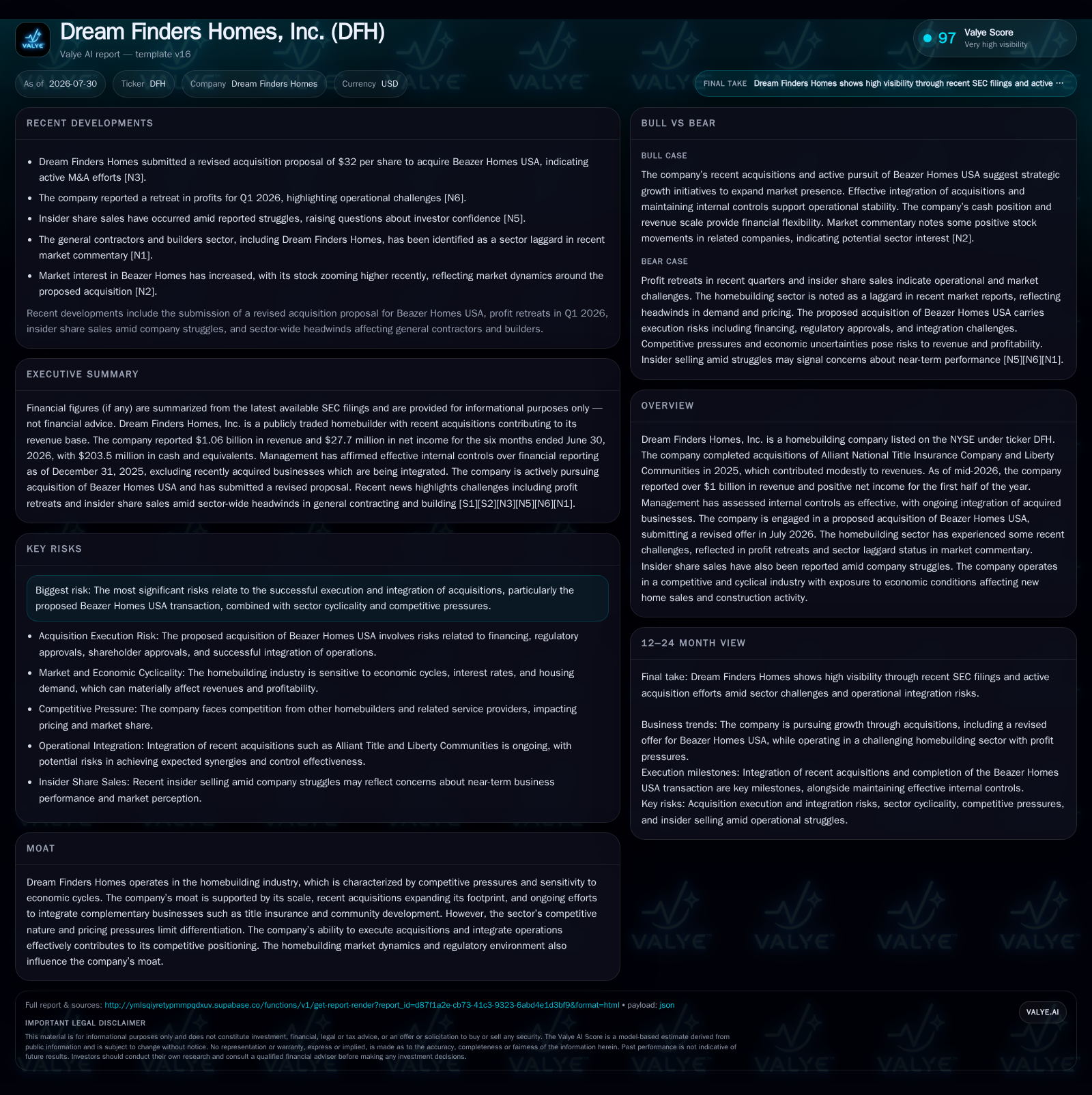
Dream Finders Homes reported positive net income in H1 2026, supported by ongoing integration of 2025 acquisitions including Alliant Title Insurance and Liberty Communities. The company submitted a revised $32/share all-cash offer for Beazer Homes USA in July 2026, aiming to broaden its footprint and service capabilities. Despite sector-wide cyclical headwinds reflected in cancellation rates and pricing pressures, Dream Finders demonstrates resilience through backlog management and operational scale expansion. Execution risks around acquisition integration and cyclical demand remain key watchpoints.
Strong Quarterly Momentum Supports Strategic Ambitions
Dream Finders Homes’ latest quarterly results for Q2 2026 underscore improving operational momentum as the company reported over $1 billion in revenue cumulatively for the first half of the year along with positive net income for this early phase of the housing cycle recovery [S2][S3][F1]. Management affirmed the effectiveness of internal controls even as it navigates complex integration of recent acquisitions including Alliant National Title Insurance Company and Liberty Communities completed in 2025 [S1].
Acquisition-Led Geographic Expansion & Vertical Integration Progress
The strategic framework driving Dream Finders’ current trajectory is clearly shaped by acquisition activity which has expanded its geographic footprint and vertically integrated complementary services. The acquisitions of Alliant Title Insurance and Liberty Communities add discrete revenue lines outside pure home construction—namely title insurance services and community development activities—that offer potential margin improvements through captured cross-selling and control over ancillary transaction processes [S1]. This vertical integration aligns with broader industry trends where national homebuilders like D.R. Horton and Lennar also develop or acquire adjacent services to differentiate offer packages.
The recent revised all-cash $32/share bid for Beazer Homes USA in July 2026 is particularly notable. Positioned as a regional competitor emphasizing midscale housing markets, Beazer’s acquisition would significantly enhance Dream Finders’ land inventory (lots held/controlled) and access to new build cycles across diverse markets [N1][S4][S7]. Success here depends heavily on efficient post-merger integration to realize anticipated operational synergies such as streamlined lot acquisition processes and reduced procurement costs through scale. This deal marks an aggressive bet on consolidating scale benefits amidst structural affordability pressures challenging smaller builders.
Backlog and Sales Metrics Paint Cycle-Sensitive Demand Picture
Key KPIs from Dream Finders’ filings point to stable construction backlog values—representing contracts signed but homes not yet closed—as a critical gauge of forward sales health during a fluctuating environment [S1][S2][F1]. Backlog stability suggests resiliency against volatile shifts in cancellation rates which traditionally spike when mortgage interest rates rise or consumer confidence fades.
While explicit cancellation rates aren’t prominently disclosed in absolute terms, monitoring these alongside average selling price (ASP) dynamics provides insight into pricing power retention versus discounting pressure during soft patches. The number of homes closed quarter-over-quarter likewise serves as a tangible volume proxy to confirm whether customer deposits are translating into firm demand or if buyer hesitancy is growing. These metrics collectively illustrate Dream Finders’ ability to manage sales velocity—a crucial factor in cycle-sensitive earnings predictability.
Competitive Landscape: Positioning Among National & Regional Builders
In comparison with peers like Beazer Homes USA (target), D.R. Horton, Lennar Corporation (national players), Dream Finders occupies a hybrid competitive position blending regional market depth with increasingly broad geographic reach through acquisitions. While lacking the sheer scale of top-tier national builders, their vertical integration into title insurance via Alliant distinguishes their service bundle offering relative to more regionally focused competitors reliant solely on homebuilding revenues [S1][N1].
However, persistent commoditization in residential construction means differentiation remains limited largely to localized brand reputation, lot control efficiency, and pricing savvy. In this light, Dream Finders’ move toward expanded lot inventories coupled with ancillary services promises better margin control if execution milestones on integration are met successfully.
Growth Opportunities: Scale Benefits Versus Integration Execution Risk
Scaling through acquisitions offers clear advantages by expanding addressable markets, increasing bargaining leverage in materials procurement, and spreading fixed overhead costs over larger volumes. However, integration risk looms large especially given the heterogeneity between traditional homebuilding operations and title insurance/community development businesses acquired recently [S1][S4]. Operational challenges such as systems harmonization delays or employee turnover could erode expected synergy gains.
Macroeconomic uncertainties add further complexity; rising mortgage rates can depress booking velocity while labor shortages inflate build costs—both factors heightening sensitivity around key KPIs like cancellation rates or gross margins post-closing. Monitoring deviations in these indicators relative to historical seasonality will illuminate how well execution risk is being mitigated amidst rapid expansion.
Key Operational Risks From Sector Volatility and Execution Slippage
Dream Finders explicitly cites numerous operational risks consistent with homebuilding sector dynamics: macroeconomic downturns dampening housing demand; interest rate hikes escalating mortgage costs; inflationary pressures on materials and labor; zoning restrictions limiting land development options; contract cancellation volatility; regulatory compliance burdens; plus the complexity of integrating acquired entities successfully [S2][S25].
Recent insider selling activity following sharp share declines highlights some internal concern regarding these risks manifesting materially near term [N5][N6]. Such trading patterns serve as cautionary sentiment signals that warrant close observation alongside objective performance factors like cancellation trajectory or customer deposits accruals.
Upcoming Catalysts: Beazer Deal Prospects & Backlog Developments
Investor focus should center on imminent milestones including receipt of regulatory approvals and shareholder votes necessary for closing the Beazer acquisition transaction—the outcome of which will decisively alter Dream Finders’ growth runway profile [N1][S7].
Additionally, successive quarterly updates on backlog composition—especially net new orders less cancellations—and customer deposits will reveal demand sustainability beneath surface revenue growth narratives. These leading indicators directly correlate with forthcoming construction starts and closings that drive margin realization.
Financial Profile Discussion: Liquidity Cushion Amid Debt Negligibility
From a financial standpoint, Dream Finders maintains robust liquidity with cash and equivalents totaling approximately $203 million as of June 30, 2026—substantially exceeding its nominal total debt balance last reliably reported around $3.3 million at year-end 2021—resulting in a strong net cash position [F1]
This healthy capital base affords meaningful optionality to fund ongoing acquisition-related investments without immediate refinancing necessity despite the sector’s capital intensity norms tied to land acquisition cycles. It provides a buffer enabling strategic flexibility as macroeconomic headwinds intermittently pressure operating cash flows.
This analysis synthesizes recent SEC filings alongside news releases to frame Dream Finders Homes’ operational stance amid evolving sector conditions. It refrains from recommending investment action but highlights critical execution factors shaping future performance visibility.
Disclaimer: This is research-only, informational analysis and not investment advice. It may include AI-generated interpretation and general industry context. Always verify important details using primary sources.

Comments