
Mainz Biomed Turns Focus to Pancreatic Cancer with Strategic Pipeline Shift
The company pivots from colorectal cancer diagnostics toward pancreatic cancer screening, marked by key divestitures and leadership changes.
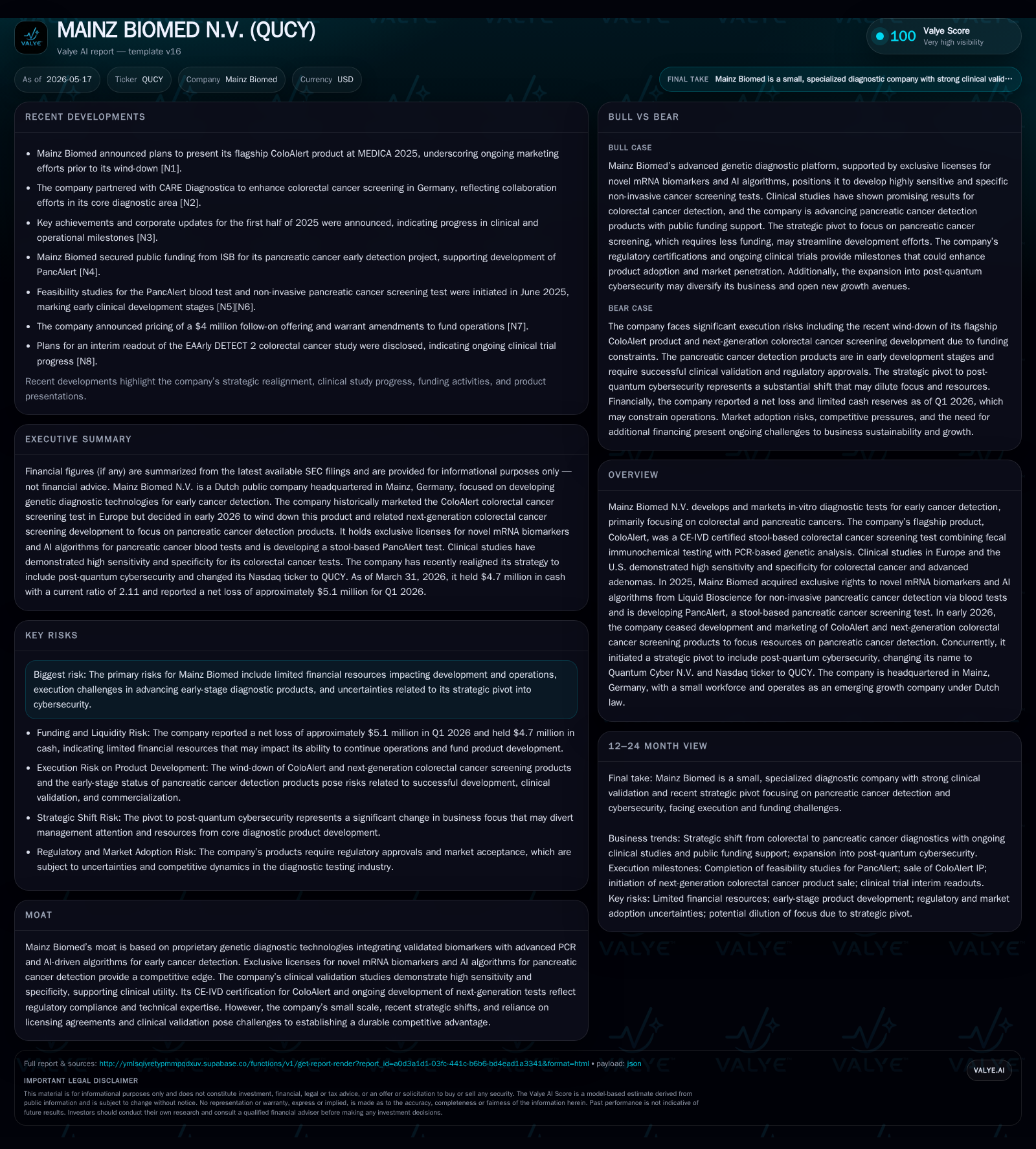
In Q1 2026, Mainz Biomed decisively discontinued its ColoAlert colorectal cancer screening product line, selling associated intellectual property as part of a broader strategic pivot. This shift refocuses the firm’s limited resources on PancAlert, a novel pancreatic cancer screening test leveraging proprietary mRNA biomarkers and AI algorithms, underscoring a transition into higher-growth but earlier-stage diagnostics. The near-term operating updates reveal significant restructuring, including personnel reductions and rebranding efforts to align with a cybersecurity growth strategy intersecting with pancreatic cancer detection. Despite technological differentiation in molecular diagnostics, financial and execution risks remain prominent given the company’s small scale and developmental status of its core pipeline.
Latest Operating Updates: Strategic Divestitures and Corporate Restructuring
The latest quarter ended March 31, 2026 [S2] marks a pivotal inflection point for Mainz Biomed N.V., signaling a robust operational pivot. The company formally wound down development and marketing of its cornerstone colorectal cancer detection product, ColoAlert—a CE-IVD certified stool-based test combining immunochemical assays with PCR genetic analysis—as well as its next generation colorectal diagnostic candidates. The firm is actively marketing its next-gen colorectal IP for sale.
This divestiture was accompanied by substantial workforce reductions—cutting approximately 65% of personnel initially dedicated to colorectal diagnostics—and closure or sale of its European Oncology Lab operations in Germany [S5]. These measures are a direct response to restricted capital availability and management's strategic decision to prioritize emerging opportunities requiring lower upfront investments.
Parallel to this restructuring, significant leadership changes took place: David Lazar was appointed director and co-CEO, while Robert Liscouski became non-executive Chairman. These appointments align with the company's broadened corporate strategy to integrate post-quantum cybersecurity ventures with continued pancreatic cancer diagnostic development [S1]. The corporate identity shift towards "Quantum Cyber N.V." pending shareholder approval further evidences this dual focus [S1], including the Nasdaq ticker update to "QUCY" effective in early 2026 [S3]. Equity financing maneuvers executed through amended distribution agreements provide incremental liquidity but underscore funding constraints persisting around execution capacity [S3].
Business Model Evolution: From Colorectal Diagnostic Kits to Pancreatic Cancer Detection
Historically, Mainz Biomed generated revenues primarily through sales of ColoAlert test kits across selected European markets where colorectal cancer screening programs are established [S1]. This model involved selling physical stool sample collection kits integrated with PCR assay components to laboratories or screening providers. Revenue drivers centered on volume uptake in EU screening routines coupled with reimbursement policies supporting early cancer detection diagnostics.
The pivot represents a fundamental business model evolution. With ColoAlert sunsetted, Mainz now concentrates on PancAlert—an investigational in-vitro diagnostic candidate aiming at early pancreatic cancer detection via non-invasive stool-based testing. Developed under an exclusive license from Liquid Bioscience acquired in 2025, PancAlert leverages novel mRNA biomarkers combined with AI-powered analyses designed for high sensitivity/specificity [Valye_report_excerpt; S1]. Unlike ColoAlert's established market pathway, PancAlert remains in clinical validation stages supported by non-refundable government grants offsetting development expenses.
This shift positions Mainz’s potential customer base toward specialists and healthcare providers focused on pancreatic oncology screening—a nascent segment lacking widespread standardization or reimbursement pathways. Market adoption will depend heavily on successful clinical trial outcomes confirming utility beyond traditional markers and navigating complex regulatory frameworks transitioning from IVD Directive (IVD-D) to the more stringent In Vitro Diagnostic Regulation (IVDR) in Europe [S1]. Thus revenue prospects become more contingent on milestone achievements than routine kit sales.
Technology and Product Portfolio Analysis: Proprietary Biomarkers and AI Integration
Mainz Biomed’s technological moat emanates from proprietary molecular biomarker technologies incorporating genetic signatures validated for early oncological disease states. ColoAlert’s stool-based platform paired fecal immunochemical testing (FIT) with multiplex PCR targeting well-characterized colorectal adenoma mutations—a synergistic approach demonstrating strong diagnostic performance per clinical studies.
PancAlert seeks to extend this paradigm into pancreatic adenocarcinoma detection by exploiting liquid biopsy advances: exploiting exclusive rights to mRNA biomarkers isolated by Liquid Bioscience alongside AI-powered pattern recognition algorithms tailored for subtle early pancreatic lesions. This convergence intends to overcome limitations inherent in purely biochemical or imaging-based modalities which traditionally exhibit low sensitivity for early-stage disease.
Regulatory achievements such as CE-IVD certification underpin quality control rigor reinforcing product readiness for market entry pending final approvals under IVDR’s enhanced analytical and clinical performance requisites [S1]. However, reliance on licensed IP raises questions about long-term moat durability absent full ownership though unilateral acquisition option mitigates some concerns. The integration of AI delineates product differentiation relative to competitors often dependent on simpler occult blood tests or conventional tumor markers.
Industry Structure and Competitive Position: Regulatory Landscape and Peer Context
Mainz Biomed operates within the specialized subset of in-vitro diagnostics oriented toward early oncology detection—a landscape marked by high technical standards, evolving regulation, and fragmented reimbursement environments. Colorectal cancer screening is an established market segment dominated by sizable incumbents offering fecal occult blood tests (FOBT), FITs, colonoscopy services integration, or multi-target molecular assays.
Transitioning into pancreatic cancer detection situates Mainz in a frontier domain characterized by scarce validated screening protocols due to historically poor prognosis cancers and low early detection rates. Increased regulatory scrutiny along IVDR implementation introduces certification timing risks but also elevates barriers protecting validated technology entrants.
While Mainz boasts differentiated proprietary technology immunoassay/AI hybrid platforms enabling promising diagnostic accuracy innovations compared to legacy methods, its small operational scale (~13 people as measured March 2026) constrains distribution reach relative to biotech peers with broader commercialization infrastructure or deeper financial backing [S1]. Pricing power remains uncertain given nascent reimbursement for pancreatic screening tests juxtaposed with growing payer pressures favoring cost-effective diagnostics.
Growth Catalysts: Pancreatic Cancer Screening Potential and Market Entry Milestones
The central growth vector lies in PancAlert’s clinical advancement trajectory supported by public grant funding aimed at offsetting R&D expenditures [S1]. Demonstrating high sensitivity and specificity for pancreatic lesions during ongoing or planned trials represents critical catalysts likely impacting regulatory submissions under IVDR.
Increased awareness of high mortality pancreatic cancers fuels demand for non-invasive early detection modalities potentially expanding screening adoption beyond symptomatic cases. Achieving regulatory approvals would open initial European market access followed potentially by U.S. FDA clearance leveraging surrogate marker validations.
Further growth depends on strategic partnerships or collaborations that could enable expanded clinical trial enrollment access or augment distribution networks aligned with gastroenterology/oncology specialists. Government funding continuation would also materially influence resource availability necessary for sustaining development timelines [Valye_report_excerpt; S6].
Risks and Constraints: Funding Limitations, Execution Challenges, and Pipeline Uncertainty
Despite prospective upside, Mainz faces multiple headwinds stemming largely from constrained capital limiting parallel pipeline pursuits—as evidenced by forced discontinuation of colorectal programs—and necessity to streamline operations drastically affecting institutional knowledge retention [S5]. Reliance on licensing agreements for key biomarkers presents potential vulnerability should negotiations falter or acquisition options be unexercised.
Clinical trial execution delays or underperformance risk stalling momentum critical for PancAlert adoption while evolving IVDR requirements may introduce protracted approval cycles increasing time-to-market uncertainty [S1]. Ledgers reflect no recent explicit debt disclosures but equity issuance agreements indicate future dilution pressures potentially impacting shareholder value concentration dynamics [S3; S9]. Attempts at expanding into post-quantum cybersecurity further risk diverting finite management attention away from nascent diagnostics commercialization hurdles.
Regulatory milestones including successful IVDR certifications for PancAlert-related components will determine near-term market introduction feasibility [S1; S8].
Corporate governance developments like shareholder approvals related to the company name change to Quantum Cyber N.V., amendments increasing authorized share capital up to 900 million ordinary shares reflecting anticipated fundraising needs bear watching [S19; S26] [S8]. Nasdaq listing compliance remains an active concern following minimum bid price deficiency notifications with September 2026 compliance deadlines imposed by Nasdaq exchange rules
Additionally, any inbound strategic partnerships blending cybersecurity assets with diagnostic innovation could signal broader transformative ambitions altering the company’s operational roadmap beyond pure biotech-focused paths.
This analysis synthesizes operational disclosures through mid-May 2026 filings highlighting Mainz Biomed’s decisive repositioning within molecular diagnostics emphasizing pancreatic cancer amidst structural industry challenges and scaling constraints. The company’s ability to balance dual initiatives spanning cybersecurity while progressing PancAlert clinical validation milestones embodies both opportunity complexity and execution risk inherent in emerging biotech enterprises shifting strategic direction.
Disclaimer: This report is for informational purposes only without investment advice or research views. It relies solely on publicly sourced SEC filings as noted without non-public material information.
Disclaimer: This is research-only, informational analysis and not investment advice. It may include AI-generated interpretation and general industry context. Always verify important details using primary sources.

Comments