
Rani Therapeutics Confronts Nasdaq Listing Pressure While Advancing Oral Biologic Delivery Pipeline
Rani's latest quarter highlights clinical progress and collaboration expansion amid stock price challenges.
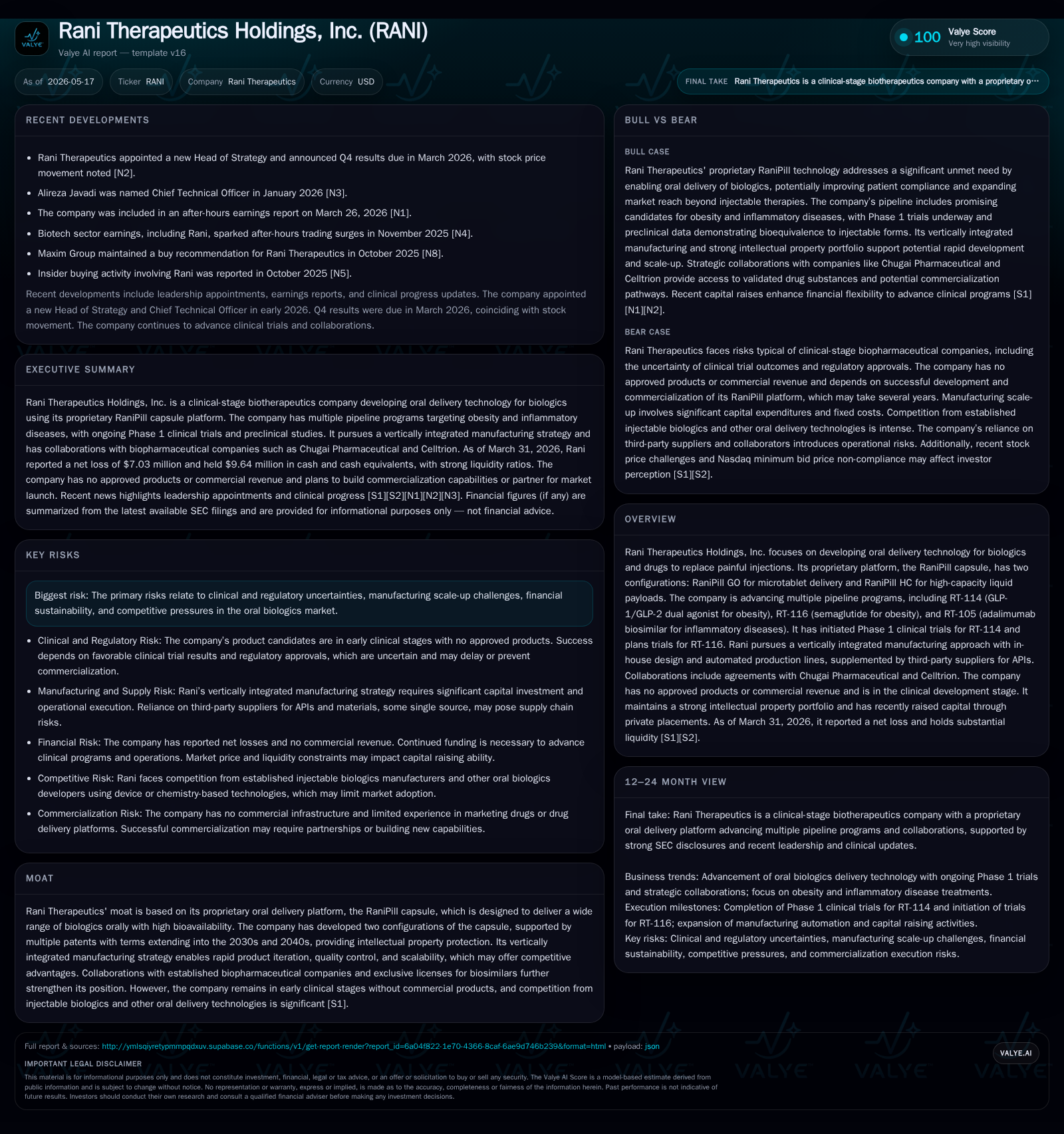
In its most recent quarter ending March 2026, Rani Therapeutics advanced its clinical pipeline, notably initiating a Phase 1 trial for RT-114 using its novel oral delivery platform. Strategic partnerships with Chugai Pharmaceutical and ProGen continue to bolster development and regulatory efforts. However, Nasdaq has notified the company of its non-compliance with minimum bid price requirements, introducing potential listing risks if unresolved by November 2026. Rani's vertically integrated manufacturing and proprietary RaniPill technology remain central to its business model targeting injectable biologic replacement, although lack of commercial revenue keeps financial sustainability under scrutiny.
Recent Operating Update
Rani Therapeutics' latest quarterly filing (10-Q filed May 15, 2026) reported ongoing clinical advancement alongside notable corporate developments impacting investor confidence. The company disclosed receipt of a Nasdaq notification regarding non-compliance with the exchange's minimum bid price rule (below $1.00 for over 30 consecutive business days), triggering a 180-day cure period ending November 9, 2026 [S2, S14]. This puts near-term market listing stability under pressure unless share price improves.
On the clinical front, Rani continues to advance its novel oral delivery platform technology embodied in the RaniPill capsule. Its high-capacity variant, the RaniPill HC, entered Phase 1 trials in December 2025 with lead candidate RT-114 — a GLP-1/GLP-2 dual agonist formulated for obesity treatment [S1]. This marks a tangible inflection point as the company transitions from preclinical validation to human testing for payloads requiring liquid formulation at higher volumes.
Strategic partnerships underpin much of Rani’s current development momentum. The collaboration with Chugai Pharmaceutical focuses on advancing an orally delivered antibody therapy for hemophilia using the RaniPill HC platform; this deal includes upfront payments totaling $10 million alongside staged technology transfer, development milestones up to $75 million+, sales thresholds potentially adding another $100 million in milestones plus royalties on net sales [S8]. Additionally, Rani coordinates closely with ProGen Co. on co-development and commercialization rights for RT-114 globally, sharing costs and profits while allocating territorial commercialization roles [S26].
Business Model
Rani Therapeutics operates as a clinical-stage biotherapeutics entity developing drug-agnostic oral delivery technologies designed primarily to replace painful injections of biologics like peptides and antibodies with convenient oral capsules. Its core innovation is the RaniPill capsule system which physically administers drugs via enteric-coated capsules that release their payload directly into the GI tract enabling absorption comparable to traditional injection routes.
Two main product configurations drive this platform strategy:
- RaniPill GO: Designed for microtablet formulations delivering up to ~3 mg doses. It has already completed three Phase 1 trials establishing foundational bioavailability data.
- RaniPill HC: A high-capacity design meant for liquid drugs up to approximately 200 µL dose volumes suitable for larger molecule biologics like monoclonal antibodies.
Revenue mechanics are currently hypothetical given no approved products exist yet; expected future revenue streams include milestone payments and royalties from collaborations/licensing agreements as well as eventual commercial sales post-approval. Early financing arrangements include equity raises and warrant issuances totaling over $60 million pro forma as of late 2025 [S8], supporting ongoing R&D and manufacturing expansion.
The company pursues vertical integration in manufacturing — internal design teams develop automated production lines for both capsule iterations while selectively relying on third parties for APIs and biologic insert manufacture [S1]. This integration is intended to optimize quality assurance, intellectual property protection, scalable capacity growth, and rapid clinical iteration capability but requires heavy upfront capital investment that weighs against near-term profitability.
Its key competitive differentiator is its mechanically engineered oral delivery platform capable of enabling oral dosing of molecules traditionally limited to injectables due to degradation or poor absorption.
Peer comparisons could include other oral biologic delivery ventures focusing on nanoparticle technologies or enzymatic protection systems; however, many competitors have yet to demonstrate equivalent payload capacity or bioavailability at scale. Major pharmaceutical companies dominate injectable biologics markets but face patient adherence challenges related to needle aversion — an unmet need that Rani targets.
Partnering established pharmaceutical companies such as Chugai (a noted Japanese player) signals external validation and access to proven therapeutic candidates needing novel delivery modes. The exclusivity provisions in licensing agreements combined with multiple patent families extending into the mid-to-late decade suggest defensible IP barriers around core platform technology [S1].
Nonetheless, industry-wide barriers include stringent regulatory scrutiny for new delivery devices especially involving microneedles or invasive mechanisms within capsules, complex manufacturing scale-up demands tied to sterile assembly processes, and entrenched competitor products backed by expansive distribution networks.
Growth Drivers
Growth drivers stem mainly from:
- Clinical Pipeline Progression: Phase 1 trial start for RT-114 underpins translation from preclinical success toward pivotal studies necessary for registration submissions.
- Strategic Collaborations: Milestone-driven agreements with Chugai (hemophilia antibody) and ProGen (obesity therapeutics) provide incremental funding inflows plus diversified product candidate exposure beyond internally developed assets.
- Manufacturing Expansion: Building vertically integrated automated production lines enables scaling from pilot runs toward commercial volumes while maintaining control over quality standards.
- Market Demand for Oral Biologics: Structural tailwind from enduring patient preference shifts away from injectables due to convenience improvement opportunities supports long-term adoption potential.
These drivers tie directly into measurable KPIs such as successful clinical trial readouts (e.g., topline efficacy/safety endpoints), milestone attainment triggering payments in collaboration contracts, manufacturing yield improvements measured during scale campaigns, and ultimately regulatory approvals enabling market entry.
Risks / Watchpoints / Growth Constraints
Key risks include:
- Nasdaq Listing Risk: Current share price weakness threatens delisting if not rectified by early November 2026 [S14], potentially impairing liquidity access.
- Clinical Trial Uncertainty: As a pre-commercial biotech entirely dependent on early-stage trials including unproven innovative delivery modalities there is substantial risk around safety outcomes and regulatory acceptance.
- Manufacturing Scale-Up Complexity: The novel mechanical capsule design requires precise automation combined with aseptic conditions; scale challenges could delay timelines or increase costs materially.
- Commercialization Experience Deficit: Management lacks prior commercial infrastructure experience necessitating reliance on partners which can limit margin retention or dictate partnership terms.
- Competitive Pressures: Established injectable biologic brands hold entrenched market positions; competing oral delivery approaches may emerge diminishing uniqueness.
- Financial Sustainability: Negative operating income nearing $38 million as of year-end 2025 with limited cash reserves poses ongoing funding requirements dependent on capital raises or partnering milestones [F1].
What To Watch Next
Upcoming catalysts include:
- Clinical data updates from ongoing Phase 1 study of RT-114 expected to validate bioavailability consistency and tolerability profiles.
- Regulatory feedback or milestone payments from Chugai collaboration particularly around development progress timelines.
- Potential newsflow on initiation dates or progress milestones relating to additional pipeline candidates such as RT-116 (semaglutide obesity program) or biosimilar programs partnered with Celltrion though latter remain preclinical stage.
- Any signs of stock price recovery preserving Nasdaq listing status post cure period deadline in November 2026.
- Announcements related to commercialization partnerships or infrastructure build-outs indicating preparation for eventual product launches.
Financial Profile Outlook
As of March 31, 2026, [F1] reports cash & equivalents totaling approximately $9.64 million against total debt approximating $13.54 million as last reported at September-end 2025. Net debt stands near $3.9 million reflecting manageable leverage given absence of significant revenues thus far. Current ratio at about 3.4 evidences short-term asset coverage above liabilities providing liquidity comfort despite operating losses nearing $38 million annually [F1].
The financial position underscores typical clinical-stage biotech cash burn dynamics driven by heavy R&D spend supporting pipeline advancement alongside costly manufacturing infrastructure investment. Future capital efficiency hinges on milestone realization from collaborations and successful equity offerings aligned with value inflections marked by clinical progress or regulatory approvals.
This analysis is grounded strictly in disclosed operating facts without offering investment research views or forecasts. All information reflects filings up through May 17, 2026.
Disclaimer: This is research-only, informational analysis and not investment advice. It may include AI-generated interpretation and general industry context. Always verify important details using primary sources.

Comments