
Pathfinder Bancorp Solidifies Local Banking Position on Prudent Credit Strategy
The bank’s latest quarterly update highlights steady deposit growth, disciplined loan underwriting, and sustained competitive strength in its New York markets.
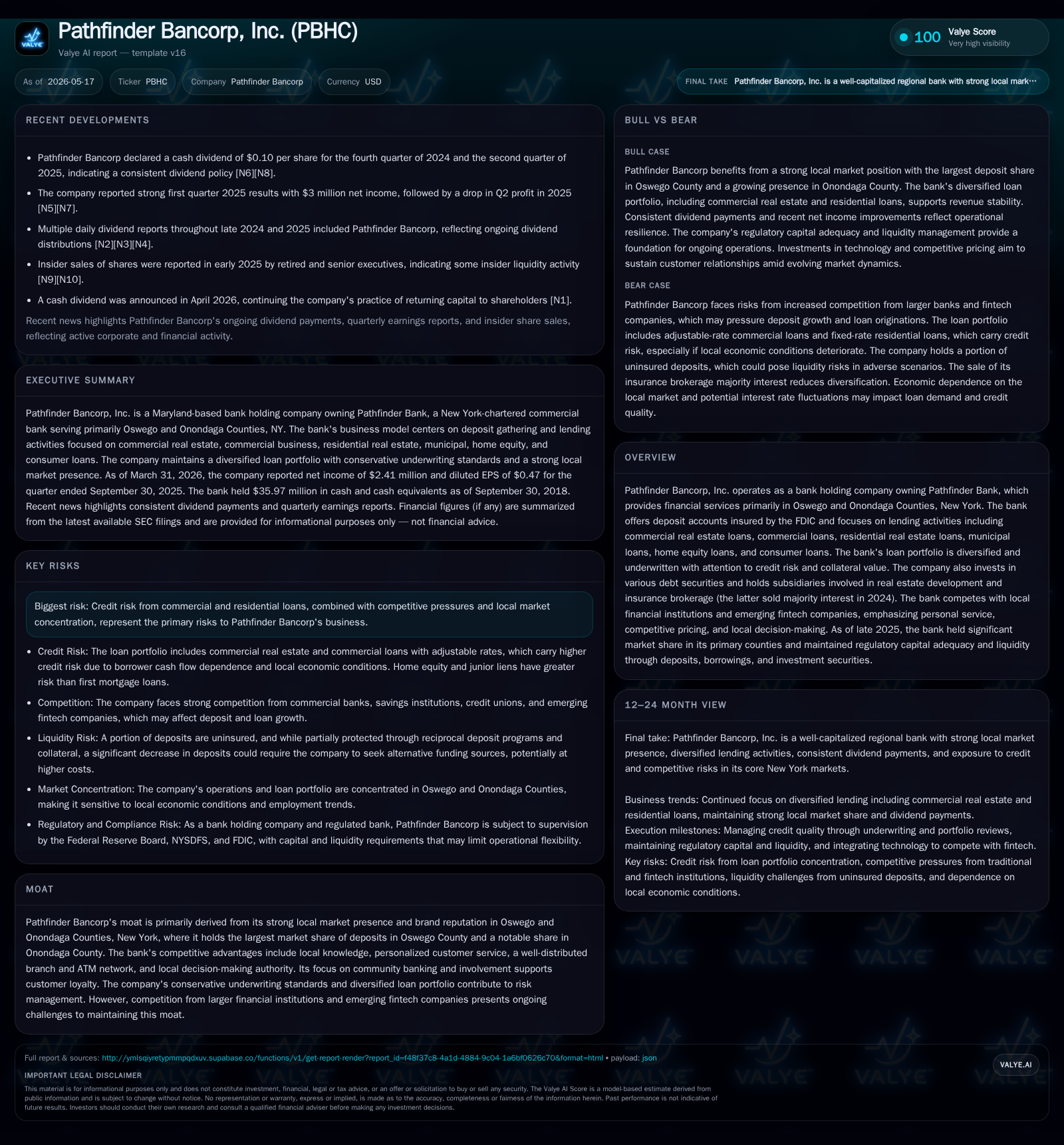
In its latest 10-Q filing for Q1 2026, Pathfinder Bancorp reports continued stability in deposit inflows and a cautiously managed loan portfolio with disciplined credit loss provisioning, affirming its conservative risk posture. The company emphasizes its leading market share in Oswego County and a notable presence in Onondaga County, leveraging local decision-making and personalized service to fend off fintech incursions. Growth drivers include modest expansions in commercial lending supported by regional economic activity and seasonal municipal deposits, while risks arise from geographic concentration and evolving credit conditions. Financially, Pathfinder maintains a strong capital base and liquidity profile backed by FHLB credit lines and reciprocal deposit arrangements.
Latest Quarterly Operating Performance and Strategic Developments
Pathfinder Bancorp's first-quarter 2026 10-Q filing [S2] underscores stable operational footing amidst ongoing regional banking challenges. Deposits continued to grow modestly, supported by steady inflows from retail customers and municipal deposits. Management's discussion articulates a maintained conservative stance on credit losses, with the allowance for credit losses calibrated to reflect both specific pool analyses — covering residential real estate and consumer loans — and discrete commercial loan evaluations. This prudent approach aligns with the bank's historical emphasis on managing credit risk through rigorous underwriting standards.
The loan portfolio composition reveals modest shifts consistent with seasonal factors; commercial loans edged up slightly while residential real estate loans experienced minor contraction linked to prepayment dynamics observed in prior quarters. The recent May 7 event filing [S3] discloses an extension of resale registration rights agreements with Castle Creek Capital Partners VII LP—reflecting ongoing capital management flexibility but does not materially alter capital structure at this time.
Pathfinder Bancorp’s Business Model and Service Offerings
Pathfinder Bancorp operates principally through its wholly owned Pathfinder Bank subsidiary targeting Oswego and Onondaga Counties in New York [S1]. The business model hinges on localized deposit gathering deployed into a diversified loan portfolio that includes commercial real estate loans, residential mortgages adhering largely to Fannie Mae conforming guidelines, municipal deposits secured by collateral mandates, home equity loans, consumer loans, and small business unsecured lending. This broad loan mix cushions revenue dependency on any single sector while preserving disciplined collateral valuation processes.
Additionally, the bank invests selectively in debt securities issued by U.S. government entities and agencies to manage liquidity and interest rate risk exposure [S1], [S24]. Notably, Pathfinder withdrew majority interests from non-core insurance brokerage operations in 2024 to refocus capital towards core banking activities. The company's localized decision-making authority enables swift underwriting adjustments attuned to community conditions—a critical advantage over larger institutions constrained by centralized policies.
Competitive Landscape and Industry Structure in Central New York
Within Oswego County, Pathfinder holds the largest market share of deposits which forms the core of its protective moat. This dominant position is buttressed by customer loyalty fostered through personal service, supported branch networks, extensive ATM footprint, and deep familiarity with regional economic cycles. In adjacent Onondaga County, while competition intensifies from national banks with broader product suites and scale advantages, Pathfinder differentiates itself via rapid local underwriting decisions and community engagement.
Emerging fintech firms introduce alternative digital offerings that pressure traditional fee lines; however, Pathfinder’s strategic emphasis on competitive pricing and relationship banking partially offsets these headwinds. Regulators such as New York State Department of Financial Services (NYSDFS) oversee operational compliance [S1], requiring adherence to Basel III capital or Community Bank Leverage Ratio rules applied at subsidiary levels despite the holding company’s exemption status.
Key Growth Drivers Fueling Deposit and Loan Expansion
Expansion trajectories rest on several observable pillars:
- Commercial Lending Demand: Marginal growth in commercial loans reflects renewed investment appetite among local businesses for property improvements and working capital aligned with Oswego-Onondaga economic activities.
- Municipal Deposit Seasonality: Significant public sector deposits arise cyclically from budget inflows to villages, towns, counties, and school districts; this seasonality requires short-term liquidity buffers managed prudently.
- Reciprocal Deposit Networks: Through CDARS/ICS programs, Pathfinder efficiently extends FDIC insurance coverage beyond typical limits for large depositors enhancing funding stability.
- Diversified Loan Mix: A balanced portfolio limits concentration risk fostering incremental volume gains without elevating vulnerability.
These elements combine with monitored KPIs such as deposit growth rates just north of low single digits per quarter reported internally [S2], references to continuing healthy loan originations especially in CRE segments [S25], lending committee oversight policies enforcing credit discipline [S18], as essential drivers underpinning measured asset expansion.
Risks and Constraints: Credit, Competition, and Local Market Concentration
Dominant risks stem principally from the geographic concentration within Central New York intrinsic to community banks like Pathfinder. Economic fluctuations affecting local industries can rapidly influence asset quality trends; recent quarterly disclosures cite specific watchpoints around commercial loan delinquencies linked to two key borrower relationships [S28]. Although the bank employs comprehensive credit loss allowance methodologies calibrated via historical loss rates per loan category [S1], isolated spikes require attention.
Competitive pressures arise both from entrenched regional banks with greater scale economies offering bundled product discounts, as well as new fintech entrants enticing customers with enhanced digital experiences outside traditional branch networks. Regulatory constraints impose capital conservation buffers limiting dividend flexibility [S9], creating tradeoffs between shareholder distributions versus retained earnings reinforcement needed for organic growth support.
Deposit concentration also presents vulnerability given that about 13-14% of deposits may be uninsured nominally but are mitigated by reciprocal programs confirmed at recent quarter-end balances [S6]. However, shifts in depositor behavior or unexpected withdrawal patterns during economic stress could necessitate more costly alternate funding.
Upcoming Milestones and Market Signals to Monitor
Key near-term focal points include:
- Monitoring second-quarter loan portfolio health indicators post-Q1 outcomes for early signs of credit stress or improved recovery trends.
- Observing deposit retention patterns through seasonal cycles given historical municipal timing effects.
- Evaluating impacts of registration rights agreement expiration set for May 8, 2026 related to private placement securities with Castle Creek Capital Partners VII [S3]. This could influence future capital strategy maneuvers if resale registrations are delayed or modified.
- Tracking regulatory announcements regarding Basel III implementation or changes affecting community bank capital requirements which may necessitate adjustments to leverage strategy.
- Dividend declaration cadence following recent Nasdaq-reported $0.10 per share payouts that signal shareholder return priorities aligned with earnings sustainability [N1].
Although explicit current leverage ratios are not updated in this quarter's filing [S2], previous disclosures report manageable borrowings largely sourced from FHLB-NY advances under multiple facilities available for liquidity contingencies ([S5], [S6]).
Noteworthy is the bank’s meticulous approach to funding mix optimization utilizing brokered deposits strategically combined with insured reciprocal arrangements (CDARS/ICS) safeguarding uninsured portions—adding resilience if market disruptions occur ([S5]). Interest rate derivative hedges used selectively mitigate repricing mismatches thereby stabilizing earnings volatility caused by rate swings ([S8], [S25]).
This financial posture corroborates the operating narrative that Pathfinder Bancorp prioritizes balance sheet strength supporting sustainable community-focused lending expansion without excessive risk buildup.
This analysis is based exclusively on disclosed SEC filings up to May 15, 2026 ([S2], [S3], [S1]) supplemented by secondary news sources ([N1]) without any forward-looking investment recommendations or price targets.
Disclaimer: This is research-only, informational analysis and not investment advice. It may include AI-generated interpretation and general industry context. Always verify important details using primary sources.

Comments