
First Community Corp Executes Strategic Share Repurchase Backed by Regional Banking Strength
FCCO’s latest quarterly filing reveals a $7.5 million share repurchase authorization alongside ongoing integration of its Signature Bank of Georgia acquisition, underscoring its regional banking focus.
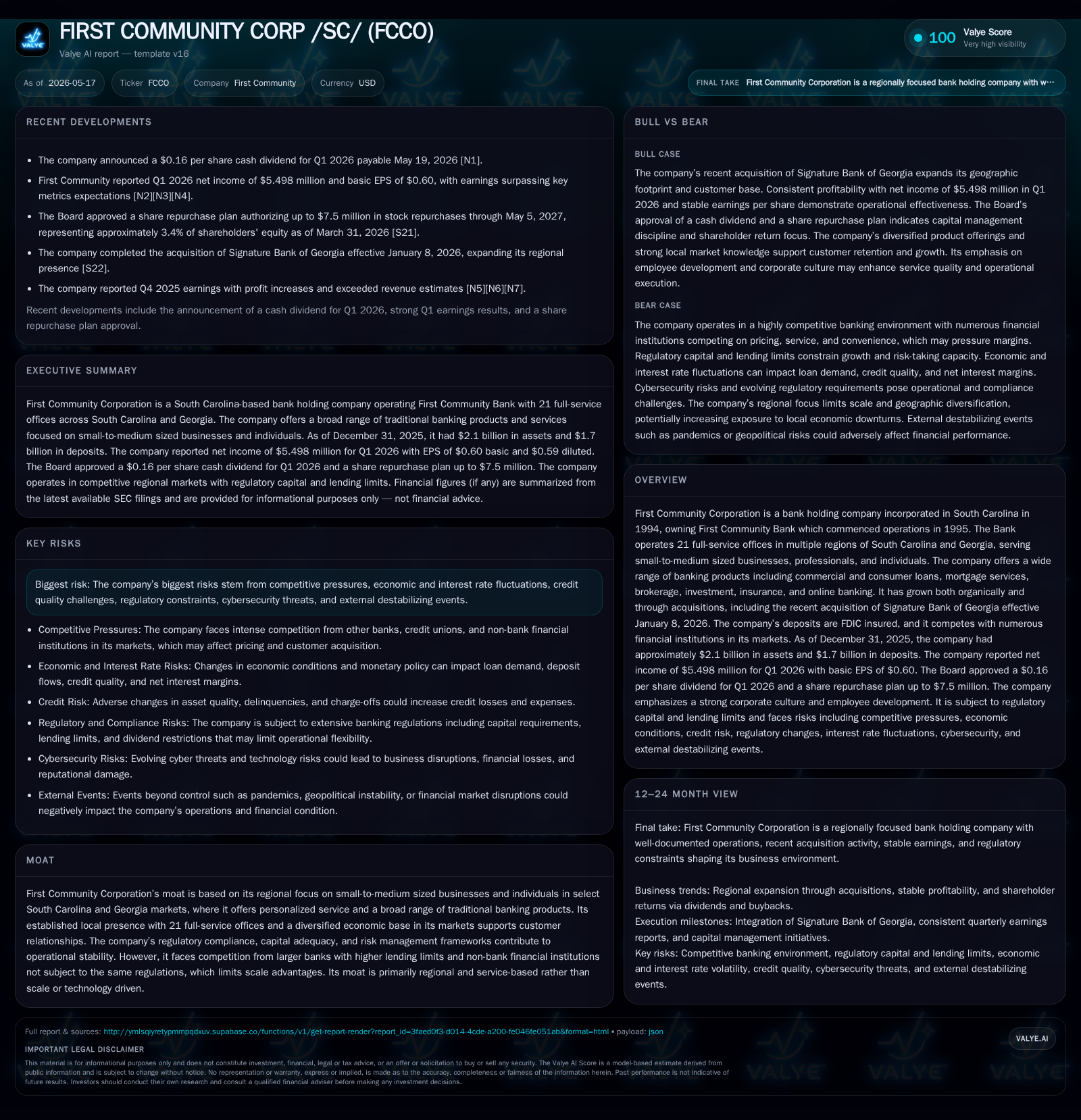
First Community Corporation (FCCO) recently announced a significant capital allocation shift with board approval of up to $7.5 million for share repurchases, representing about 3.4% of equity as of Q1 2026. This financial maneuver coincides with the early stages of the integration of Signature Bank of Georgia, acquired in January 2026, reinforcing FCCO’s growth via strategic M&A. The company operates a regional bank targeting small-to-medium enterprises and individuals across South Carolina and Georgia through 21 full-service branches, competing in a niche market where personalized relationships and a diversified product offering create its moat. While facing typical risks from regulatory constraints, credit quality fluctuations, and competition from larger banks and fintech, FCCO’s measured growth through acquisitions and service expansion positions it for continued regional relevance.
Latest Quarterly Update: Share Repurchase Approval and Acquisition Integration
The May 15, 2026 Form 10-Q filing reveals First Community Corporation’s decisive move to deploy up to $7.5 million toward a share repurchase program authorized by its Board of Directors [S2,S3]. This represents roughly 3.4% of FCCO’s shareholders’ equity as reported at March-end 2026—a substantial allocation signaling confidence in the company's capital position after completing the recent acquisition of Signature Bank of Georgia on January 8, 2026 [S3]. Management retains discretion over timing and methods—ranging from open market purchases to negotiated transactions—allowing flexibility to respond to market conditions while enhancing shareholder value [S3].
This repurchase authorization closely follows first quarter earnings that surpassed analyst estimates on multiple fronts [N2,N3], suggesting operational momentum amid integration phases. The purchase complements ongoing efforts to optimize capital usage following the expansion into Georgia markets via the Signature Bank deal announced mid-2025 and consummated early this year [S1,S3,S26]. Together these reinforce FCCO's strategy to solidify its regional footprint through tactical M&A while maintaining capital discipline via measured shareholder returns.
Business Model and Product Offering: Regional Focus on SMEs and Relationship Banking
First Community Corporation holds its banking operations primarily through First Community Bank, which operates from its headquarters in Lexington, South Carolina along with twenty-one full-service branches across select South Carolina regions (Midlands, Upstate, Piedmont) and segments of Georgia (Augusta area) [S1]. The company focuses heavily on servicing small-to-medium sized enterprises (SMEs), professionals such as accountants or lawyers, as well as individual consumers.
Revenue generation stems from interest income on commercial loans (working capital, equipment acquisition), consumer loans (auto financing, home improvements), mortgage lending (both held-for-investment portfolios and sales into secondary markets), plus diversified fee income from brokerage/investment products and insurance offerings integrated under one roof [S1]. Additionally, FCCO provides digital banking capabilities that cater to increasing client demand for online service access—while preserving personalized relationship dynamics fundamental to community banking.
The model emphasizes long-term relationships fueled by tailored service rather than scale-driven pricing power or advanced fintech solutions common among national players. FCCO thus occupies a service-centric niche characterized by local knowledge advantages but constrained lending limits tied to capital ratios under federal regulations [S1,S10,S24]. The bank's regulatory adherence—embracing FDIC insurance coverage up to standard limits—and conservative credit underwriting underpin operational stability even amid fluctuating economic cycles.
Industry Positioning: Niche Competitor Among Mid-Sized South Carolina and Georgia Banks
FCCO operates squarely in the mid-sized regional bank sector serving Southeast communities where competition includes both larger regional banks capable of higher lending volumes and technologically advanced fintech entities operating outside traditional regulatory boundaries. Larger institutions may leverage superior scale economics affecting loan pricing or deposit rates; fintech disruptors offer speedier service models often appealing to younger demographics.
FCCO’s competitive moat derives primarily from established local presence via physical branches—21 offices spread across targeted counties—and relationship-based customer retention strategies which yield switching costs grounded in trust rather than contractual lock-ins [S1]. However, the absence of broad-scale technology platforms limits ability to capture rapidly evolving customer segments highly reliant on mobile-first experiences.
Pricing power is modest given dense competitor overlap within its footprint; nevertheless, diversified product offerings spanning commercial loans to investment advisory services enhance cross-sell opportunities that mitigate reliance on sporadic interest income fluctuations [S10,S20]. Regulatory compliance requirements further favor incumbents like FCCO who maintain robust governance frameworks amid ever-changing supervisory expectations related to capital adequacy and safe lending practices
Growth Drivers: Organic Expansion, M&A Activity, and Service Diversification
FCCO continues growing deposits organically supported by community ties augmented by steady loan portfolio increases focusing on SME working capital needs alongside consumer mortgage demand aligned with local demographic trends [S1,S3]. A critical pillar driving recent growth is the successful acquisition and integration of Signature Bank of Georgia earlier this year which expanded both geographic reach into Augusta’s financial markets as well as client breadth in Georgia’s SME segment [S3,S26].
Beyond traditional balance sheet expansion, FCCO strategically diversifies revenue through brokerage/investment services and insurance products which contribute noninterest fee income—adding margin stability independent of interest rate cycles or credit losses inherent in lending businesses [S1]. Digital capabilities enhancement further supports client retention by meeting evolving preferences for accessible online banking platforms without sacrificing personal relationship elements valued by core customers.
Management's disciplined approach marries meaningful M&A opportunities with steady organic growth initiatives rather than aggressive expansion which could strain capital buffers. This aligns with maintaining regulatory-compliant capital levels required for sustainable dividend distributions or share repurchases as evidenced by recent board actions [S2,S3]. Key operational KPIs such as deposit growth rates post-acquisition integration periods will be important metrics signaling successful execution going forward.
Risk Factors and Constraints: Regulatory Environment, Competition, and Credit Quality
FCCO faces risk vectors typical for community regional banks yet nuanced by increasing regulatory requirements impacting capital management flexibility. While FCCO qualifies as a small bank holding company exempt from certain Federal Reserve capital rules at holding company level, its subsidiary bank must meet Basel III–style minimum Common Equity Tier 1 ratios along with maintained capital conservation buffers impinging on dividend or stock buyback actions if thresholds are not met [S10,S12].
Credit quality risks manifest notably from concentrations in commercial real estate loans—particularly non-owner occupied CRE loans constituting over three times the bank’s risk-based capital—which invites enhanced supervisory scrutiny demanding prudent underwriting discipline amidst fluctuating property valuations due to rising interest rates or economic headwinds [S13,S20]. Cybersecurity is an elevated concern; the institution maintains a dedicated Information Security Officer role reporting regularly directly to the board ensuring robust defense mechanisms against potential breaches or disruptive attacks affecting information systems that underpin all banking operations [S1].
Competitive pressures remain acute from larger institutions offering broader product suites at scale discounts plus non-bank fintechs delivering disintermediating services unconstrained by traditional bank regulatory frameworks. These dynamics limit pricing power even in established markets forcing FCCO toward continuous innovation balanced carefully against heightened compliance cost burdens encountered within regulated environments.
Monitor Points: Execution of Repurchase Plan, Loan Growth Trends, and Dividend Sustainability
Investor attention should focus next on how management executes its up-to-$7.5 million share buyback over the next twelve months relative to market conditions—which could serve as a tactical lever complementing steady organic growth momentum sustained since the Signature Bank acquisition proved accretive earlier this year [S3,N2,N3]. Monitoring loan book progression via subsequent quarterly disclosures will provide measurable insight into how well new market penetration initiatives take hold particularly within Georgia regions newly onboarded through M&A.
Dividend behavior also merits observation given FCCO’s track record maintaining quarterly payouts at $0.16 per share consistent with board announcements throughout early 2026—where regulatory constraints around capital conservation buffers may temper future increases until credit portfolio stability is assured amid broader macroeconomic uncertainties around inflation or monetary policy shifts that impact loan demand/supply dynamics [N1,N4]
Net income reported for full year stood at approximately $19.2 million demonstrating ongoing profitability underpinning viable dividend distributions discussed above.
FCCO appears positioned financially soundly to navigate incremental growth opportunities while managing compliance demands effectively.
This analysis is based solely on publicly available information from SEC filings dated March through May 2026 along with corroborated news sources; it does not constitute investment advice nor incorporate insider or non-public data.
Disclaimer: This is research-only, informational analysis and not investment advice. It may include AI-generated interpretation and general industry context. Always verify important details using primary sources.

Comments