
Wing Yip Food Begins Nasdaq Share Consolidation to Preserve Listing and Strengthen Market Position
Wing Yip Food initiates a 4-for-1 share consolidation to comply with Nasdaq's minimum bid price rule, maintaining market access while advancing its distribution-led growth strategy in China.
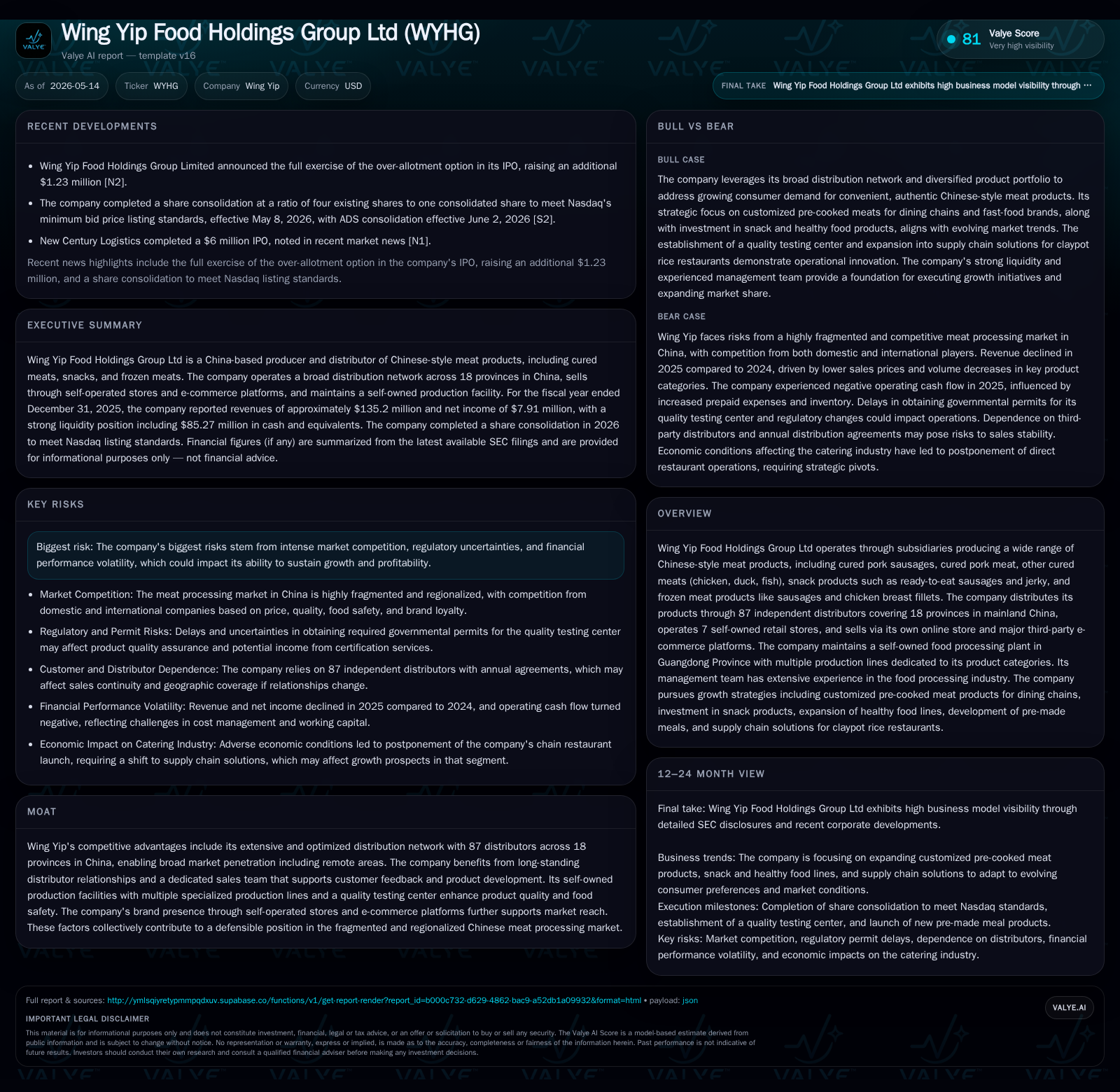
In May 2026, Wing Yip Food Holdings Group Limited executed a shareholder-approved 4-for-1 share consolidation designed to mitigate delisting risk from Nasdaq due to minimum bid price requirements. This maneuver preserves shareholder economic interest and trading liquidity through proportional ADS consolidation, setting a more stable platform amid competitive pressures. The company operates a comprehensive Chinese-style meat products portfolio distributed via a robust network of 87 distributors across 18 Chinese provinces, supplemented by its own retail stores and growing e-commerce channels. Emerging convenience food lines targeting younger consumers, backed by specialized production capacity in Guangdong, represent strategic growth vectors. Key risks include volatile market competition, regulatory uncertainties in mainland China, and financial performance variability.
Share Consolidation: Purpose and Immediate Implications
Wing Yip Food Holdings Group Limited completed a pivotal corporate action in Q2 2026 — a shareholder-sanctioned 4-for-1 ordinary share consolidation effective May 8, aimed squarely at satisfying Nasdaq's minimum bid price requirement under Listing Rule 5550(a)(2) [S2]. Without this measure, the company risked delisting from Nasdaq given its stock price performance trends prior to consolidation. Proportionally mirroring this at the ADS level, Wing Yip instructed Deutsche Bank Trust Company Americas not to adjust the ADS-to-ordinary share ratio; instead four old ADSs convert into one new ADS effective June 2 on Nasdaq’s capital market [S2].
This carefully coordinated timing means ADS holders retain their full economic interest while benefiting from a higher per-ADS market value post-consolidation — an essential structural move that helps preserve investor confidence and trading liquidity amid low bid-price pressures common for many small-cap foreign private issuers. Between the company-level share consolidation’s effective date and the ADS market adjustment date, trading will reflect pre-consolidation pricing though the underlying equity has consolidated [S2]. This sequence underlines the tactical nature of the move as a preventive step against forced delisting.
Business Model and Product Portfolio Overview
Wing Yip Food operates an integrated Chinese-style meat production business spanning cured pork sausages, cured pork meats as well as other cured proteins such as chicken, duck, and fish. Its portfolio expands into ready-to-eat snack products (sausages, jerky) and frozen categories including sausages and chicken breast fillets [S1]. Production activities are centralized in Guangdong province where it owns a food processing plant equipped with several dedicated production lines tailored by product category alongside an internal quality testing lab ensuring rigorous food safety compliance [S1].
Revenue arises primarily from wholesale sales through its distribution network but also significantly from direct sales through its seven proprietary retail stores plus digital platforms — notably its Wing Yip Mall online store launched in October 2017 alongside partnerships with major Chinese e-commerce marketplaces like Tmall, JD.com, TikTok (Douyin), Kuaishou, Pinduoduo, and Alibaba’s wholesale platform (1688) [S1]. This multi-channel approach leverages shifting consumption trends favoring convenience shopping.
Accounting for revenue follows US GAAP Topic 606 provisions distinguishing principal versus agent roles in contract performance obligations; Wing Yip recognizes gross revenue when acting as principal reflecting full consideration on sale [S1].
Distribution Network and Market Reach in China
A core pillar of Wing Yip’s strategic moat is its expansive distribution reach that encompasses 87 independent distributors servicing 18 provinces across China including crucial economic hubs such as Guangdong, Zhejiang, Shanghai, and Hunan [S1][S16]. This network effectively penetrates varying regional markets spanning populous urban centers down to remote counties — an operational feat requiring careful distributor vetting along standardized selection criteria to maintain quality control over downstream handling.
Distributor relationships are deepened through ongoing engagement via dedicated sales teams who collect customer feedback forward-looking toward consumer taste profiling enabling tailored marketing launches. The company further incentivizes distributor performance through tiered rebate programs tied to progressive sales targets fostering strong channel loyalty and active product push strategies across regions [S16][S18].
The dual presence of company-operated retail outlets adds controlled brand exposure directly to end consumers beyond wholesale touchpoints while online sales continue to grow their footprint gradually with e-commerce revenues forming about 1.56% of total revenue by fiscal year-end 2025 ($2.10M) up from $1.78M (1.33%) in 2023 highlighting early but promising digital adoption strides [S1][S16].
Competitive Environment and Industry Positioning
Wing Yip operates within China's highly fragmented meat processing industry characterized by numerous regional players often competing fiercely on price alongside quality differentials. Here the company’s robust distribution network represents a distinct competitive advantage enabling broad geographic coverage with relatively high switching costs related to established partner trust plus product consistency guaranteed via dedicated plant facilities [S1].
Its vertical integration aspects—owning production capacity coupled with robust distributor loyalty—provide buffer against regional supply disruptions or inconsistent quality issues that often plague smaller processors lacking scale or capacity specialization. Brand recognition is further bolstered by direct-to-consumer retail operations plus an increasing presence on leading e-commerce sites strengthening omni-channel penetration.
That said, Wing Yip faces typical challenges around pricing pressure from competitors including local producers able to undercut on cost but potentially lacking Wing Yip’s rigorous quality controls or breadth of product innovation supported by R&D efforts focused on new convenient formats appealing to changing demographics [S22]. Regulatory scrutiny remains high within China's food sector; compliance adherence is critical considering evolving food safety laws recently amended as of September 2025 emphasizing stricter standards which Wing Yip seems well-positioned for given its internal testing capabilities [S9].
Emerging Growth Drivers: E-commerce and Tailored Product Lines
Recent years have seen pronounced shifts in consumer lifestyles toward convenient meal solutions favoring ready-to-eat or easy-prep products especially among younger demographics balancing work-life demands. Wing Yip has responded proactively by developing new frozen sausage and pre-made meal product lines aligned precisely with these consumption habits.
Following successful small-scale trial production mid-July 2024 yielding positive market feedback, commercial-scale production began Q1 2025 leveraging existing plant capabilities but introducing specialized lines focusing on nutritionally balanced offerings suitable for quick preparation environments like dining chains or household use [S1]. These moves reflect structural rather than cyclical demand shifts driven by macro lifestyle trends.
Simultaneously expanding online presence allows Wing Yip direct feedback loops from digitally engaged consumers facilitating iterative product development sensitive to modern taste profiles while scaling mass production sustainably [S1]. While e-commerce revenues remain a modest fraction (~1.56%), their steady increase signals meaningful runway linked closely to successful rollout milestones like distributor uptake rates or SKU penetration monitored quarterly.
Potential Risks and Market Headwinds
Wing Yip’s operating environment is exposed to several inherent risks that merit close observation:
- Market competition intensity could constrain pricing power limiting margin expansion despite rising input costs indicated by recent declines in gross profit margins to ~29% from ~31% previously amid rising raw material prices plus currency fluctuations impacting costs broadly [F1][S22].
- Regulatory uncertainties remain salient given mainland China’s tightening food safety laws requiring continuous operational investment into compliance systems; failure here could disrupt supply or invoke penalties damaging financial profiles.
- Financial performance volatility was evidenced by net income falling nearly 30% year-over-year to $7.9 million alongside operating income contraction reflecting margin pressures plus elevated administrative expenses linked partially to depreciation increments indicating recent capex investments [F1][S1].
- Governance structure risks tied to foreign private issuer status imply fewer U.S.-style protections possibly affecting investor confidence unrelated directly to fundamentals but important as sentiment drivers in volatile emerging-market listings context [S1].
- The share consolidation itself suggests stock price challenges that may continue post-event depending on broader market reception or operational execution against growth targets.
Upcoming Catalyst Events and Monitoring Metrics
Key near-term catalysts arising from recent activity include monitoring post-share consolidation trading volume/pricing stability following June 2 ADS re-ratio implementation which will materially affect float size dynamics albeit without diluting economic stake per holder [S2]. Management commentary on Nasdaq compliance strategies reported alongside Q2 results will further clarify medium-term listing viability prospects.
Operationally tracking quarterly KPIs around growth of convenience product line revenues as percentage of total sales plus distributor count retention/expansion rates across provinces deliver insightful markers on scalability of growth vectors initiated since late-2024 product rollouts (i.e., frozen sausages/pre-made meals). E-commerce channel revenue trajectories signal digital adoption success supporting broader strategic pivot towards omnichannel consumption patterns favored increasingly by millennial/Gen Z cohorts within China’s urban centers.
Latest Financial Snapshot Supporting Operational Analysis
Latest financial snapshot
| Metric | Value | Period |
|---|---|---|
| Cash & equivalents | $85mm | |
| 2025-12-31 | ||
| Total debt | $18mm | |
| 2025-12-31 | ||
| Net debt | $-67mm | |
| 2025-12-31 | ||
| Current assets | $132mm | |
| 2025-12-31 | ||
| Current liabilities | $28mm | |
| 2025-12-31 | ||
| Current ratio | 4.77x | |
| 2025-12-31 |
Source: SEC companyfacts cache [F1].
| Metric | Value (USD) | Date |
|---|---|---|
| Revenue | 135,192,629 | |
| 2025-12-31 | ||
| Net Income | 7,913,888 | |
| 2025-12-31 | ||
| Cash & Equivalents | 85,269,432 | |
| 2025-12-31 | ||
| Total Debt | 17,792,538 | |
| 2025-12-31 | ||
| Current Assets | 132,172,259 | |
| 2025-12-31 | ||
| Current Liabilities | 27,701,738 | |
| 2025-12-31 |
The current ratio stands at approximately 4.77 indicating strong short-term liquidity despite modest top-line contraction (~6.5% decline year-on-year). Net debt is negative around -$67 million reflecting sizable cash reserves relative to debt load providing cushion for ongoing investment needs including R&D innovation supporting pipeline expansions noted earlier [F1][S1].Depreciation expense increases suggest recent capex focused on scaling production lines for new convenience products.[/footnote]
Overall financial robustness complements operational foundation positioning Wing Yip Food well for navigating competitive landscape despite margin headwinds observed recently.
Disclaimer: This report is for informational purposes only and does not constitute investment advice or recommendations.
Disclaimer: This is research-only, informational analysis and not investment advice. It may include AI-generated interpretation and general industry context. Always verify important details using primary sources.

Comments