
HCM IV Acquisition’s Strategic Positioning as a New SPAC Amid Fierce Deal-Drive Competition
HCM IV Acquisition Corp. holds significant capital from its recent IPO, positioning itself to compete in a crowded SPAC market while navigating governance and market challenges.
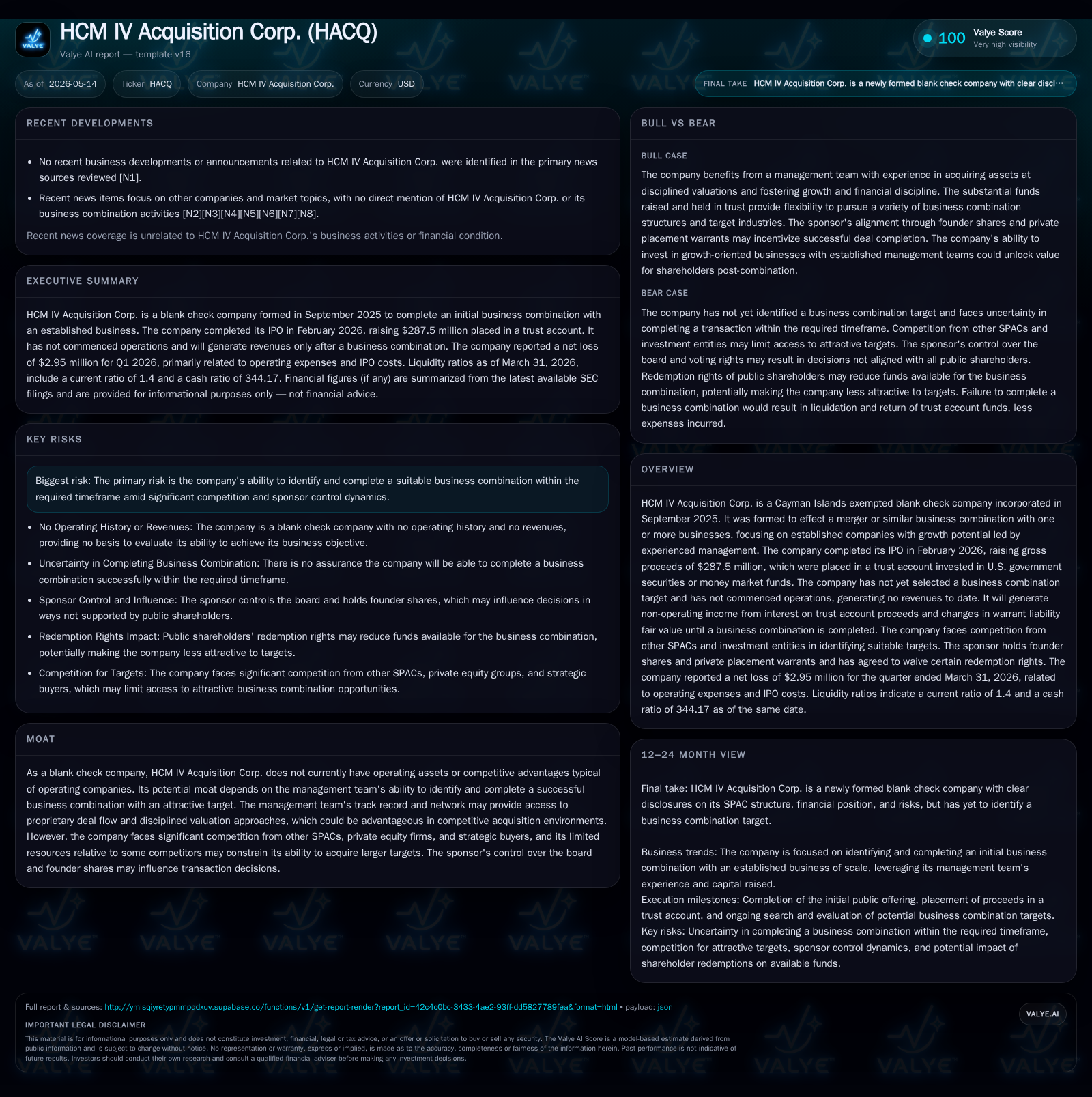
HCM IV Acquisition Corp., a Cayman Islands-exempted blank check company, completed its IPO in February 2026, raising $287.5 million placed in a trust account invested in U.S. government securities. As of the latest quarter ending March 31, 2026, it remains pre-combination with no revenues but generates non-operating income from trust interest. The company operates amid fierce competition with other SPACs and private equity firms targeting established companies with growth potential. Success hinges on the management team's ability to source and close an attractive deal within regulatory and shareholder-related constraints. Key risks include public shareholder redemption rights and sponsor control dynamics that could complicate transaction execution.
Latest Quarterly Update Illuminates Current Operations and Capital Standing
In its latest quarterly filing dated May 14, 2026 [S2], HCM IV Acquisition Corp. ("HACQ") confirms that it has yet to select or engage substantively with any business combination target. The company remains a blank check entity with no revenues or operating activities aside from administrative functions. Crucially, HACQ holds the full gross IPO proceeds of $287.5 million raised in February 2026 safely segregated in a trust account invested primarily in short-term U.S. government securities or money market funds [S1], earning non-operating interest income.
This capital preservation is essential given the regulatory requirement that proceeds stay intact until an initial business combination is consummated or the company dissolves upon failure within the prescribed timeframe. The April 2, 2026 Form 8-K [S3] notes that starting April 6, 2026, HACQ enabled separate trading of Class A ordinary shares and warrants previously bundled into units — an important step that increases liquidity granularity for investors.
The latest balance sheet snapshot [F1] as of March 31, 2026 shows current assets of approximately $1.18 million against current liabilities near $0.84 million, yielding a current ratio of 1.4 — consistent with a lean cost structure without operating revenues but adequate liquidity for ongoing due diligence and administrative costs.
Understanding HCM IV Acquisition’s Blank Check Business Model and Sponsor Influence
HACQ was incorporated as a Cayman Islands exempted blank check company in September 2025 explicitly to acquire one or more operating businesses via merger or similar transactions [S1]. It made its public debut through a February 2026 IPO offering units comprised of one Class A ordinary share combined with one-quarter warrant exercisable at $11.50 per share [S8]. Proceeds from the offering were placed into the stipulated trust account pending deal completion.
The company’s business model entails sourcing an established growth-oriented target led by an experienced management team — aiming to leverage sponsor expertise for disciplined valuations and operational improvements post-merger [S7]. However, as characteristic of SPACs, HACQ has no standalone operating assets or revenue stream prior to completing its initial business combination.
The Sponsor holds approximately 8.63 million founder shares at nominal cost along with private placement warrants purchased concurrently with the IPO [S8]. This ownership confers significant influence over board composition before any business combination closes — enabling appointment of all directors and substantial voting power over transaction decisions [S1]. Furthermore, sponsor agreements commit these insiders to vote their shares in favor of any deal the board approves regardless of public shareholder sentiment, potentially diluting minority investors’ effective control [S1].
Redemption rights granted to public shareholders upon proposed combinations introduce complexity: shareholders may redeem their shares for pro rata trust amounts rather than approving transactions via votes, which can reduce effective transaction capital and thus influence target negotiations.[S1]
Competitive Dynamics and Structural Challenges in the SPAC Market Environment
HACQ enters a highly competitive arena populated by numerous other SPACs along with traditional private equity firms and strategic acquirers jockeying for attractive targets [S1]. Most competitors possess larger pools of capital or broader operational infrastructures enabling pursuit of bigger or more complex targets. HACQ’s $287.5 million war chest limits the size and scope of feasible acquisitions compared to certain peer funds seeking multibillion-dollar deals.
Additionally, revamped regulations introduced in 2024 have increased compliance costs and elongated deal timelines across the sector [S7], intensifying pressure on new entrants to deliver timely transactions under scrutiny by regulators and shareholders alike.
Market scarcity of ideal acquisition candidates heightens negotiation leverage among targets who may exploit SPAC deadlines — particularly as HACQ approaches dissolution windows if unable to close deals on favorable terms within two years following IPO launch [S1]. This dynamic creates urgency but also risk that suboptimal deals might be consummated or protracted searching might undermine investor confidence.
Key Growth Drivers: Deal Sourcing, Sponsor Track Record, and Market Timing
Central to HACQ’s growth prospects is its management team's capability to leverage proprietary deal flow from established networks cultivated across prior investment ventures [S28]. These relationships can yield early access to promising targets not broadly solicited through auction processes.
Moreover, disciplined valuation frameworks aimed at avoiding overpaying serve as competitive advantages amidst inflating asset prices common in recent market cycles [S28]. The strategic focus on businesses exhibiting scalable growth trajectories led by competent teams aims to amplify intrinsic value creation post-combination.
Timing remains critical; successfully executing deals within regulatory windows enhances investor sentiment towards both stock performance and warrant conversion likelihoods. Conversely, delays or missed deadlines substantially elevate liquidation risks which would return only trust-account cash minus costs to shareholders.
Risks and Constraints: Redemption Rights, Sponsor Control, and Regulatory Landscape
A core risk vector involves shareholder redemption provisions embedded within HACQ’s governance structure whereby investors may opt out of purchased combinations in exchange for cash distributions funded from trust proceeds [S1]. Significant redemptions diminish deal funding capacity potentially forcing renegotiations or abandonment.
Sponsor control mechanisms carry inherent conflicts: founder shares grant outsized voting influence that may diverge from public investor interests when approving transactions [S1]. Although designed to align sponsors’ incentives via skin-in-the-game equity holdings, such control asymmetry can affect perceived fairness or governance quality.
Regulatory burdens arising from the SEC’s enhanced oversight since 2024 amplify compliance expense loads while mandating heightened disclosures related to conflicts of interest, valuation methodologies, and shareholder protections—factors increasing transactional overhead and elongating diligence cycles [S7].
What Investors Should Monitor Next: Pipeline Progress, Market Trends, and Shareholder Actions
Investors should track key milestones including public announcements indicating preliminary or exclusive engagement with acquisition candidates—which would signal progress beyond the initial search phase [S2]. Market reception towards separated trading of shares versus warrants post-unit split (effective April 6, 2026) will illuminate investor sentiment on dilution risk premia embedded in outstanding warrants comprising a quarter fraction per unit initially issued [S3].
Monitoring broader SPAC market liquidity conditions—such as comparable deal multiples achieved recently—and the rate at which competing vehicles secure binding letters of intent gives further insight into underlying demand dynamics impacting HCM IV’s competitive positioning.
Subsequent shareholder voting outcomes related to proposed initial business combinations will serve as pivotal validation checkpoints regarding alignment between sponsor recommendations and public holders’ assessments.
Financial Overview: Liquidity Position and Capital Management Supporting Strategic Flexibility
Latest financial snapshot
| Metric | Value | Period |
|---|---|---|
| Current assets | $1177159 | |
| 2026-03-31 | ||
| Current liabilities | $838278 | |
| 2026-03-31 | ||
| Current ratio | 1.4x | |
| 2026-03-31 |
Source: SEC companyfacts cache [F1].
As reported for the quarter ended March 31, 2026 [F1], HCM IV maintains current assets totaling approximately $1.18 million against current liabilities around $0.84 million resulting in a current ratio near 1.4—demonstrating sufficient short-term liquidity given its lack of operating revenue.
Operating expenses currently manifest as net expenditures related primarily to administrative functions needed during the search phase; operating income reflects an approximate loss of $0.9 million for the latest quarter consistent with expected startup burn rates absent revenue streams [F1].
Cash balances represented mainly by trust account deposits offer robust financial flexibility enabling patience in sourcing appropriate targets without immediate pressure for capital deployment—preserving options amid competitive bidding environments while meeting necessary compliance commitments.
This analysis is based solely on publicly available SEC filings through May 14, 2026 ([S1], [S2], [S3], etc.) combined with validated companyfacts financial data ([F1]). It does not constitute investment advice or endorsement but provides an informed assessment anchored in current disclosure.
Disclaimer: This is research-only, informational analysis and not investment advice. It may include AI-generated interpretation and general industry context. Always verify important details using primary sources.

Comments