
Jupiter Neurosciences Advances JOTROL™ Platform Amid Liquidity and Market Listing Pressures
The company’s latest quarterly filing highlights operational progress in clinical trials and consumer product launches but underscores ongoing financial and regulatory risks.
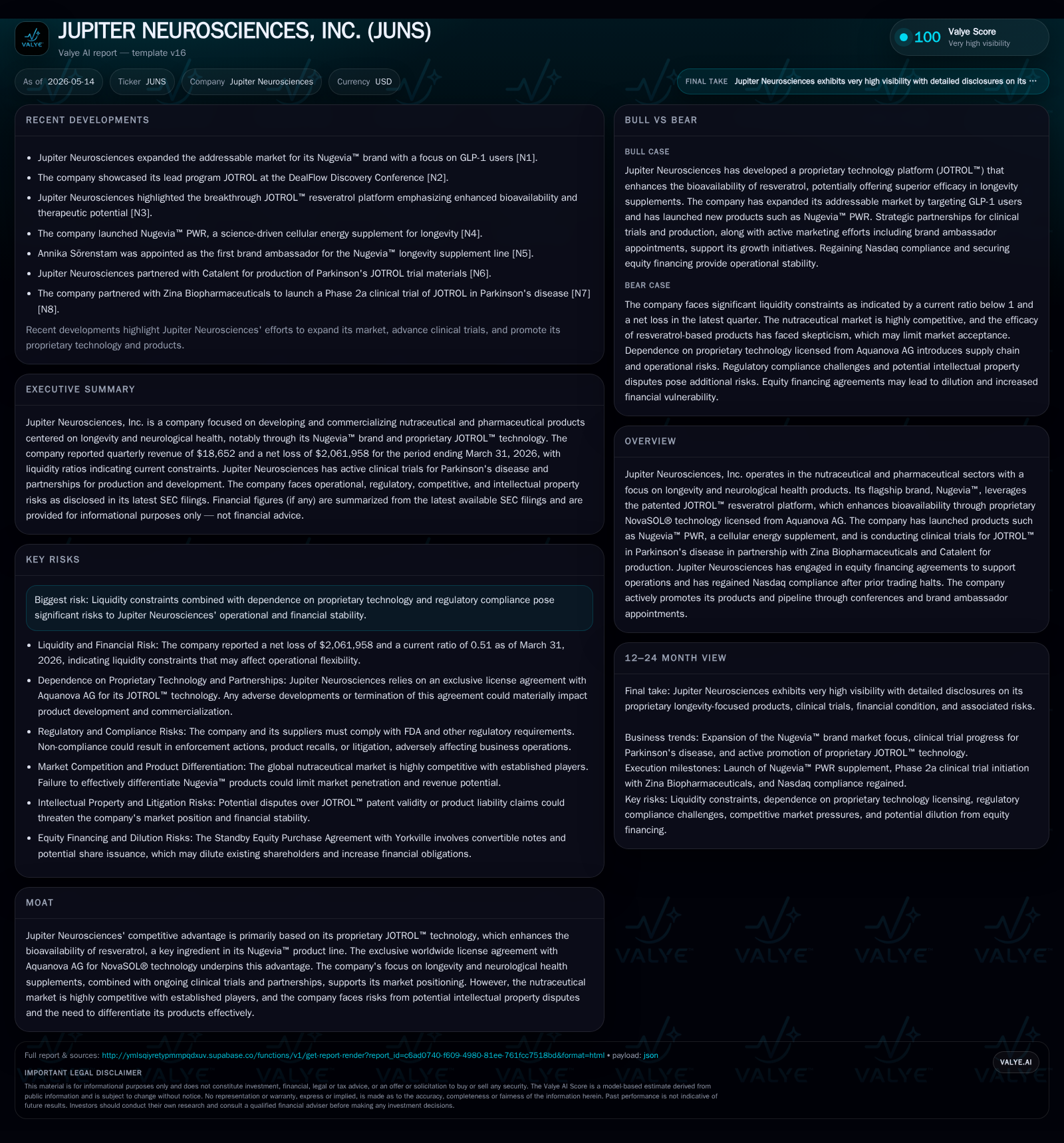
Jupiter Neurosciences continues to advance its proprietary JOTROL™ resveratrol-based platform through clinical development focused on Parkinson’s disease and consumer-facing longevity supplements under the Nugevia™ brand. The latest quarterly report confirms maintenance of previously disclosed risk factors, with no material updates but persistent challenges related to liquidity, Nasdaq listing compliance, and dependence on Aquanova’s licensed NovaSOL® technology. Growth hinges on successful trial outcomes, market adoption of Nugevia products, and capital-raising execution within tight financial constraints.
Recent Operating Update
Jupiter Neurosciences' Q1 2026 Form 10-Q filing dated May 14, 2026, serves as the primary lens into the company’s current operational standing. The quarterly disclosure reiterates that the risk factors outlined in the preceding Annual Report on Form 10-K remain unchanged with no material updates noted [S2, S14]. Thus, the firm continues to face significant liquidity challenges compounded by Nasdaq listing compliance pressures related to minimum bid price and market capitalization thresholds [S27]. The company reported no meaningful revenue growth during this quarter with total revenues lingering at $21,796 for the full year ending December 31, 2025 — reflecting nascent commercial activity in its nutraceutical product line rather than pharmaceutical sales. Operating losses persist at nearly $8.9 million as of year-end 2025 [F1]. The quarter saw critical amendments to its Standby Equity Purchase Agreement (SEPA) with Yorkville permitting flexible monthly installment payments on convertible notes but underscoring continued financing dependency [S11].
Business Model
Jupiter Neurosciences generates potential value primarily through two interconnected avenues: clinical-stage pharmaceutical development focusing on neurological disorders such as Parkinson’s disease, and consumer-focused nutraceuticals marketed under the Nugevia™ brand. Both rely heavily on the company’s proprietary JOTROL™ platform—an enhanced oral resveratrol formulation leveraging Aquanova AG's licensed NovaSOL® delivery technology that significantly boosts bioavailability over standard resveratrol preparations [S1].
Revenues are currently dominated by early-stage product sales of Nugevia supplements such as Nugevia™ PWR (cellular energy support) launched via direct-to-consumer social media channels in late 2025. Pharmaceutical efforts remain in Phase IIa clinical trials for neuroinflammation therapies tied to Parkinson's disease treatment, conducted jointly with Zina Biopharmaceuticals and Catalent for supply chain scaling [S1]. Licensing agreements require milestone payments upon regulatory approvals alongside royalty structures pegged at approximately 5% of net sales for use of NovaSOL®, representing a material ongoing cost structure tied to this competitive key asset.
Revenue generation mechanics hinge on consumer demand for science-backed longevity supplements during a health-conscious aging demographic, while pharmaceutical upside depends on successful trial progression enabling future licensing or commercialization deals. Margins will be influenced by manufacturing efficiencies—especially scaling pharmaceutical-grade production—and marketing spend intensity required to overcome consumer skepticism in the highly competitive nutraceutical space.
Industry Structure and Competitive Position
Operating at the intersection of nutraceuticals and pharmaceuticals targeting neurological health uniquely positions Jupiter Neurosciences in a fragmented yet rapidly expanding sector. The global nutraceutical market was valued at over $450 billion in 2023 with projections approaching $8 trillion by 2030, driven by rising preventive healthcare awareness worldwide. However, this space is fiercely competitive with established multinational brands like Nestlé Health Science and Amway alongside numerous specialized niche players vying for customer loyalty [S1, S16].
Jupiter's moat lies in its exclusive rights to JOTROL™/NovaSOL® technology which offers an efficacy differentiation via enhanced bioavailability—a crucial factor given historical challenges around resveratrol’s clinical utility. However, broader skepticism exists within both consumers and some healthcare professionals about resveratrol benefits generally necessitating substantial clinical evidence to sustain price premiums or generate durable pricing power [S16]. Differentiation must therefore rest not only on technological exclusivity but also clinical validation and effective scientific marketing campaigns.
Pharmaceutically, Jupiter operates at an early stage in CNS disorders development where multiple large biopharma firms also compete but face high R&D costs and regulatory hurdles. Success would potentially open licensing or partnership pathways amplifying growth beyond nutraceutical sales.
Growth Drivers
Several potential growth catalysts underpin Jupiter's strategic outlook:
- Clinical Trial Progress: The ongoing Phase IIa Parkinson's disease trial results could validate JOTROL™’s therapeutic claims driving pharmaceutical development momentum and investor confidence [S1].
- Nutraceutical Market Expansion: Effective commercialization of Nugevia™ products targeting aging populations seeking mitochondrial health support can stimulate early revenue growth aligned with long-term secular trends toward wellness supplementation [S1].
- Technology Licensing: Continued exclusive license access enables proprietary product offerings potentially expandable across other neurological or longevity-related indications.
- Capital Raising Flexibility: Utilization of SEPA facilities from Yorkville provides runway extension to fund R&D milestones and market expansion despite challenging cash flow fundamentals [S11].
- Brand Development Initiatives: Active engagement through conferences and strategic brand ambassadors aims to enhance market penetration against competitive noise.
Risks and Growth Constraints
Critical issues temper Jupiter Neurosciences’ growth trajectory:
- Liquidity Strains: Current ratio below unity (0.51) signifies pressing short-term resource limitations necessitating additional capital infusions or cost containment efforts to avoid forced downsizing or operational disruptions [F1].
- Nasdaq Compliance Risk: Failure to meet Minimum Bid Price Requirement or Market Value of Listed Securities Requirement by August 25, 2026 poses delisting threat unless remedial measures like reverse stock splits are enacted effectively controlling shareholder dilution risk [S27].
- Dependence on Licensing: The Aquanova agreement underpins core product viability; any disruption or termination would critically impair production capability and pipeline prospects necessitating costly replacement technology searches [S1,S23].
- Regulatory Compliance Complexity: Sustained adherence across FDA, FTC, USDA, EPA regulations related to dietary supplements is complex; enforcement actions or litigation over product claims could precipitate reputational damage or operational interruptions [S9,S16].
- Market Skepticism: Entrenched doubts regarding resveratrol’s efficacy mandate rigorous differentiated clinical validation; failure here risks muted consumer uptake limiting revenue scale potential.
- Manufacturing Scale-Up: Transitioning pharmaceutical supply lines from pilot-scale to commercial production entails execution risks related to quality control and timely fulfillment impacting launch cadence.
What To Watch Next
Essential upcoming milestones include:
- Phase IIa Clinical Trial Updates: Data readouts expected in coming quarters will be pivotal in validating JOTROL™’s therapeutic promise for CNS disorders.
- Nugevia Commercial Metrics: Monitoring direct-to-consumer sales volume trends, customer retention rates, digital marketing ROI, and distribution channel expansions will offer insight into market acceptance.
- Financial Reporting Trends: Quarterly cash burn rates relative to capital available under SEPA agreements will signal sustainability ahead of next funding rounds.
- Nasdaq Compliance Filings: Company disclosures around share price management initiatives including any announced reverse splits or capital restructuring efforts.
- Regulatory Developments: Any FDA guidance or enforcement actions impacting supplement claims or manufacturing practices could materially shift operational flexibility.
Financial Profile Summary
Latest financial snapshot
| Metric | Value | Period |
|---|---|---|
| Current assets | $3.41mm | |
| 2026-03-31 | ||
| Current liabilities | $6.73mm | |
| 2026-03-31 | ||
| Current ratio | 0.51x | |
| 2026-03-31 |
Source: SEC companyfacts cache [F1].
As of March 31, 2026, Jupiter Neurosciences held $3.41 million in current assets against $6.73 million in current liabilities yielding a current ratio of approximately 0.51 — indicative of constrained short-term liquidity conditions requiring vigilant cash management or additional capital raisings imminently [F1]. The full-year operating loss as of December 31, 2025 stood near $8.9 million reflective of heavy ongoing R&D investment absence of broad product commercialization gains [F1]. Revenues totaling $21,796 remain minimal consistent with early-stage supplement launch dynamics underscoring the developmental phase status of the business model overall.
The company’s financing arrangements including convertible promissory notes under SEPA provide short-term funding but introduce dilution risk alongside payment obligations requiring structured management attention into fiscal year 2026 [S11,S17].
This analysis is based solely on publicly available SEC filings including the company’s latest quarterly report dated May 14, 2026 (10-Q) and annual report dated April 1, 2026 (10-K), supplemented by industry insights where cited. It does not constitute investment advice.
Disclaimer: This is research-only, informational analysis and not investment advice. It may include AI-generated interpretation and general industry context. Always verify important details using primary sources.

Comments