
Spartacus Acquisition Corp. II Updates IPO Trust Account and Trading Structure Post-Quarterly Filing
Spartacus Acquisition Corp. II advances its SPAC structure with separate trading of shares and warrants and maintains strong trust account balance ahead of its merger deadline.
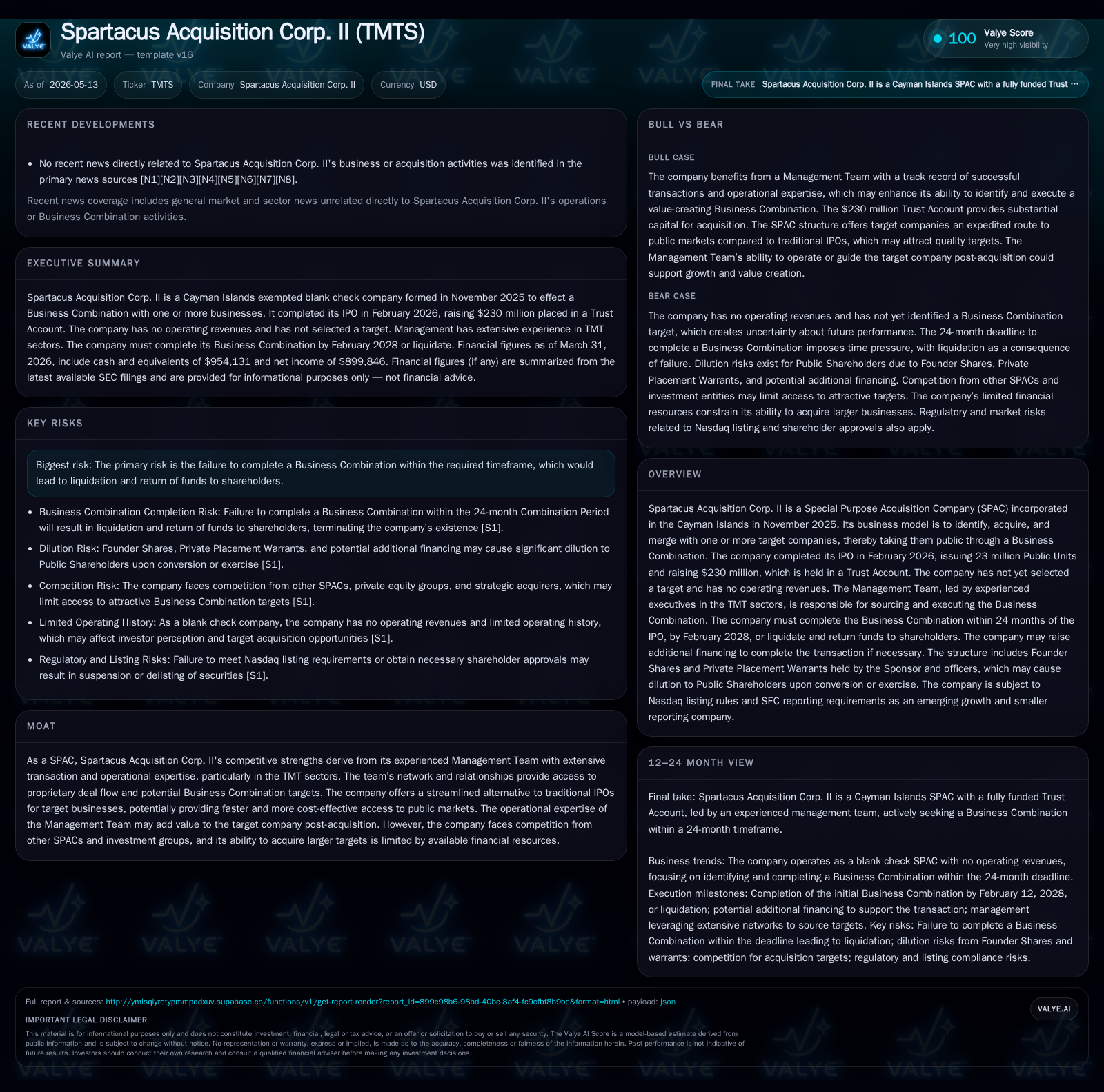
In its May 2026 quarterly filing, Spartacus Acquisition Corp. II disclosed that it enabled separate trading of its Class A ordinary shares and warrants, a strategic move to increase shareholder flexibility. The company holds approximately $954 million in cash related to its IPO proceeds in trust, underscoring a solid liquidity position for pursuit of a Business Combination within the February 2028 deadline. While no operating revenues exist pending combination, management’s expertise in TMT sectors provides deal sourcing advantages amid competitive pressures in the SPAC landscape.
Latest Operating Update: May 2026 10-Q Highlights
Spartacus Acquisition Corp. II's recent quarterly filing (10-Q) dated May 12, 2026 [S2] marks key operational milestones two months after the closing of its initial public offering (IPO). Notably, the company announced effective April 2, 2026, that holders of units issued at IPO can now separately trade the Class A ordinary shares and the redeemable warrants associated with those units [S3]. This structural change enhances shareholder flexibility by allowing investors to manage exposure to the equity component and warrant-linked upside independently.
The filing reconfirms that all IPO proceeds totaling $230 million remain secured in a Trust Account maintained by Continental Trust & Stock Transfer Company as trustee [S1], [S2]. This sum represents the core capital available to fund a future Business Combination with one or more target companies, typically within the technology, media, and telecommunications (TMT) sectors given management’s expertise.
At quarter-end, Spartacus Acquisition Corp. II had no operating revenues as it remains an acquisition shell focused on identifying suitable targets before consummation of a transaction [S2]. The company emphasizes that it must complete a Business Combination on or before February 12, 2028 or liquidate and return the Trust Account proceeds net of permitted expenses [S1], thereby setting an explicit timeline governing strategic activities.
Business Model: SPAC Mechanics and Value Proposition in TMT Sector
Spartacus Acquisition Corp. II operates as a Special Purpose Acquisition Company (SPAC), raising capital through an IPO without current operations but with a mandate to acquire private companies via Business Combinations that effectively take those entities public [S1]. It executed its IPO on February 12, 2026, issuing 23 million Public Units at $10 each comprising one Class A ordinary share plus one-third of one redeemable warrant exercisable at $11.50 per share [S1]. In parallel, the Sponsor acquired over four million Private Placement Warrants under similar terms [S1].
A critical feature is the Trust Account that holds nearly all IPO proceeds to protect public investors’ capital until deployment in a vetted transaction or refund upon liquidation [S1]. This escrow mechanism reduces risk exposure while enabling disciplined deal-making.
The management team leverages extensive backgrounds within TMT industries—Peter D. Aquino as Chairman and Igor Volshteyn as CEO—to source proprietary deal flow using longstanding sectoral networks and operational expertise [S1], [S25]. Unlike traditional IPO routes often constrained by underwriting processes and market timing uncertainties, Spartacus offers target companies accelerated access to public capital markets through merger structures tailored for speed and customization.
Revenue generation for Spartacus is contingent on completing a Business Combination; until then, it incurs costs without earnings. Post-combination revenue streams arise from operating the acquired entity publicly rather than from the SPAC itself. Hence, financial returns depend heavily on selection quality and transaction execution.
Industry Context: SPAC Competition, Regulatory Framework, and Market Dynamics
The blank-check company space has proliferated with numerous SPACs competing alongside private equity firms, leveraged buyout funds, strategic acquirers, and operating businesses pursuing acquisitions [S17], [S21]. Spartacus Acquisition Corp. II faces inherent challenges concerning financial scale—the $230 million base capital limits capacity to pursue larger deals compared with well-funded competitors possessing greater firepower.
Redemption rights held by public shareholders introduce potential resource dilution; if many elect redemption upon announcement of a Business Combination, funds available for acquisition decrease proportionately [S6], [S26]. Additionally, warrants outstanding could dilute equity stakes post-merger.
Regulatory scrutiny has heightened post-SPAC boom years. SEC mandates require heightened disclosure around target companies’ audited financials meeting PCAOB standards or reconciled GAAP/IFRS statements timely enough for proxy filings—presenting hurdles given some targets’ readiness limitations [S13]. Furthermore, compliance costs related to Sarbanes-Oxley Act controls will likely rise post-combination especially if targets lack established controls infrastructure.
Growth Drivers: Pipeline for Target Identification and Deal Execution
Central growth enablers rest upon the Management Team’s strengths in sourcing attractive TMT targets leveraging their deep industry relationships forged over decades [S25]. These include advisory roles complementing investment experience enabling active operational input during due diligence.
Spartacus plans to structure deals flexibly utilizing combinations of cash held in trust plus additional financing instruments such as convertible debt or equity-linked securities when necessary—allowing transaction tailoring that meets target preferences for consideration form [S7]. Such financial optionality serves both to bridge valuation gaps and strategically enhance competitiveness versus rival bidders.
Timelines impose urgency; however, management pursues measured diligence ensuring alignment with long-term value creation rather than rushing ill-fitting transactions close to the February 2028 deadline. Definitive merger agreements followed by shareholder vote approvals constitute key milestones signaling sustained progress.
Risks and Constraints: Time Sensitivity, Funding Limits, and Competitive Pressures
The paramount risk remains failure to consummate a Business Combination within the federally mandated window ending February 12, 2028—forcing liquidation with capital returned less costs incurred potentially frustrating investor expectations [S17], [S2].
Financial capacity constrains potential target size especially as redemptions may reduce merger funding pools substantially at closing—heightening pressure to balance shareholder interests while preserving acquisition firepower [S26].
Competitive landscape intensifies challenges; better-resourced SPACs or established private equity firms may outbid Spartacus or secure higher-quality assets through existing distributor networks or direct proprietary channels [S21]. Moreover, reputational risks tied to being perceived as a blank-check vehicle lacking operational history might deter some prospective counterparties despite management’s credentials [S10].
Catalysts To Watch: Upcoming Milestones and Market Signals
Investors should monitor announcements regarding identification or signing of definitive merger agreements or letters of intent—a tangible validation of pipeline advancement potentially triggering elevated share price momentum or increased warrant exercise activity [S3], [S1].
Shareholder votes related to approving targeted Business Combinations provide another critical inflection point impacting timeline extensions or changes in governance frameworks affecting combination feasibility.
Trading volume patterns arising after separate listing of shares (TMTS) and warrants (TMTSW) commencing April 2026 should be noted for indications on market sentiment towards modular ownership adjustments reflecting investor confidence.
Additionally, any disclosures around follow-on financings such as forward purchase commitments or backstop arrangements would materially affect dilution prospects and balance sheet strength pre-deal closure.
Financial Snapshot: Liquidity, Capital Resources, and Leverage
Latest financial snapshot
| Metric | Value | Period |
|---|---|---|
| Cash & equivalents | $954,131 | |
| 2026-03-31 | ||
| Total debt | $300,000 | |
| 2026-03-31 | ||
| Net debt | $-654,131 | |
| 2026-03-31 | ||
| Current assets | $1,030,285 | |
| 2026-03-31 | ||
| Current liabilities | $112,091 | |
| 2026-03-31 | ||
| Current ratio | 9.19x | |
| 2026-03-31 |
Source: SEC companyfacts cache [F1].
As of March 31, 2026 ([F1]), Spartacus Acquisition Corp. II reported approximately $954 thousand in cash and equivalents held primarily in its Trust Account earmarked for Business Combination use. Total debt stood modestly at around $300 thousand for incidental financing needs resulting in a net cash position near $654 thousand (cash minus debt).
Operating loss figures remain nominal at this stage given absence of active business operations (-$55k reported operating loss for year-ended December 31, 2025) alongside net losses attributable mostly to startup administration [-$1 million net loss] underscoring early lifecycle phase prior to revenue generation via transactions [F1].
This liquidity foundation suits Spartacus well to finance due diligence expenses, legal fees for merger structuring efforts alongside carrying potential working capital infusions for acquired entities post combination without immediate refinancing needs barring larger-than-anticipated deals requiring incremental capital raises.
Disclaimer: This is research-only, informational analysis and not investment advice. It may include AI-generated interpretation and general industry context. Always verify important details using primary sources.

Comments