
Unusual Machines Expands Domestic Manufacturing to Secure U.S. Drone Supply Chains
Recent operational advances and strategic acquisition bolster Unusual Machines’ position as a leading NDAA-compliant drone component supplier.
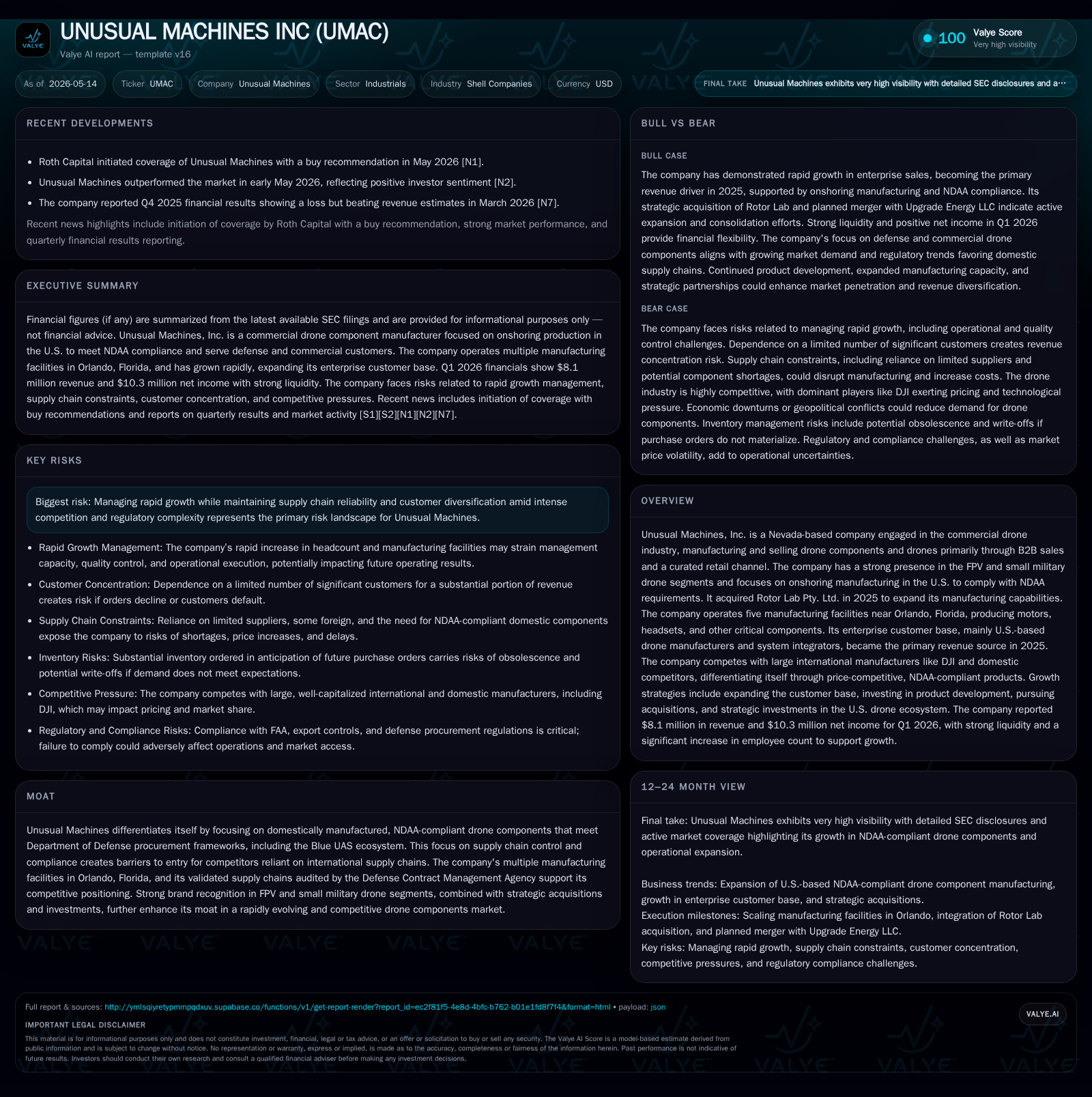
In Q1 2026, Unusual Machines launched a motor production facility in Orlando, Florida, complementing its acquisition of Rotor Lab to deepen domestic manufacturing capabilities. This expansion aligns with growing U.S. defense mandates for NDAA compliance and strengthens the company’s supply chain resilience. Its business model capitalizes on B2B sales within defense and commercial drone segments, focusing on high-performance motors and components audited by federal agencies. Despite rapid growth opportunities tied to drone market expansion and regulatory tailwinds, risks remain around supply chain complexity and customer concentration.
Quarterly Growth Momentum: Building U.S.-Based Manufacturing Capacity
The latest Q1 2026 filing reveals that Unusual Machines successfully commenced motor production at a newly built facility in Orlando, Florida during Q4 2025 [S2]. This expansion of their domestic footprint is critical, positioning the company to meet intensifying U.S. defense procurement demands notably governed by the National Defense Authorization Act (NDAA), which restricts foreign-made components, especially from adversarial sources.
Complementing this facility launch was the strategic acquisition of Rotor Lab Pty. Ltd., an Australian drone component specialist acquired in September 2025 [S1]. Prior to this transaction, the two entities co-developed multiple motor designs and sizes; post-acquisition, Rotor Lab functions as the core engineering center for motor design, prototyping, and smaller batch production orders [S2]. This merger expands Unusual Machines' vertical integration capabilities, helping accelerate product cycles while maintaining supply chain resilience vital for government contracts.
Inventories are carefully managed using first-in, first-out accounting methodology and evaluated rigorously against net realizable value benchmarks including current sales prices to mitigate risks of obsolescence amid fast-evolving technology demands [S2].
Business Model and Product Portfolio: Targeting NDAA-Compliant Drones with Trusted Brands
Unusual Machines operates primarily through B2B channels selling drone components such as motors and headsets to enterprise customers—including U.S.-based drone manufacturers focused on commercial, mission-critical, and defense applications [S1]. The company also leverages curated retail channels supporting FPV (first-person view) enthusiasts under brand names including Rotor Riot and Fat Shark, both well-recognized in niche FPV communities.
Revenue hinges on long-term contracts with drone system integrators who require robust supply chain compliance. The company's facilities—five manufacturing sites near their Orlando headquarters—allow end-to-end domestic production meeting stringent Department of Defense standards [S1]. Products undergo audits by the Defense Contract Management Agency to verify cybersecurity protocols and supply chain security—gatekeepers for procurement eligibility under the Blue UAS framework. Unusual Machines has secured Blue Framework certification for six components since August 2024 and aims to broaden this portfolio further [S1].
This focus creates a substantial moat relative to competitors reliant on international suppliers unable or unwilling to meet these federal compliance standards.
Competitive Dynamics in the U.S. Drone Components Industry
While global leaders like DJI dominate mass-market drone sales internationally, Unusual Machines carves out differentiation domestically by prioritizing NDAA compliance and supply chain sovereignty [S1]. This strategy addresses heightened DoD scrutiny over foreign influence in sensitive hardware segments—especially those applicable to small military drones where reliability and provenance are paramount.
The company’s ability to price competitively stems from transparent U.S.-based manufacturing versus foreign import tariffs or delays prevalent in global supply chains. Brand loyalty within FPV hobbyist circles also drives ancillary retail sales while enterprise sales concentrate on expanding government-approved product offerings.
Scaling operations rapidly introduces execution risks given the need for precise quality controls amidst complex component sourcing challenges. Nonetheless, few U.S. players possess similar audited supply chains capable of satisfying multi-agency reviews—providing Unusual Machines a defensible leadership role.
Key Growth Catalysts: Onshoring, Regulatory Compliance, and Strategic Acquisitions
The broader drone industry exhibits strong structural growth projected to reach nearly $58 billion globally by 2030 [S1]. Specific segments like drone motors forecast expansion at ~13% CAGR through the mid-2030s. Unusual Machines leverages these market dynamics by emphasizing domestic production aligned with defense ecosystem requirements. This allows capture of wallet share from customers compelled to source Blue Framework-qualified components.
The land-and-expand approach is crucial: initial product placements with large U.S.-based manufacturers open avenues for expanded orders across component categories supported by steady product innovation pipelines fueled through Rotor Lab’s engineering capabilities [S2].
Strategic acquisitions such as Rotor Lab enhance design know-how while enabling scale efficiencies—accelerating roadmap delivery timelines critical in a sector marked by rapid technological evolution.
Risks and Constraints: Supply Chain Complexity and Customer Concentration
Rapid growth management represents a prominent risk factor; scaling manufacturing capacity without compromising product quality or incurring excess inventory requires meticulous operational discipline [S1]. The company acknowledges substantial inventory balances reflecting raw materials and finished goods that must be actively monitored for obsolescence given fast innovation cycles in drone electronics [S2].
Customer concentration adds volatility; revenue depends heavily on enterprise contracts with a limited set of large manufacturers/integrators whose procurement needs fluctuate based on regulatory funding cycles or technology refresh plans [S1].
Talent acquisition particularly in engineering and manufacturing expertise is an ongoing constraint amid intense competition from larger industry incumbents possessing deeper resource pools. Additionally, evolving FAA regulations on unmanned aircraft systems introduce regulatory uncertainty impacting overall market adoption rates.
Near-Term Catalysts: Operational Milestones and Market Adoption Signals
Key execution highlights include accelerating volume output at the Orlando motor plant through 2026 alongside leveraging Rotor Lab’s R&D pipeline to introduce new motor variants tailored for emerging use cases within both commercial FPV racing drones and compact military applications [S2,S3]. Further certification expansions under the Blue Framework will simplify customer acquisition barriers for federally related procurements.
Investor communications dated May 2026 convey positive momentum with financial results reinforcing confidence around scaling efforts while addressing supply chain constraints proactively [S3]. Market awareness within aerospace-defense communities about Unusual Machines’ expanding certifications augurs well for broadening penetration into high-value enterprise accounts.
Financial Snapshot: Balance Sheet Strength Supports Expansion
Latest financial snapshot
| Metric | Value | Period |
|---|---|---|
| Cash & equivalents | $223mm | |
| 2026-03-31 | ||
| Current assets | $315mm | |
| 2026-03-31 | ||
| Current liabilities | $2mm | |
| 2026-03-31 | ||
| Current ratio | 128.23x | |
| 2026-03-31 |
Source: SEC companyfacts cache [F1].
As of March 31, 2026, Unusual Machines maintains an exceptionally strong liquidity profile with cash & equivalents totaling $222.9 million against modest current liabilities near $2.46 million yielding an extraordinary current ratio exceeding 128x [F1][S2]. This capital base mitigates refinancing risks while funding ongoing facility build-outs, R&D investments at Rotor Lab, and working capital needs amid inventory build.
Net income swings present volatility reflective of investment phases; recent net income benefited from unrealized gains on investments but operating losses persist aligned with aggressive growth spending typical for early-stage industrial tech companies carving out niche market share [S8]. Cash flow usage patterns underscore continued investment alongside public offerings grossing approximately $150 million deployed for capacity enhancements [S9].
Overall financial posture provides ample runway for strategic execution without immediate liquidity constraints observed among peers compromising scale efforts.
This analysis synthesizes reported facts from Unusual Machines Inc.’s recent SEC filings (10-Q dated May 14, 2026; 10-K dated March 12, 2026) supplemented with sector context on drone industry growth drivers and regulatory frameworks relevant to defense-grade component manufacturing. It avoids speculative or non-public data discussions.
Disclaimer: This is research-only, informational analysis and not investment advice. It may include AI-generated interpretation and general industry context. Always verify important details using primary sources.

Comments