
MIRA Pharmaceuticals Advances Ketamir-2 Phase 1 Results with Persistent Liquidity and Clinical Development Challenges
MIRA Pharmaceuticals reports positive Phase 1 data for Ketamir-2 while continuing to invest in early-stage drug development amid substantial funding needs.
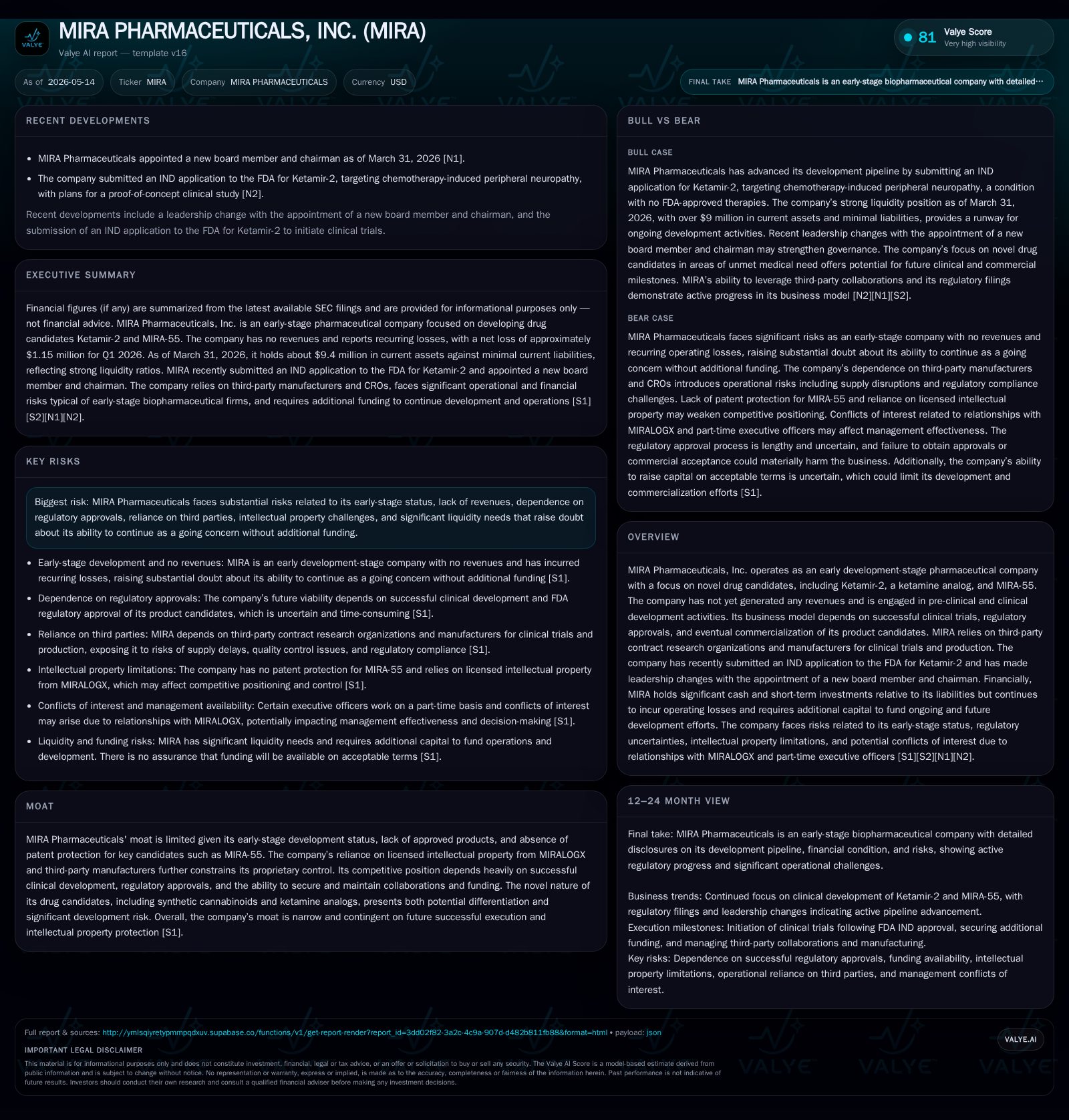
MIRA Pharmaceuticals, an early-stage biopharma focused on novel neurological and inflammatory conditions, announced positive unblinded results from its Phase 1 clinical trial of Ketamir-2, a selective oral NMDA receptor modulator. The successful safety and pharmacokinetic profile support advancing to a Phase 2a study targeting chemotherapy-induced peripheral neuropathy (CIPN) planned for Q2 2026. Despite this clinical progress, MIRA remains pre-revenue with no approved products and continues to rely heavily on external funding to sustain operations. The company faces typical early-stage biotech risks including regulatory uncertainty, lack of patent protection on some candidates, and operational dependency on third parties for manufacturing and trials. Capital availability and successful execution of the clinical programs will determine its medium-term viability.
Recent Operating Update
MIRA Pharmaceuticals’ latest quarterly filing dated May 14, 2026 ([S2]) anchors the current analysis. Most notably, on May 13, the company disclosed positive unblinded data from its completed Phase 1 clinical trial evaluating Ketamir-2—a proprietary selective oral NMDA receptor modulator—demonstrating favorable safety, tolerability, and pharmacokinetic properties across single and multiple dosing regimens in healthy volunteers ([S3]). This milestone completes the Phase 1 program ahead of schedule and follows prior dosing updates showing near-completion of all cohorts ([S8]).
The company is preparing to advance Ketamir-2 into a Phase 2a proof-of-concept trial targeting chemotherapy-induced peripheral neuropathy (CIPN), an area of high unmet medical need with no approved therapies. Clinical site selection is underway with a planned protocol submission to the FDA following Phase 1 finalization. Management indicated intentions to seek FDA Fast Track designation based on oncology relevance and anticipated expedited regulatory processes ([S3]).
In parallel, MIRA updated its preclinical pipeline: SKNY-1 is being developed as an orally-administered small molecule aimed at weight loss and nicotine addiction without central nervous system adverse events seen in past CB1 antagonists or GLP-1 injectables. MIRA-55 is progressing as an inflammatory pain therapeutic candidate exhibiting analgesic properties in models. Both are undergoing chemistry, manufacturing & controls (CMC) optimization with objectives to file INDs by late 2026 ([S3],[S5]).
These developments exemplify MIRA’s focus on novel neuropsychiatric-related drug platforms—synthetic cannabinoids and ketamine analogs—that require validation through rigorous clinical progression given limited prior art.
Business Model
MIRA operates as an early-stage pharmaceutical company predominantly developing licensed drug candidates rather than internally discovered molecules ([S1]). Its primary revenue model depends on successful transition through preclinical research into human clinical trials followed by securing regulatory approvals leading to commercialization or partner licensing arrangements. No products have launched yet; hence there are no revenues.
Revenue-driving mechanics involve raising capital via equity financings—chiefly through At The Market (ATM) sales—and structuring collaborations or licensing deals upon advancement of key assets ([S4]). Clinical trial milestones drive internal valuations; investor interest hinges on de-risking signals like Phase 1 safety success or preliminary efficacy.
MIRA leverages third-party contract research organizations (CROs) for conducting trials and contract manufacturing organizations (CMOs) for production needs. This outsourcing optimizes fixed costs but reduces direct control over timelines and quality assurance—a common trade-off for small biotech firms ([S1]).
The value proposition rests on two front-line candidates: Ketamir-2 as a selective NMDA receptor antagonist designed as a ketamine analog targeting neuropathic pain indications; and MIRA-55 as a synthetic cannabinoid candidate addressing inflammatory pain. Additional pipeline projects like SKNY-1 are geared toward metabolic/neuro-addiction domains.
Industry Structure and Competitive Position
MIRA's domain lies within highly innovative but high-risk therapeutic areas—neuropathic pain relief leveraging novel NMDA receptor modulators alongside cannabinoid-based approaches. Both represent segments where few FDA-approved alternatives exist especially for CIPN—estimated as a sizable oncology supportive care market globally.
This nascent positioning offers differentiation through potentially improved efficacy/safety profiles (as implied by superior activity over gabapentin/pregabalin in preclinical neuropathic pain models per recent disclosures), but the company lacks patent coverage on some compounds such as MIRA-55 which limits exclusivity ([S1]). Reliance on licensed IP from MIRALOGX also constrains proprietary control.
Competition ranges from established pharmaceutical giants offering conventional neuropathic agents to emerging biotechs developing psychedelic analogs or cannabinoid medicines. The developmental novelty implies regulatory complexities arising from limited precedent for these synthetic cannabinoid drugs or ketamine derivatives.
Operationally, MIRA competes by progressing assets rapidly through clinical phases supported by external partners while managing costs via lean staffing—its CFO notably part-time highlights potential internal resource constraints ([S27]). Strategic partnering remains critical both for capital injection and commercial capabilities given MIRA’s pure-play R&D orientation.
Growth Drivers
Clear growth catalysts for MIRA stem from execution across several development milestones:
Advancement of Ketamir-2: Successful completion of Phase 1 clears the path for Phase 2a CIPN studies planned in Q2 2026. Positive efficacy readouts here would substantially elevate asset valuation.
Regulatory Accolades: Fast Track designation by the FDA could fast-path approval timelines and facilitate closer agency collaboration.
Pipeline Expansion: Progressing SKNY-1 and MIRA-55 toward IND-enabling studies broadens therapeutic scope potentially mitigating single-product dependency risk.
Partnering Activities: Engagements at BIO Partnering Investment & Growth Summit offer opportunities to secure licensing or co-development alliances enhancing resource access.
These drivers align tightly with operational KPIs such as clinical site initiations, patient enrollment rates in trials, FDA interactions/acceptances of protocols, patent filings/licensing deals completed, and cash runway extensions from financings.
Risks and Growth Constraints
Despite encouraging clinical signals, MIRA faces several material risks:
Early Stage Status: With zero revenues and continuing operating losses exceeding $10 million annually ([F1]), execution failure at any stage may jeopardize survival.
Regulatory Uncertainty: Approval pathways for synthetic cannabinoids/ketamine analogs remain uncertain; adverse regulatory interpretations could delay or block market entry ([S11],[S23],[S26]).
Intellectual Property Limitations: Absence of robust patent protections especially for certain key compounds exposes MIRA to generic competition risk post-launch ([S1]).
Funding Dependency: Current cash reserves (~$4.8 million) against minimal liabilities provide tight operational cushioning. Continued cash burn necessitates additional fundraising under uncertain capital market conditions ([F1],[S4],[S22]).
Third-party Reliance: Dependence on CROs/CMOs adds risks related to compliance lapses or delays not fully controllable by MIRA ([S1]).
Additional concerns include geopolitical/economic headwinds potentially tightening biotech investment flows; compliance risks under evolving healthcare fraud/abuse laws; employee retention challenges given resource limits; and competition intensity within experimental therapeutics sectors.
What to Watch Next
Critical forthcoming events that will shape MIRA’s trajectory include:
Initiation of Ketamir-2 Phase 2a CIPN Trial: Timing accuracy around the second quarter of 2026 start will confirm project momentum ([S3],[S8]).
FDA Regulatory Interactions: Feedback regarding Fast Track candidacy application is pivotal both commercially and financially.
Data Presentations: Sharing detailed Phase 1 data at AACR Annual Meeting in April can influence scientific validation perceptions ([S3]).
Pipeline Development Milestones: Progression of SKNY-1/MIRA-55 into IND-enabling studies later in 2026 will impact future opportunity set breadth ([S5]).
Capital Raising Activity: Success or failure in accessing equity markets or strategic collaborations will dictate operational sustainability beyond near-term cutoffs ([F1], [S4]).
Monitoring these metrics against operating expense trends will provide insight into whether MIRA can sustain its R&D investment pace without compromising liquidity.
Financial Profile Brief Contextualization
Latest financial snapshot
| Metric | Value | Period |
|---|---|---|
| Cash & equivalents | $5mm | |
| 2026-03-31 | ||
| Current assets | $9mm | |
| 2026-03-31 | ||
| Current liabilities | $114761 | |
| 2026-03-31 | ||
| Current ratio | 82.16x | |
| 2026-03-31 |
Source: SEC companyfacts cache [F1].
As of March 31, 2026 end-period balance sheet metrics reveal approximately $4.8 million cash & equivalents against current liabilities near $115k resulting in an elevated current ratio above 82x—indicative of conservative liability structure but underscored by low absolute liquidity reservoir ([F1]).
Losses continue unabated with net income recorded at roughly -$10.4 million for the latest available outcome period ending December 31, reflecting typical burn rates associated with early-phase biopharma reliant on R&D spend without commercial inflows ([F1]).
While recently completing equity raises via ATM offerings helped bridge capital gaps previously ([S4]), the sustainability horizon remains limited unless key product advancements catalyze more substantial funding avenues or partnerships.
This analysis synthesizes public SEC filings up through May 14, 2026 alongside recent corporate disclosures without conjecture beyond documented evidence. It reflects operating realities common among nascent biotechnology firms navigating innovation-intensive but capital-dependent drug development pathways.
Disclaimer: This is research-only, informational analysis and not investment advice. It may include AI-generated interpretation and general industry context. Always verify important details using primary sources.

Comments