
POMDOCTOR Ltd’s Scale and Liquidity Challenges Define Post-IPO Growth Path
Recent quarterly filings highlight POMDOCTOR's intensified focus on scaling its online hospital and pharmaceutical supply chain amid liquidity strains and competitive pressures.
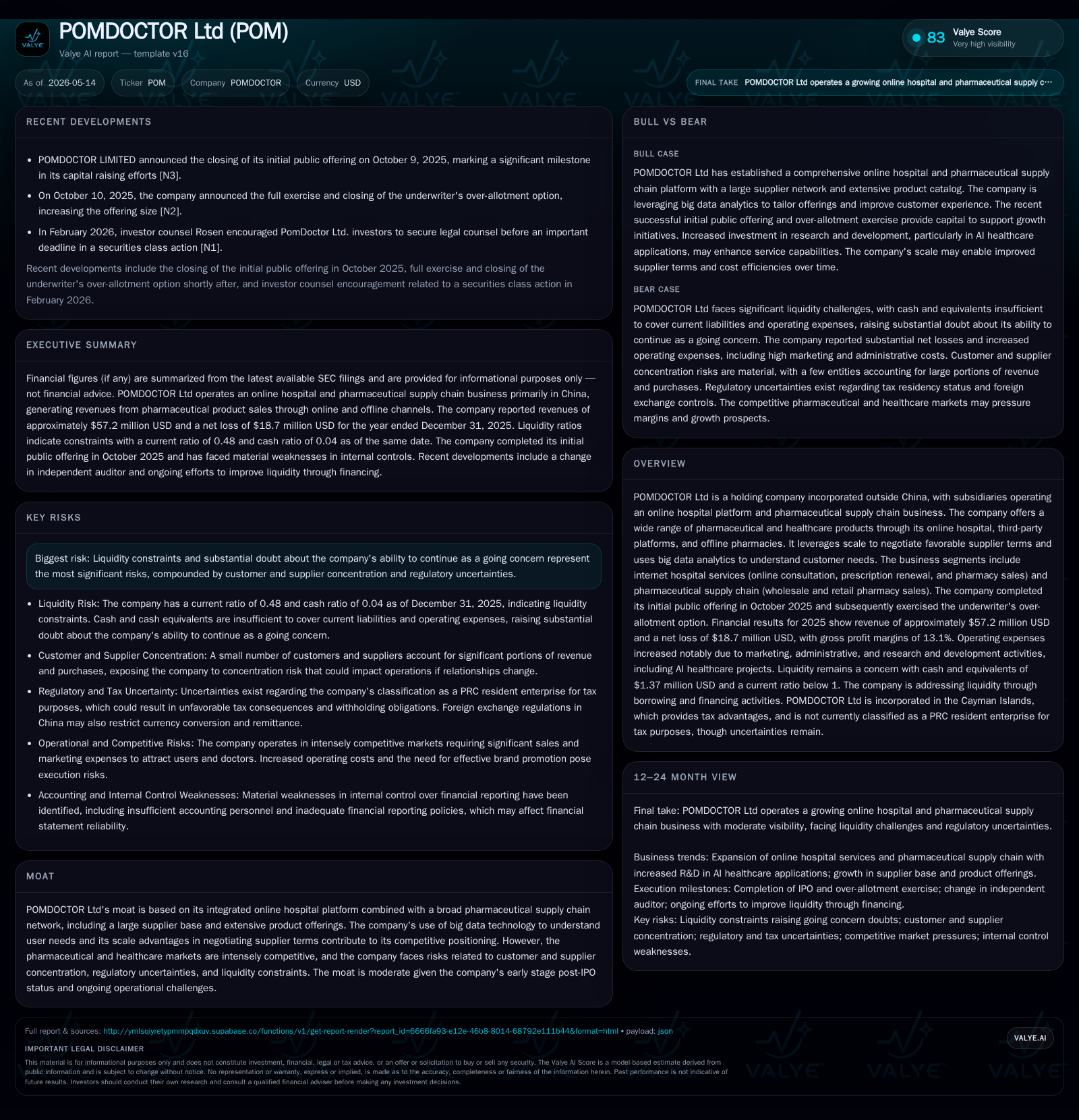
POMDOCTOR Ltd is pursuing rapid expansion of its integrated online hospital platform and pharmaceutical supply chain network following its October 2025 IPO. The latest 6-K filing confirms an accounting firm transition reflecting ongoing operational formalization, while the annual 20-F reveals steady revenue growth to $57.2 million in 2025 but with deepening net losses and tight liquidity ratios. The company leverages scale for better supplier terms and uses big data analytics to drive customer engagement, yet faces significant risks from customer concentration, regulatory uncertainties, and working capital deficits. The key to value creation lies in achieving sustainable profitability through improved operational leverage, expanded product coverage, and prudent capital management.
Recent Operating Update
POMDOCTOR Ltd disclosed a routine but important governance development in its April 20, 2026 Form 6-K filing ([S2]) by replacing Marcum Asia CPAs LLP with HYYH CPA LLC as its independent registered public accounting firm. No disagreements or reportable events were cited concerning past audits, indicating stable financial governance despite identified historical material weaknesses in internal control over financial reporting disclosed during the IPO process. Such transitions are typical post-IPO as companies mature their audit function.
Also notable was the resignation of Vice President Dexiang Wei effective April 1, 2026 reported earlier ([S3]). This departure was not linked to any operational disagreements.
The annual report on Form 20-F filed May 14, 2026 ([S1]) anchors the strategic operating context: POMDOCTOR aims to leverage scale primarily through its Internet hospital business — encompassing online consultations, prescription fulfillment, and associated pharmaceutical sales — complemented by wholesale distribution and retail pharmacy operations.
Business Model
POMDOCTOR's revenue engines are concentrated into two core segments:
Internet Hospital Services: This segment includes virtual medical consultations, prescription renewals processed through the platform’s licensed pharmacies, and sales of pharmaceutical/healthcare products directly to consumers.
Pharmaceutical Supply Chain: Incorporates wholesale drug distribution to third-party platforms and companies plus retail drug sales via offline pharmacies.
Revenue is derived mainly from product sales combined with service fees paid within the ecosystem—doctors receive service fees incentivizing patient engagement; users pay for consultations and pharmaceutical products. Revenues scale through volume of transacting patient accounts driven by user acquisition and retention.
Cost structure is heavily weighted by procurement costs for pharmaceuticals—reflecting low gross margin typical of pharmacy wholesale—and rising marketing expenses required to compete effectively. Margins are influenced by product mix shifts toward lower-margin generic or mass-market drugs.
The company aggressively negotiates supplier terms leveraging scale: bulk purchasing discounts, extended payment terms, volume rebates—all designed to improve procurement economics over time. Simultaneously, it offers suppliers advanced data insights sourced from broad patient usage patterns gathered across the platform’s user base. This symbiotic relationship strengthens supplier loyalty and barriers to entry.
Industry Structure & Competitive Position
Operating at the intersection of China's burgeoning online healthcare services market and traditional pharmaceutical supply chains situates POMDOCTOR in a rapidly evolving but fiercely competitive space. Key industry forces shaping its trajectory include:
- Governmental Regulation: Online medical services are tightly regulated in China requiring licenses for Internet hospitals and pharmacies; compliance demands are complex.
- Competitive Landscape: Players range from tech giants investing heavily in digital health ecosystems to established brick-and-mortar pharmaceutical wholesalers expanding online presence.
- Customer Behavior: Increasing mobile internet penetration paired with aging demographics drives structural demand growth in chronic disease management via telemedicine.
- Supplier Dynamics: Concentration among few major pharma suppliers creates negotiation pressure but also opportunity if scale can be increased sufficiently.
POMDOCTOR's moderate moat is underpinned by integration of online consultations with pharmacy logistics—a less common offering—and data-driven supplier collaboration. However, limited scale relative to larger incumbents constrains bargaining power currently.
Growth Drivers
Several identifiable levers could propel POMDOCTOR's expansion:
- User Base Expansion: Growing registered users and transacting accounts on the Internet hospital platform directly boost recurring revenue potential.
- Product Assortment Growth: Expanding SKUs (currently about 46,912 across more than 700 suppliers) broadens customer choice encouraging higher basket sizes.
- Marketing Investment: Increased sales/marketing spend (up to ~24% of revenue in 2025) fuels brand awareness which is crucial given competitive intensity.
- Technology & Data Analytics: Leveraging big data for personalized service offerings enhances customer satisfaction and retention rates.
- Supplier Negotiations: Improved terms achieved via scale can enhance gross margins over time if trade-offs on product mix are managed carefully.
- Regulatory Tailwinds: Favorable policy evolution encouraging online healthcare adoption supports structural demand growth.
Risks / Watchpoints / Growth Constraints
POMDOCTOR faces material challenges:
- Liquidity Risk: End-of-year cash barely covers a fraction of short-term liabilities (current ratio ~0.48), underscored by net debt exceeding $10 million USD [F1]. This raises going concern flags highlighted by management [S4][S7].
- Customer & Supplier Concentration: Two customers represent nearly two-thirds of accounts receivable; two suppliers account for over 60% of purchases [S16], risking revenue volatility.
- Profitability Pressure: Despite growing revenues (~$57M), net losses widened significantly ($18.7M loss in 2025) due largely to high operating expenses and slim gross margins fluctuating along product mix shifts [F1][S25].
- Regulatory Uncertainty: Compliance requirements may tighten or shift unexpectedly impacting cost structure or business operations [S1].
- Internal Controls & Reporting Weaknesses: Material weaknesses remain partially unresolved requiring ongoing remediation investments posing execution risks [S21][S19].
- Debt Burden & Refinancing Risk: Heavy dependence on related-party loans with varying interest rates including some non-interest bearing loans demands careful cash flow management [S24].
What To Watch Next
Key upcoming indicators that will clarify POMDOCTOR's trajectory include:
- Quarterly updates on operating cash flow trends reflecting progress on profitability improvements.
- User metrics detailing new registered patient accounts and active users driving recurring revenue flows.
- Progress reports on internal control remediation efforts critical for regulatory confidence.
- Supplier diversification efforts reducing concentration risks.
- Any refinancing activities or equity raises addressing liquidity constraints.
- Updates on regulatory environment impacting Internet hospital operation mandates or pricing policies.
Financial Snapshot Summary
Latest financial snapshot
| Metric | Value | Period |
|---|---|---|
| Cash & equivalents | $1369974 | |
| 2025-12-31 | ||
| Total debt | $12mm | |
| 2025-12-31 | ||
| Net debt | $10mm | |
| 2025-12-31 | ||
| Current assets | $15mm | |
| 2025-12-31 | ||
| Current liabilities | $31mm | |
| 2025-12-31 | ||
| Current ratio | 0.48x | |
| 2025-12-31 |
Source: SEC companyfacts cache [F1].
| Metric | Value (USD) | Period Ending |
|---|---|---|
| Revenue | $57,187,079 | |
| 2025-12-31 | ||
| Operating Income | -$16,964,554 | |
| 2025-12-31 | ||
| Net Income | -$18,723,015 | |
| 2025-12-31 | ||
| Cash & Equivalents | $1,369,974 | |
| 2025-12-31 | ||
| Total Debt | $11,700,687 | |
| 2025-12-31 | ||
| Current Assets | $15,010,029 | |
| 2025-12-31 | ||
| Current Liabilities | $31,197,632 | |
| 2025-12-31 | ||
| Current Ratio | 0.48 | Calculated |
The financials reveal substantial operating losses coupled with a heavy working capital deficit indicative of mounting pressures on cash flow sufficiency making near-term capital planning crucial.
This analysis synthesizes recent quarterly details emphasizing governance changes alongside a comprehensive annual filing highlighting growth strategies centered on scaling an integrated Internet hospital-pharma supply chain model facing ongoing liquidity risks amid intense competition. The ability to expand meaningful user adoption while managing operational leverage will be decisive for longer-term sustainability.
Disclaimer: This is research-only, informational analysis and not investment advice. It may include AI-generated interpretation and general industry context. Always verify important details using primary sources.

Comments