
Comtech Telecom’s Strategic Shift Following Satellite and Space Communications Divestiture
Comtech Telecommunications Corp. pivots its business focus amid the divestiture of its Satellite and Space Communications segment, reshaping its growth and operational profile.
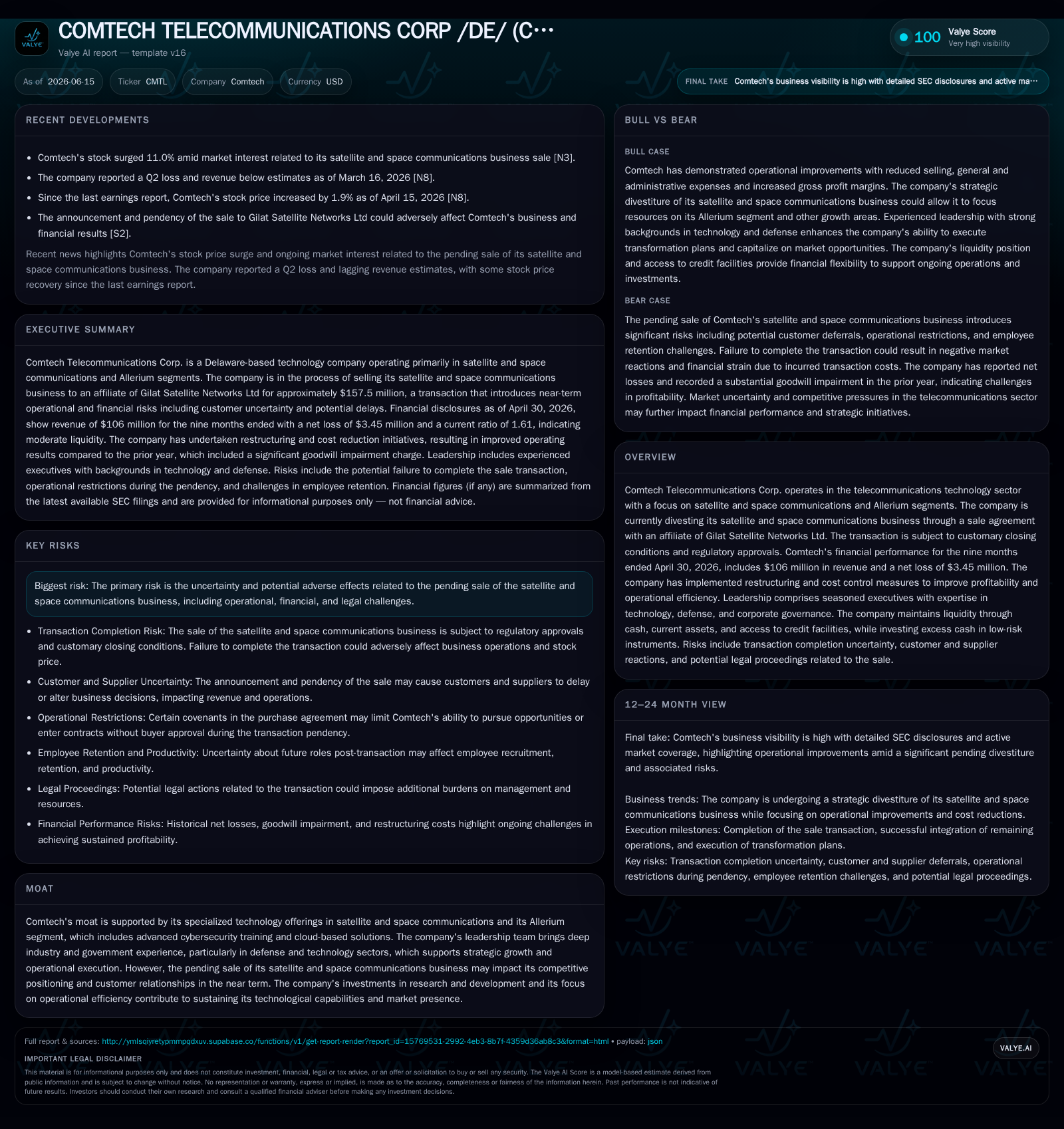
In its latest quarterly filing, Comtech Telecommunications Corp. disclosed the pending sale of most of its Satellite and Space Communications business to Gilat Satellite Networks Ltd., a move that marks a significant strategic pivot. This divestiture follows restructuring efforts aimed at improving operational efficiency and profitability, with the company now concentrating on its advanced cybersecurity and cloud-based Allerium segment. Despite reporting a net loss in fiscal 2026 Q3, Comtech demonstrates notable operating improvements and maintains adequate liquidity and access to credit facilities. The transition involves risks related to customer uncertainty and contractual restrictions but offers potential for refocusing investment and cost management in core competencies.
Recent Operating Update: Divesting Core Satellite Business
Comtech Telecommunications Corp.'s Q3 2026 10-Q filing reveals a landmark strategic development: the pending sale of most of its Satellite and Space Communications ("S&S") business to Gilat Satellite Networks Ltd.'s affiliate [S2][S3]. Completed post-quarter end on June 14, 2026, this transaction signals a decisive shift away from a historically central segment that generated specialized telecommunications equipment critical to satellite communications networks.
This divestiture follows continued restructuring efforts over fiscal 2025-2026 designed to improve profitability and operational efficiency across Comtech's business units. Notably, S&S operations posted improved segment operating income driven by lower selling, general & administrative (SG&A) expense and higher gross profit margins, partially offset by elevated research and development (R&D) spending relative to revenue [S2][S20]. The prior year's results were marred by a non-cash goodwill impairment of $79.6 million within S&S, underscoring sustained challenges in that segment.
The operational pivot is intertwined with liquidity management strategies; as of the quarter ending April 30, 2026, Comtech held $28.5 million in cash alongside $23.6 million in available Revolver Loan capacity, totaling roughly $49.4 million in liquid resources [S2][F1]
Business Model: From Satellite Systems to Cybersecurity Platforms
Traditionally centered on satellite communications hardware—comprising ground infrastructure components such as troposcatter technologies—and space communications systems integration for government and commercial clients, Comtech monetizes through product sales combined with long-term service contracts relying heavily on defense and government-related projects [S1]
Currently transitioning out of this classic telecom equipment manufacturing niche via divestiture of S&S, the company is increasingly emphasizing its Allerium segment. This division focuses on advanced cybersecurity training services tailored toward government entities alongside cloud-based platform solutions designed to secure critical infrastructure. Revenue drivers here hinge on growing contract wins within cybersecurity spaces bolstered by strategic investments in internal software capabilities and cloud infrastructure build-outs [S2][S14]
R&D expense trends reveal marginal growth—to approximately $13.4 million (4.2% of sales)—reflecting sustained innovation efforts despite contraction in satellite equipment demand [S2]. The company’s investment distribution suggests an effort to offset legacy segment decline with emerging cybersecurity service expansion
Industry Structure & Competitive Position
Operating within telecommunications technology industry segments that range from satellite communications manufacturing to cybersecurity solution provision positions Comtech uniquely as it straddles hardware-centric and software/cloud-centric models. Prior to divestiture considerations, competitors such as Gilat Satellite Networks Ltd., ViaSat, Broadcom Inc., InterDigital, and Nokia represent relevant comparators across discrete telecom equipment or wireless patents-focused domains.
Compared with peers focused wholly on equipment manufacturing or software licensing alone, Comtech’s dual-segment exposure has been both an opportunity for diversification and a challenge regarding margin consistency amid technological disruption. Post-sale alignment will narrow focus chiefly onto cyberspace security training and network platform delivery where customer retention dynamics derive predominantly from long-term government contracts with high switching costs linked to specialized training content and cloud compliance certification.
Growth Drivers
The primary growth catalyst lies in Comtech's ability to capitalize on global increases in cybersecurity demand—especially from U.S. government agencies requiring secure cloud-based platforms for training and defense readiness [S1][S14].
Further drivers include:
- Continued expansion of cloud computing infrastructure within Allerium.
- Leveraging proprietary content intellectual property for advanced cybersecurity skill development.
- Opportunities arising from technological advances outside traditional satellite radio frequency infrastructure.
- Cost rationalization freeing capital from legacy hardware programs toward emerging cybersecurity-led service contracts.
While satellite ground infrastructure demand faces cyclical pressures tied to broadband connectivity deployments and government budget allocations for defense communications hardware, Allerium’s domain benefits from structural tailwinds favoring heightened cyber threat preparedness worldwide.
Risks & Growth Constraints
Significant risk stems from transaction-induced uncertainty surrounding customer relationships in the S&S segment during sale pendency; some purchasers may defer or cancel orders until ownership transition concludes [S2]. Additionally:
- Covenants embedded within sale agreements impose operational constraints pre-closing,
- Potential employee attrition driven by ambiguity around future roles undermines productivity,
- Legal exposure exists regarding derivative proceedings linked to divestiture,
- High outstanding debt relative to capital base necessitates precise cash flow management,
- Technology obsolescence risk amid rapid industry innovation cycles demands agile R&D allocation,
- Market competition from more integrated or scale-efficient players restricts pricing power,
- Dependence on government contracting subjects revenue volatility tied to policy shifts.
What To Watch Next
Key milestones include closure timing of the S&S transaction contingent upon conventional regulatory approvals—a process that could influence near-term order book stability [S2]. Monitoring backlog status alongside book-to-bill ratios post-sale will provide insight into order cadence resilience.
Further scrutiny should also focus on:
- Integration success within remaining segments following asset divestiture,
- Execution efficacy on restructuring initiatives aimed at driving operating leverage gains,
- Evolutions in R&D spend aligned with Allerium platform scalability efforts,
- Liquidity trajectory post debt repayments funded by divestiture proceeds,
- Customer renewal rates within cybersecurity offerings signaling potential demand sustainability.
Financial Profile Summary
Despite posting a net loss attributable primarily to restructuring costs ($6.5 million) and amortization expenses ($14.7 million), adjusted operating income excluding these charges was positive at roughly $17.9 million—a marked improvement from prior-year adjusted losses highlighting progress toward operational stabilization [S20]
Cash investments continue toward building out Allerium’s cloud computing network infrastructure while scheduled principal repayments under credit facilities demonstrate disciplined capital structure management supporting long-term resilience [S7][S10]
Disclaimer: This analysis is based solely on publicly available filings and industry context information without insider knowledge or forward-looking projections beyond cited sources. It does not constitute investment advice or research views.
Disclaimer: This is research-only, informational analysis and not investment advice. It may include AI-generated interpretation and general industry context. Always verify important details using primary sources.

Comments