
CVR Energy Balances Operational Shifts and Credit Risks in Diversified Energy Portfolio
CVR Energy’s latest quarter reveals strategic reversions in renewables processing, credit risk challenges, and capital structure adjustments amid commodity market volatility.
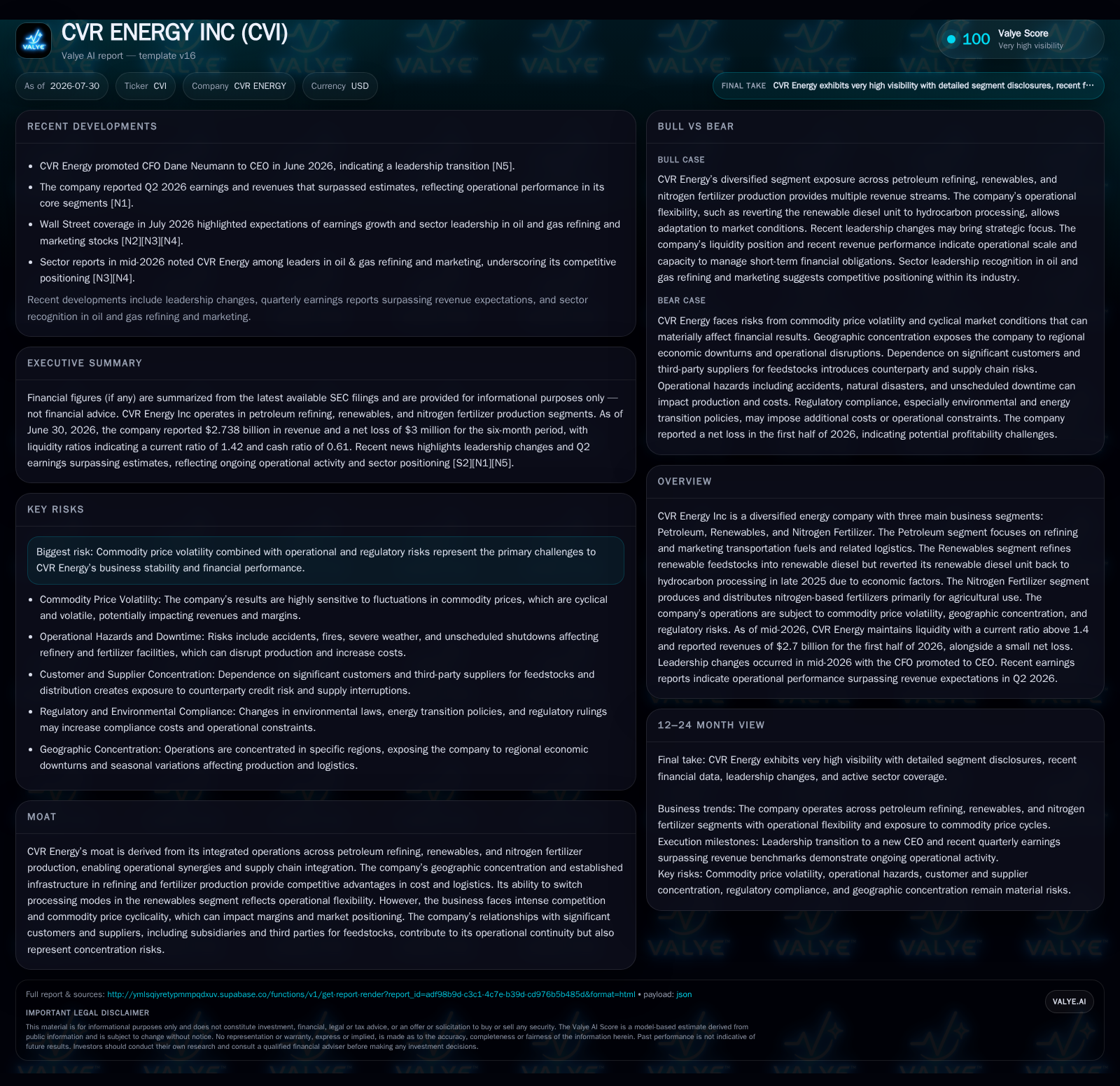
In Q2 2026, CVR Energy reported revenue strength but continued to navigate headwinds from commodity price fluctuations and counterparty credit risks intrinsic to its petroleum refining and nitrogen fertilizer segments. Notably, the company reverted its renewable diesel unit to conventional hydrocarbon processing in late 2025, highlighting a pragmatic response to economic headwinds despite regulatory pressures favoring renewables. New long-term debt issuances have reshaped the capital structure, improving cash proceeds but increasing leverage. Going forward, operational flexibility, customer credit monitoring, and regulatory compliance under evolving Renewable Fuel Standard (RFS) mandates will be key performance determinants.
Recent Operating Update: Strategic Reversions and Risk Disclosure
CVR Energy’s Q2 2026 operating disclosures update critical facets influencing near-term results and risk exposures [S2]. The company reiterated dependence on significant customers across its petroleum refining and nitrogen fertilizer segments alongside inherent risks tied to the creditworthiness of counterparties including distributors and feedstock suppliers. This dynamic underscores the sensitivity of CVR’s revenue streams to credit cycles within the energy and agricultural markets. Moreover, operational risk factors including weather-related damages, accidents, or sudden equipment failures impose additional volatility on production levels and margins
A strategic pivot was formalized with the decision in late Q3 2025 to revert the Wynnewood, Oklahoma renewable diesel unit back to conventional hydrocarbon fuel processing. This reversal reflects challenging economics amid input cost structures and renewable fuel credit market volatility despite tightening regulations under the EPA Renewable Fuel Standards (RFS). The EPA’s final rule effective mid-2026 raised blending volume mandates for biomass-based diesel and advanced biofuels to their highest levels historically, increasing compliance costs for refiners that cannot secure small refinery exemptions (SREs). For CVR Energy, this regulatory environment creates both cost pressure and strategic uncertainty regarding future investment in renewables versus conventional refining [S2], [S1].
Business Model: Integration of Petroleum Refining, Renewables, and Fertilizer Production
CVR Energy operates an integrated energy platform composed primarily of three segments: Petroleum refining/marketing of transportation fuels; Renewables processing targeting renewable diesel production (currently phased back to hydrocarbon processing); and Nitrogen fertilizer manufacturing serving predominantly agricultural users. Revenue is generated through sale of refined petroleum products (gasoline, distillates), nitrogen-based fertilizers (urea, ammonia derivatives), and historically through renewable fuel credits tied to biodiesel blends.
Revenue mechanics vary by segment: Petroleum revenues fluctuate with refining throughput volumes (measured in barrels per day), product yield optimization, feedstock crude oil price movements, and wholesale pricing dynamics influenced by crack spreads. The Nitrogen Fertilizer segment generates revenue based on production volumes (tons), fertilizer pricing linked closely to agricultural demand cycles and natural gas input costs. The Renewables segment revenue derives not only from fuel sales but also heavily depends on government credits incentivizing biofuel blends under RFS frameworks.
CVR’s ability to flexibly convert its Wynnewood facility between renewable diesel and traditional hydrocarbon production offers operational adaptability to shifting margin environments—a valuable competitive lever uncommon among peers who have made larger sunk investments into fixed renewable capacity. This flexibility may mitigate downside during periods when renewable fuel economics deteriorate due to feedstock tariffs or volatile credit prices but could also limit scale economies achievable by dedicated renewables plays [S1], [S2].
Industry Structure and Competitive Position
Operating within the integrated energy and petrochemical sector places CVR Energy among oil refiners like Valero Energy (VLO) that balance conventional fuels with growing renewable segments. Its fertilizer operations align it partially with chemical producers such as CF Industries focused on nitrogen products distributed to Midwest agriculture markets.
CVR’s geographic concentration—especially its refinery located in Oklahoma—and reliance on certain key customers for feedstocks and product distribution present both logistical advantages in supply chain integration but also heighten exposure to regional market fluctuations or natural disaster disruptions. Its integration provides cost synergies but not immunity from intense commodity price cyclicality that compress margins across upstream crude inputs and downstream product pricing.
Competitive positioning is tempered by a relatively modest scale compared with larger U.S.-based refiners who benefit from higher throughput utilization rates approaching 90%+. Additionally, peer renewable diesel producers such as Neste enjoy stronger scale effects whereas CVR’s recent reversion raises questions on sustainable differentiation within renewables.
Growth Drivers
Near-to-medium-term growth catalysts include rising overall demand for transportation fuels amid global economic recovery scenarios supporting refining volumes. Despite renewed focus on decarbonization policies, biomass-based diesel blending mandates are set at record highs for 2026-27 by EPA standards, which could spur expansions if technological or regulatory conditions improve.
Nitrogen fertilizer demand continues being driven by global food security concerns supporting agricultural input needs albeit subject to price elasticity related to crop prices and natural gas procurement costs—the major input affecting operating margins per ton.
Operational improvements such as debottlenecking projects or alkylation unit expansions planned at Wynnewood may enhance crude conversion yields or product slate quality—crucial levers for boosting per-barrel economics amid fluctuating crude grades.
Furthermore, supply chain optimization efforts integrating logistics from feedstock sourcing through finished product distribution provide potential margin uplift opportunities while minimizing downtime risks.
Risks & Watchpoints
Commodity price volatility—chiefly crude oil inputs affecting petroleum refining margins and natural gas impacting fertilizer production costs—is a persistent earnings headwind. Regulatory risk around renewables is pronounced given shifting government incentives, potential tariffs on imported biofeedstocks, evolving RFS targets without commensurate changes in SRE availability or costs.
Credit exposure remains material with notable dependency on a concentrated set of customers/distributors whose financial health directly impacts CVR’s receivables collection risk profile.
Operational hazards including equipment failure or weather-related disruptions pose non-trivial threats given asset-heavy plant operations; unplanned downtime can disproportionately erode quarterly margins due to fixed-cost absorption issues.
Liquidity constraints could emerge if market shocks impair cash flow generation; however, recent refinancing activity has extended maturities providing breathing room though at increased interest expense burdens tied to elevated coupons.
Finally, capital allocation decisions balancing investments between legacy refining assets versus potential future renewables projects will be surveilled closely for alignment with changing industry paradigms [S1], [S2], [S3].
What To Watch Next
Key milestones include updates on operational utilization rates post-renewable diesel reversion as indicators of volume recovery or margin stabilization; progress against planned yield improvement initiatives; monitoring EPA rule adjustments particularly regarding RINs pricing impact; disclosure of credit risk provisions signaling counterparty stress; updates on capital expenditure deployments supporting debottlenecking or alkylation expansion projects; quarterly earnings releases illustrating sensitivity of net income margins relative to commodity swings; leadership commentary under new CEO Dane Neumann focusing on strategic priorities around portfolio optimization; changes in customer diversification metrics mitigating single-customer concentration risks; shifts in fertilizer pricing tied to seasonal agricultural demand patterns.
Tracking these variables will help discern whether CVR can capitalize on its integrated model advantages while navigating legacy commodity cyclicality alongside new energy transition imperatives.
Financial Profile Discussion
As of June 30, 2026, CVR Energy reported total debt approximating $1.77 billion against $737 million cash reserves resulting in net debt near $1.03 billion which places moderate leverage demands on earnings capacity [F1], [S2]. The issuance earlier in February of senior notes due 2031 ($600 million at 7.5%) and 2034 ($400 million at 7.875%) raised nearly $993 million net proceeds used partially for redeeming prior higher-cost notes maturing in 2029—thereby extending maturities though at increased coupon rates comparable with broader energy sector trends around rising interest expenses [S2].
Current assets stood at $1.72 billion relative to liabilities of $1.21 billion yielding a current ratio of approximately 1.42 indicating adequate liquidity buffers for operational working capital needs even amid volatile commodity cycles [F1]. Capital expenditure commitments notably include ongoing construction-in-progress exceeding $250 million signaling active investment aimed at sustaining operational capacity or improving throughput efficiency.[S2]
Overall cash flow resilience amid net loss reporting for the first half of 2026 coupled with tight management over receivables collection will be crucial given the underlying cyclicality reinforcing the importance of monitoring working capital trends going forward.
This analysis synthesizes CVR Energy's most recent SEC filings along with contextual understanding from industry benchmarks relevant to integrated energy companies balancing traditional refining assets with evolving renewables exposure as well as agricultural chemical production niches. It highlights the company's operational strategies responding pragmatically to economic forces, evolving regulatory landscapes especially concerning renewable fuel mandates, alongside managing financial leverage sustainably. The durability of CVR's positioning will depend heavily on its ability to manage counterparty exposures effectively while investing selectively within its asset base amid shifting energy transition dynamics.
Disclaimer: This report is an independent analytical commentary intended solely for informational purposes without any form of investment advice or research view.
Disclaimer: This is research-only, informational analysis and not investment advice. It may include AI-generated interpretation and general industry context. Always verify important details using primary sources.

Comments