
Hexcel's Q2 2026 Results Reflect Resilient Aerospace Composites Business Amid Refinancing
Hexcel's latest quarterly report underscores stable aerospace materials demand and improved financial flexibility following a strategic debt refinancing.
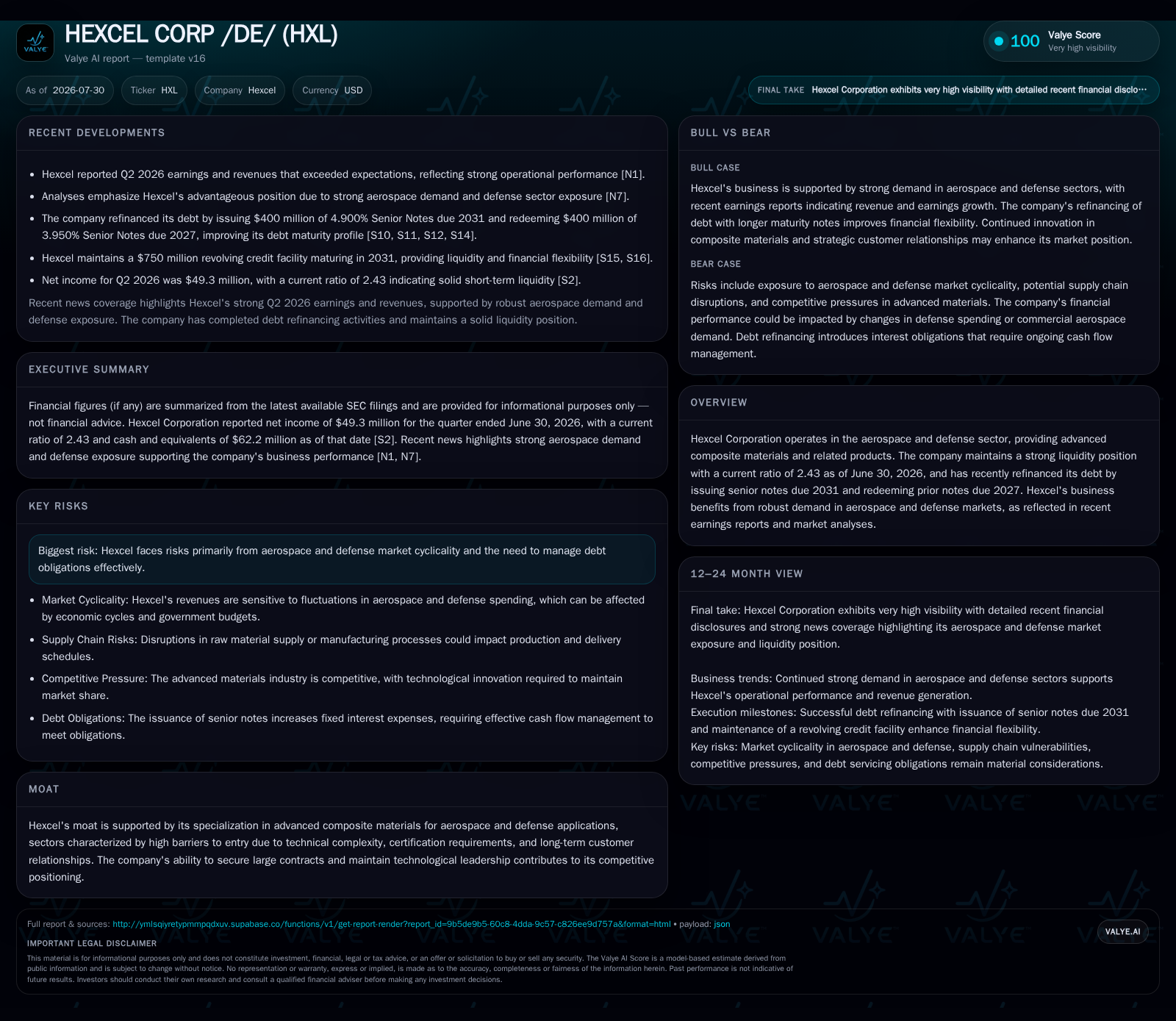
In Q2 2026, Hexcel Corporation demonstrated steady revenue growth supported by robust demand from aerospace OEMs and defense customers. The company’s operational resilience is underpinned by ongoing certification adherence, manufacturing efficiency, and a solid contract backlog. A recent refinancing maneuver replacing $400 million of 2027 senior notes with lower-cost debt maturing in 2031 improves Hexcel’s capital structure and liquidity, enabling it to weather the aerospace sector’s cyclical swings. Key risks remain tied to market cyclicality and supply chain dependencies, while upcoming contract renewals and defense spending trends will be critical demand signals.
Q2 Operating Results Highlight Ongoing Demand Stability in Aerospace Composites
Hexcel Corporation's Q2 2026 financial disclosure reveals a continuation of stable demand for its leading advanced composite materials used extensively in aerospace and defense applications. The company reported revenues beating consensus expectations for the quarter ended June 30, attributable to steady production volumes from aerospace OEM customers alongside sustained defense contract activity [S2][N1][N2]. This revenue strength aligns with Hexcel’s disclosure of a healthy order backlog, which supports near-term sales visibility despite the inherent cyclicality in its end markets. The aerospace industry's focus on lightweighting aircraft components fuels demand for Hexcel’s carbon fiber prepregs and honeycomb core materials, which are integral to OEM manufacturing processes. The quality of backlog conversion into revenue hinges on Hexcel's operational execution during fluctuating OEM production schedules, serving as a key KPI going forward.
Certifications, Supply Agreements, and Manufacturing Efficiency Support Competitive Moat
Hexcel's business model centers on manufacturing certified high-performance composite materials tailored to stringent aerospace qualification standards. Its long-term relationships with aerospace OEMs are deeply embedded in maintaining certifications that govern supply continuity and pricing power. These certifications entail comprehensive testing cycles essential for customer approval but create significant barriers to entry for competitors without equivalent technical capabilities or regulatory familiarity [S1]. Moreover, Hexcel emphasizes manufacturing yield rates—representing efficient transformation of raw materials into saleable composites—which directly affect gross margins. The company's consistent investment in R&D underscores its commitment to enhancing material properties such as strength-to-weight ratios, further buttressing its moat against peer producers like Toray Industries or Cytec Solvay Group. Maintaining high yield rates alongside industry certification status is critical for sustaining competitive differentiation and customer retention.
Industry Dynamics Shape Pricing Power and Capacity Utilization Patterns at Hexcel
The cyclical nature of commercial aerospace production drives fluctuations in Hexcel’s capacity utilization and consequently impacts its operating leverage. When OEMs ramp up aircraft build rates, Hexcel’s facilities benefit from improved utilization translating into better absorption of fixed costs and enhanced margins [S1]. Conversely, downturns can pressure pricing as supply exceeds demand temporarily. Raw material sourcing—particularly specialty fibers—and cost volatility add complexity to margin management amid global supply chain disruptions prevalent in this sector. Defense spending programs offer some counterbalance by providing steadier contract flows; however, they too are subject to political budget decisions influencing order pipelines.
Pipeline of Contract Wins Reflects Exposure to Production Ramp-Ups in Aerospace OEMs
Recent filings suggest Hexcel retains a robust pipeline of contract wins within both commercial aerospace programs and defense procurement channels [S2][S3]. Although explicit contract sizes remain undisclosed, backlog growth signals positive momentum aligned with broader industry trends in increasing aircraft deliveries and modernization efforts. This positioning is comparable qualitatively to peers such as Toray Industries who also serve top-tier aerospace manufacturers yet differ by geographic exposure or product specialization. Hexcel’s diversified portfolio across multiple OEM platforms mitigates concentration risk inherent in the value chain but tethered revenues remain largely dependent on continued expansion in large commercial aircraft production rates.
Risks from Market Cyclicality and Supply Chain Dependencies Remain Watchpoints
Despite encouraging operational results, Hexcel faces typical industry headwinds documented prominently in its annual risk disclosures with no material change reported this quarter [S1][S2]. The pronounced aerospace market cyclicality impacts order timing and volume certainty, influencing financial forecasting accuracy. Additionally, Hexcel must manage exposure to raw material supply fluctuations—especially carbon fiber feedstock—and currency translation effects given its multinational operations. Regulatory compliance including export controls remains challenging due to the sensitive nature of defense-related technologies integrated into certain product lines. Competitive pressures from peers vying for long-term supply agreements can induce price constraints especially during periods of softening demand.
"What To Watch" — Backlog Trends, Certification Updates, and Defense Spending Signals Ahead
Investors should monitor the evolution of Hexcel's order backlog in subsequent quarterly reports as an early indicator of demand sustainability or softness within core aerospace segments [S2][S3]. Follow-up updates on customer certification renewals or expansions will reveal Hexcel’s ability to maintain technological leadership crucial for contract retention amid competitive pressures. Furthermore, shifts in U.S. and allied defense budgets will materially affect government-related composite procurement volumes impacting medium-term revenues. Capacity utilization rates in manufacturing—reflective of production line ramp-up pacing—will also serve as a barometer for operating leverage improvements or cost absorption challenges.
Financial Profile Discussion – Refined Debt Structure And Strong Liquidity Underpin Execution
Hexcel strengthened its capital structure through an April 2026 debt refinancing transaction whereby it issued $400 million aggregate principal amount of senior notes at a fixed coupon rate of 4.90%, maturing in 2031; proceeds were utilized to redeem previously outstanding notes due 2027 bearing a lower coupon but earlier maturity date [S3][S22][S26]. This action extends debt maturity thereby reducing refinancing risk amid cyclical industry conditions while maintaining manageable interest expenses consistent with investment-grade profiles. The company reported cash and equivalents totaling approximately $62 million alongside current assets around $792 million against current liabilities near $326 million as of June 30, 2026—resulting in a robust current ratio of approximately 2.43 indicating strong short-term liquidity [F1]. Such financial flexibility positions Hexcel favorably to navigate working capital needs linked to inventory turnover fluctuations common in composite materials manufacture as well as fund ongoing R&D investments critical for sustaining technology leadership.
Overall, Hexcel appears well-positioned within the aerospace advanced materials value chain as an upstream supplier specializing in engineered composites underpinned by complex certification regimes that anchor customer relationships. While macroeconomic variables tied to commercial aerospace cycles and defense spend introduce inherent variability, strong operational execution evidenced by quality certifications, efficient manufacturing yields, healthy backlog levels, and prudent capital management provide a buffer against sector headwinds. Key forthcoming milestones include monitoring backlog trajectory consistency post-Q2 results alongside updates on new certification accomplishments that validate product innovation efforts reflecting evolving lightweighting demands.
Disclaimer: This is research-only, informational analysis and not investment advice. It may include AI-generated interpretation and general industry context. Always verify important details using primary sources.

Comments