
Omega Healthcare Investors Leverages Triple-Net Lease Strength as Tenant Stability Shifts
Omega’s Q2 2026 results underscore resilient rental income supported by triple-net leases amid evolving healthcare operator credit conditions.
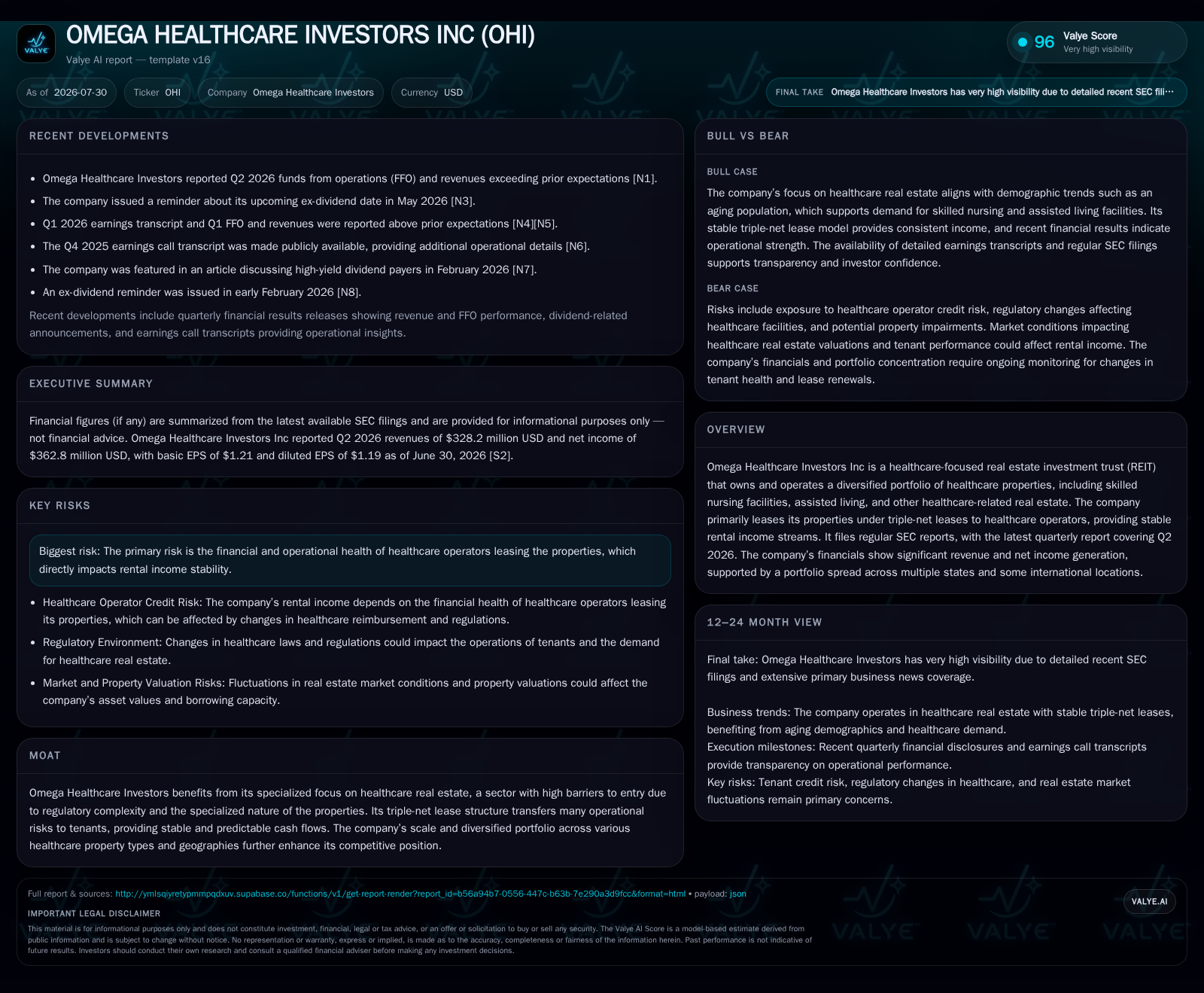
Omega Healthcare Investors reported Q2 2026 revenue and funds from operations exceeding expectations, driven by steady occupancy and lease renewals despite sector headwinds. The company’s specialized healthcare real estate portfolio leased under long-term triple-net agreements continues to provide stable cash flows, even as tenant credit quality shows signs of pressure. Portfolio diversification across skilled nursing and assisted living facilities mitigates concentration risks, while Omega’s capital structure balances leverage with proactive refinancing to manage upcoming debt maturities.
Q2 Results Highlight Operational Earnings Resilience Despite Sector Challenges
Omega Healthcare Investors delivered a robust operating quarter in Q2 2026 with rental income increasing to $266.5 million versus $239.2 million in the same period last year [S2]. This growth outperformed analyst expectations reported on July 30, driven by sustained high occupancy rates and effective lease management amidst a healthcare operator backdrop that remains mixed in credit quality [N2][S3]. Such resilience highlights the defensive nature of Omega’s portfolio anchored primarily in specialized senior housing assets.
Funds from operations (FFO), a key cash-flow proxy for healthcare REITs, also beat consensus estimates, reinforcing confidence in ongoing rent collection stability backed by Omega's portfolio structure. While certain tenants exhibited credit stress signals, the broad diversification across property types and geographies helped offset localized pressures without materially impacting total revenues or NOI growth this quarter [S2]. This outcome suggests enduring demand for Omega’s assets despite temporary sector headwinds.
Business Model Resilience: Triple-Net Lease Structure Anchors Income Stability
Omega operates as a healthcare-focused REIT owning predominantly skilled nursing facilities and assisted living centers leased under long-term triple-net lease agreements where tenants assume operational expenses including maintenance and taxes [S1][S2]. This leasing approach transfers most day-to-day operating risks to the tenants who run the clinical services on-site, enabling Omega to secure predictable rental streams largely insulated from variable operating costs.
Long-term leases typically feature contractual rent escalations and renewal options that provide visibility into near-term cash flows. Even during periods of fluctuating healthcare operator performance or regulatory uncertainty, this structural risk transfer helps contain downside volatility for Omega's income statement. Compared with peers such as Ventas and Welltower that maintain more diversified healthcare real estate portfolios including medical office buildings with different tenant risk profiles, Omega’s focus on triple-net leases creates a durable cushion against occupancy downturns or cost inflation within tenant operations.
Portfolio Quality: Diversification Mitigates Tenant Credit Risks Across Properties
Omega’s diversified property mix spans skilled nursing facilities—often more capital intensive but with steady demand—and assisted living facilities that cater to broader senior housing trends [S1]. Geographic spread across multiple states buffers against localized regional economic cycles or regulatory changes affecting Medicaid reimbursements that often underpin operator revenues.
Tenant mix includes multiple operators with staggered lease expiration schedules reducing rollover concentration risk. Although some larger tenants have encountered financial challenges recently due to sector-wide reimbursement pressures and labor cost inflation, the company proactively adjusts leasing terms where feasible to sustain occupancy levels and limit vacancies [S2]. The scale of Omega's portfolio enables negotiation leverage unseen in smaller specialized REITs exposed heavily to single-tenant risk.
Sector Positioning: Benchmarking Capital Structure and Peer Operating Metrics
At June 30, 2026, Omega held roughly $4.26 billion in total debt balanced against $39 million in cash equivalents yielding a net debt position around $4.22 billion—a profile aligned with peers though representing meaningful leverage commonly observed among large healthcare REITs [F1][S2]. The company maintains an interest coverage ratio supportive of its dividend policy without posing imminent refinancing distress.
Debt maturities are distributed over several years with no disproportionate burden concentrated within the next twelve months [S2], indicating prudent capital management amidst an interest rate environment that has stabilized after previous volatility. This maturity ladder provides flexibility for Omega to refinance or restructure debt if necessary while preserving capital for opportunistic acquisitions or asset enhancements.
Compared with well-known peers like Ventas or Welltower whose portfolios skew toward medical office space and complex hospital leases carrying different risk-reward trade-offs, Omega’s specialization affords distinct investor appeal through its niche expertise and focused balance sheet strategy.
Drivers Amplifying Demand: Aging Demographics and Lease Renewal Dynamics
Broad secular tailwinds underpin Omega Healthcare Investors’ long-term outlook as aging U.S. populations escalate demand for senior housing options including skilled nursing care [S1]. Increased life expectancy alongside chronic condition prevalence sustains occupancy rates across its properties at robust levels exceeding many general real estate sectors.
Lease renewal spreads—defined as rent increases upon tenant lease renewals—have remained positive this quarter reflecting both contractual escalation clauses and market-driven upward pressure on rents given constrained supply of suitable senior living infrastructure [S2]. These ongoing rent improvements contribute directly to same-property net operating income (NOI) growth supporting dividend sustainability.
While demographic drivers provide structural growth momentum, management must balance these gains against growing CapEx demands related to property refurbishment and regulatory compliance upgrades critical for maintaining facility appeal and certificate-of-need assurances required by many states.
Risk Vectors: Tenant Financial Health, Regulatory Headwinds, and Refinancing Exposures
The foremost operational risk remains tenant credit risk where financial distress at healthcare service providers can jeopardize timely rent payments or precipitate lease renegotiations unfavorable to the landlord [S1][S2]. Recent quarters have seen mild upticks in operators placed on cash-based accounting due to liquidity challenges driven by Medicaid reimbursement timing variability and labor cost inflation.
Regulatory changes—especially those affecting Medicare/Medicaid reimbursement policies—also pose material uncertainty impacting tenant revenue models which cascade into rent underwriting assumptions for property owners like Omega.
Capital expenditure requirements pose another cost dimension; aging skilled nursing inventories necessitate continuous reinvestment which typically falls on tenants under triple-net leases but may involve landlord collaboration particularly if asset repositioning is needed. On financing frontiers, although current debt maturities are well spaced out, any unexpected market disruptions could heighten refinancing costs creating pressure on profitability.
Forward-Looking Markers: Lease Expirations, FFO Guidance Signals, and Debt Maturity Monitoring
Investors should closely monitor near-term lease expiration schedules for tenant turnover or rent resets that could signal either margin expansion opportunities or stress points if concessions become necessary during renewals [S2]. Additionally, updates on funds from operations (FFO) guidance offer crucial insight into underlying cash flow generation trends reflecting occupancy and rent collection efficacy.
Refinancing outcomes on upcoming debt tranches will also be pivotal; successful issuance at reasonable interest rates affirms liquidity robustness whereas any uptick in spreads would merit reassessment of dividend sustainability assumptions.
Finally, management commentary around capital expenditures provides further clarity regarding maintenance investments critical to preserving long-term asset value given sector-specific infrastructure standards.
Financial Profile Discussion: Current Leverage, Liquidity Buffer, and Dividend Sustainability
As of June 30, 2026, Omega reported approximately $39 million in cash balances juxtaposed against a net debt position near $4.22 billion—the slight increase from prior quarters reflects ongoing acquisition activities offset by strong operating cash flow generation underpinning dividend payments [F1][S2]. Rental income grew sequentially reaching $266.5 million this quarter while maintaining high occupancy rates indicative of healthy asset utilization.
Funds from operations (FFO) margin expansion supports current dividend payouts without apparent strain; however, careful watchfulness is warranted on any shifts in tenant payment behavior or incremental CapEx liabilities potentially compressing adjusted funds from operations (AFFO) metrics.
Interest coverage ratios remain within comfortable thresholds providing confidence around servicing obligations despite macroeconomic uncertainties tied to interest rate fluctuations globally [S2]. In sum, the financial profile complements the operating story of sufficient liquidity combined with manageable leverage bolstering long-run dividend sustainability arguments for shareholders seeking exposure to specialized healthcare real estate.
Disclaimer: This is research-only, informational analysis and not investment advice. It may include AI-generated interpretation and general industry context. Always verify important details using primary sources.

Comments